Human Wildlife Conflict Escalates Debate on Uttarakhand Forests
Source:indiawildlifenews ↗
Why It Matters
Human-wildlife conflict is one of the most pressing socio-environmental issues in Uttarakhand. Questions in the UKPSC PCS Prelims frequently test knowledge on regional geography, protected areas, biodiversity loss, and the constitutional/legal frameworks governing environmental protection.
Summary
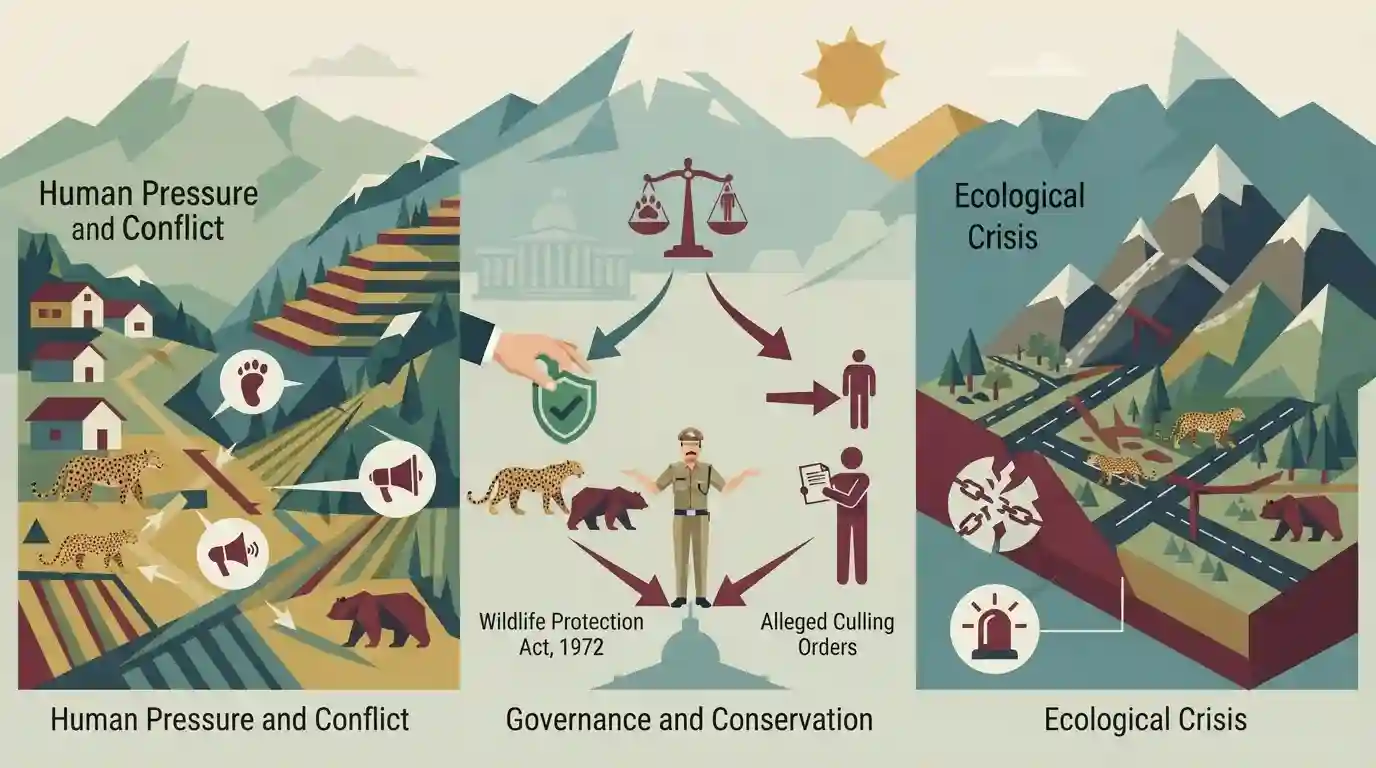
A viral claim regarding alleged government orders in Uttarakhand to kill leopards and bears has sparked a debate on human-wildlife conflict management. With regions like Pauri facing frequent and sometimes fatal encounters, the state's forest department must navigate immense public pressure while adhering to the stringent conservation mandates of the Wildlife Protection Act, 1972. The situation highlights the broader ecological crisis in the Himalayas, where habitat loss and fragmentation continue to drive wild animals into human-dominated landscapes.
Key Points
- A viral claim by a conservationist suggests that Uttarakhand forest authorities have issued controversial orders to cull leopards and bears in response to fatal wildlife attacks on humans.
- The state of Uttarakhand, particularly districts like Pauri and regions across Kumaon and Garhwal, is heavily affected by escalating human-wildlife conflicts involving leopards, tigers, and bears.
- The controversy underscores the delicate legal and ethical balance required under the Wildlife Protection Act, 1972, when determining if Schedule I animals can be declared a threat to human life and subsequently eliminated.
- Increasing conflicts are fundamentally driven by severe habitat fragmentation, anthropogenic pressures on forests, and shifts in wildlife behavior within the fragile Himalayan ecosystem.
Important Terms
Wildlife Protection Act, 1972

India's primary legal framework for protecting plant and animal species. It establishes protected areas, regulates hunting and wildlife trade, and classifies species into specific schedules for varying degrees of protection.
UPSC context
Crucial for GS3 Environment. Tests knowledge of species schedules, protected areas, and statutory bodies like NTCA.
42nd Constitutional Amendment Act, 1976
A major 1976 amendment that transferred five subjects, including 'Forests' and 'Protection of Wild Animals and Birds,' from the State List to the Concurrent List, enabling joint central-state legislation.
UPSC context
Highly relevant for GS2 and GS3. Tests Centre-State legislative relations and the evolution of environmental governance.
Human-Wildlife Conflict
Negative interactions between humans and wild animals resulting in loss of property, livelihoods, or life. It is increasingly driven by shrinking wildlife corridors, agricultural expansion, and climate stress.
UPSC context
High-yield GS3 Environment topic. Tests mitigation strategies, eco-sensitive zone management, and sustainable coexistence models.
Habitat Fragmentation
The ecological process where continuous habitats are broken into smaller, isolated patches by human activities like linear infrastructure development. It disrupts migratory routes and isolates wildlife populations.
UPSC context
Key GS3 Ecology concept. Tests drivers of biodiversity loss, ecological edge effects, and the necessity of wildlife corridors.
Prelims Trap
The Central Government or NBWL must authorize the culling of Schedule I animals posing a threat.
Under Section 11(1)(a) of the Wildlife Protection Act 1972, the state's Chief Wildlife Warden holds the exclusive statutory authority to permit hunting of a Schedule I animal, not the Centre.
Static Concepts Connected
What are the legal provisions for dealing with 'problem' Schedule I animals?
- Chief Wildlife Warden: The Chief Wildlife Warden (CWLW) of a state holds the exclusive power under Section 11(1)(a) of WPA 1972 to order the hunting of Schedule I animals.
- Stringent Conditions: The animal must be proven dangerous to human life, or diseased/disabled beyond recovery. A threat to property or crops is insufficient for Schedule I.
- Capture Over Culling: The law mandates that capturing, translocating, or tranquilizing the animal must be exhausted or deemed impossible before ordering its elimination.
How did the 42nd Amendment (1976) alter India's constitutional framework for wildlife?
- Concurrent List: Transferred 'Forests' and 'Protection of Wild Animals and Birds' from the State List to the Concurrent List, enabling central legislation.
- Directive Principles: Inserted Article 48A, mandating the State to protect and improve the environment, forests, and wildlife of the country.
- Fundamental Duties: Added Article 51A(g), making it a citizen's duty to protect the natural environment and have compassion for living creatures.
Cross-Topic Patterns
Himalayan Infra & Habitat Fragmentation
Leopard attacks in Uttarakhand directly link to habitat loss driven by unchecked infrastructure expansion, bridging human-wildlife conflict with ongoing debates on Himalayan carrying capacity.
Federalism & Wildlife Law Enforcement
While wildlife laws are largely centralized via the WPA 1972 and the Concurrent List, managing localized conflicts, issuing culling orders, and handling public protests falls entirely on state authorities.

Expect a 2026 prelims question contrasting the exact statutory powers of the Chief Wildlife Warden vs. Central bodies under WPA.
Linked PYQs · 4
Linked PYQs · 4
- 2024UKPSC_PRELIMSGS1
Which of the following National Park of Uttarakhand has been included in Project Tiger Scheme in 2015 ?
- 2024UKPSC_PRELIMSGS1
Which Constitutional Amendment Act relates to the protection and improvement of environment and safeguarding of forests and wildlife ?
- 2025UKPSC_PRELIMSGS1
Which of the following statements about causes of biodiversity loss is/are correct ? 1. Habitat loss and fragmentation are the most important cause driving animals and plants to extinction. 2. Human activities lead to over-exploitation of natural resources. 3. When a species becomes extinct, the plant and animal species associated with it do not become extinct. Choose the correct answer using following options :
- 2025UKPSC_PRELIMSGS1
Consider the following statements and select the correct answer from the options given below : Statement 1 : Uttarakhand is highly vulnerable to climate change. Statement 2 : Climate change is causing water stress and depleting biodiversity in Uttarakhand.
