Uttarakhand Leads Himalayan States in EV Infrastructure
Source:etv-bharat ↗
Why It Matters
The shift towards electric mobility forms a crucial part of India\'s climate commitments (like the Panchamrit goals) and sustainable development. Understanding state-level execution, such as Uttarakhand\'s integration of EV infrastructure with significant pilgrimage routes like the Char Dham Yatra, is important for questions on environmental policy, infrastructure development, and regional tourism economies.
Summary
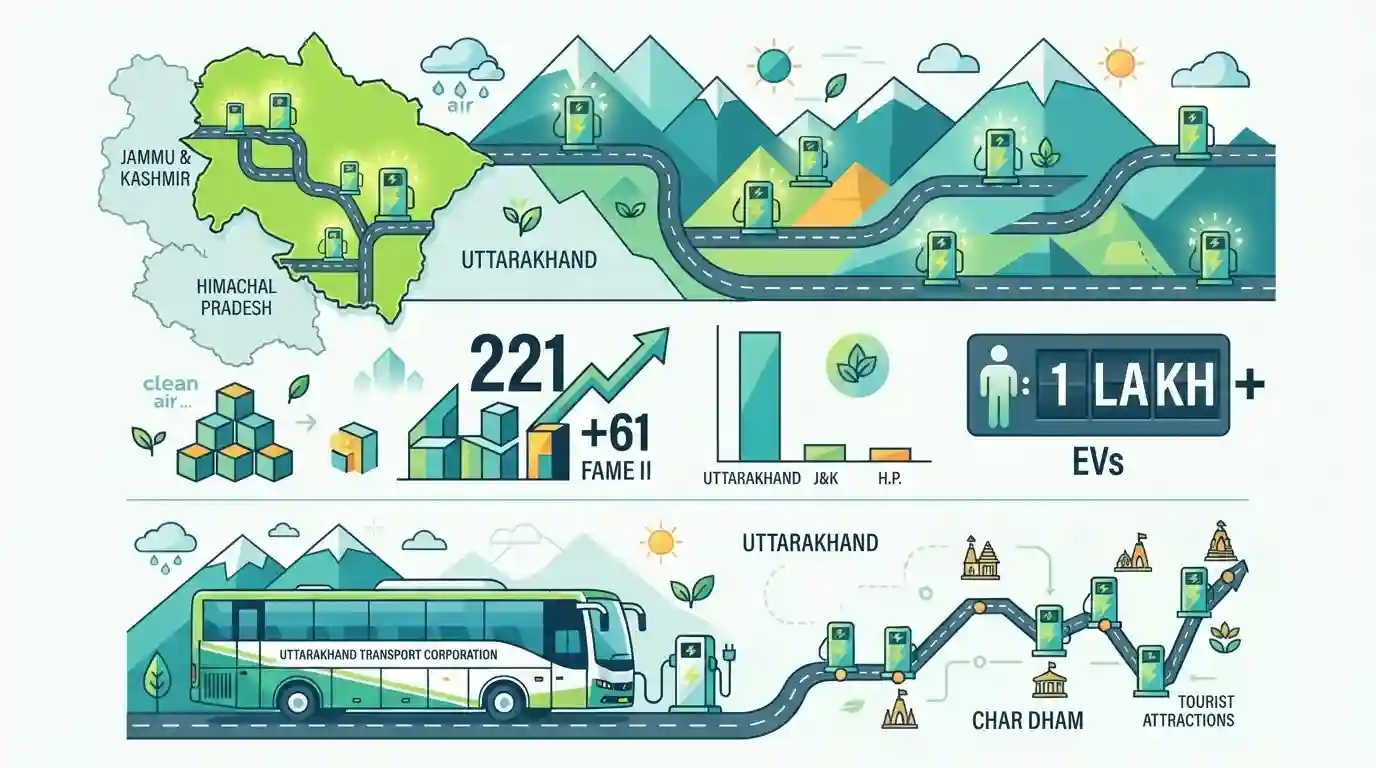
Uttarakhand has emerged as the leading Himalayan state in establishing Electric Vehicle (EV) charging infrastructure, successfully installing 221 charging stations in the past five years. An additional 61 stations were established under the central government's FAME II scheme. State Transport Minister Pradeep Batra noted that Uttarakhand now has over 1.04 lakh registered EVs, outperforming other Himalayan states like Jammu & Kashmir and Himachal Pradesh in charging infrastructure. The state government is actively expanding fast chargers along high-traffic tourist routes, including the Char Dham Yatra, and prioritizing the phased electrification of Uttarakhand Transport Corporation buses to promote green mobility and environmental conservation.
Key Points
- Uttarakhand has installed 221 EV charging stations in the last five years, making it the leading Himalayan state in electric vehicle charging infrastructure.
- An additional 61 charging units were established under the central government\'s FAME II scheme, supporting the state\'s 1.04 lakh registered EVs.
- The state is prioritizing the electrification of public transport, including phasing in electric buses for the Uttarakhand Transport Corporation.
- Fast charging networks are being heavily expanded along major tourist and pilgrimage routes, especially the Char Dham Yatra.
- Green mobility efforts aim to curb fuel dependence and pollution, with state projected power consumption for EVs rising significantly by 2028-29.
Important Terms
FAME II scheme

A central government program (Faster Adoption and Manufacturing of Electric Vehicles Phase II) offering financial subsidies for EV purchases and establishing public charging infrastructure.
UPSC context
Essential for UKPSC GS Paper 3 (Environment/Infrastructure), testing knowledge of central interventions driving Uttarakhand's sustainable transportation transition.
Uttarakhand Transport Corporation
The state-owned provider of public road transport in Uttarakhand. It is currently undergoing a phased electrification of its bus fleet to modernize transit and reduce environmental pollution.
UPSC context
Key for UKPSC GS Paper 2 (State Governance) and Paper 3 (Infrastructure), highlighting state efforts in eco-friendly public transport reforms.
Government of India
The central federal authority of India. It actively supports state-level sustainable mobility and infrastructure goals through nationwide funding and incentive programs, such as FAME II.
UPSC context
Features in UKPSC GS Paper 2 (Polity), examining Centre-State relations, cooperative federalism, and central funding of regional environmental initiatives.
Prelims Trap
Himachal Pradesh has the highest number of EV charging stations among all Himalayan states.
Aspirants often associate Himachal Pradesh with early green mobility adoption (like HRTC electric buses), but Uttarakhand currently leads Himalayan states in EV charging infrastructure.
Static Concepts Connected
What is the FAME India Scheme and its primary focus?
- Nodal Ministry: Ministry of Heavy Industries.
- Core Objective: Promoting the manufacturing of electric and hybrid vehicle technology to ensure sustainable green mobility.
- FAME II Focus: Focuses heavily on the electrification of public and shared transportation, and establishing widespread charging infrastructure.
What are India's 'Panchamrit' climate targets declared at COP26?
- Non-fossil Energy: Reach 500 GW of non-fossil energy capacity by the year 2030.
- Renewable Share: Meet 50% of the country's energy requirements from renewable energy by 2030.
- Emissions Reduction: Reduce total projected carbon emissions by one billion tonnes from now onwards till 2030.
- Net Zero: Achieve the ultimate target of Net Zero emissions by the year 2070.
Cross-Topic Patterns
Eco-tourism + Pilgrimage infrastructure
Developing fast-chargers along the Char Dham circuit bridges religious tourism revenue with strict ecological conservation in the sensitive Himalayan geography.
FAME II + State Transport Policies
The push for Uttarakhand Transport Corporation fleet electrification shows how central subsidies (FAME II) directly bankroll state-level green mobility shifts.

Expect a multi-statement question combining FAME II nodal ministry facts with Uttarakhand's leading EV infrastructure rank in the Himalayas.
Linked PYQs · 3
Linked PYQs · 3
- 2025UKPSC_PRELIMSGS1
As per Uttarakhand Budget 2025-26, the amount allocated for Char Dham Road network improvement is
- 2025UKPSC_PRELIMSGS1
Consider the following statements and select the correct answer from the options given below : Statement 1 : The State Council for Climate Change (SCCC) of Uttarakhand was established in the year 2011. Statement 2 : The responsibility of preparing Uttarakhand Action Plan on Climate Change (UAPCC) was given to the State Revenue Department.
- 2025UKPSC_PRELIMSGS1
'Panchamrit' targets announced by Prime Minister Narendra Modi in Glasgow are related with :
