Endangered Plant Conservation Program Launched for Himalayan Flora
Source:environment-watch ↗
Why It Matters
Crucial for UKPSC aspirants studying state-specific environmental initiatives, forest resources, biodiversity conservation, and ecological management in the Himalayan region.
Summary
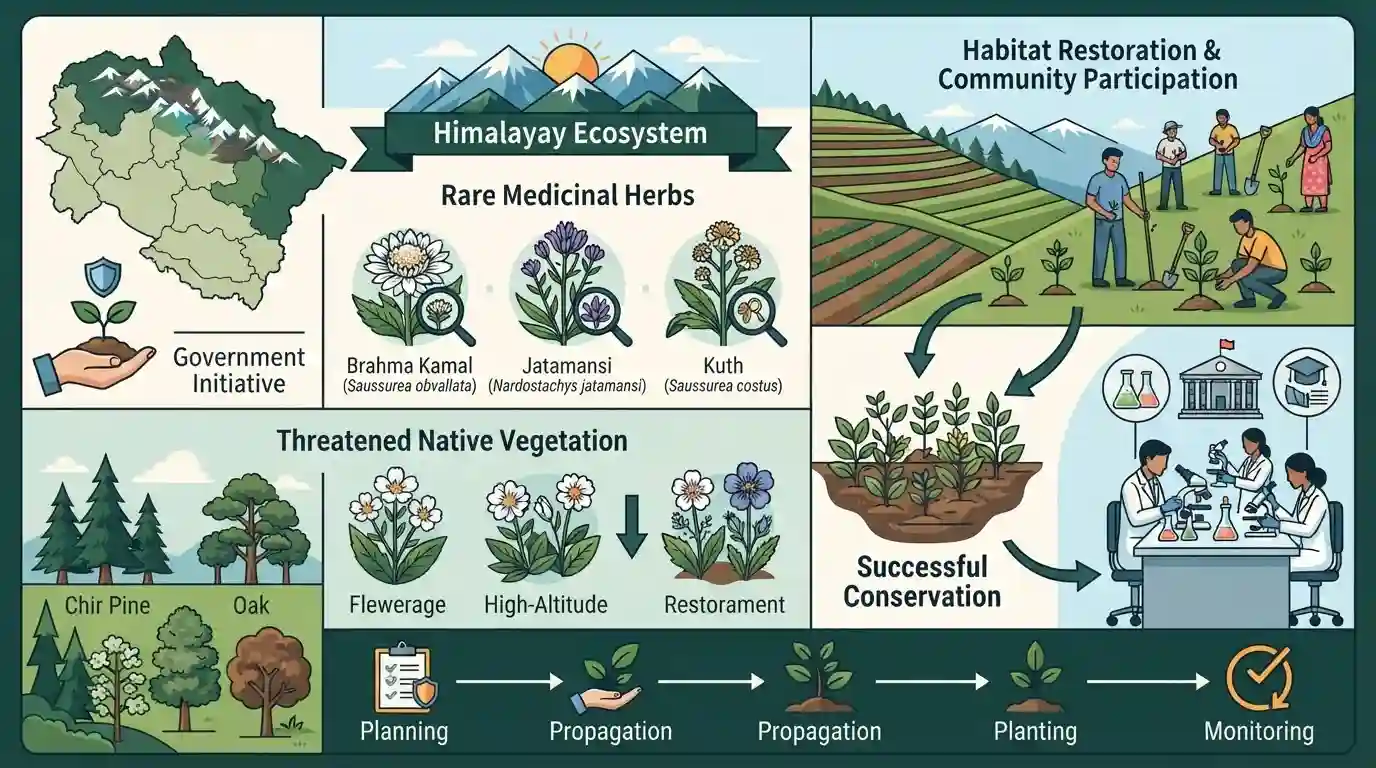
The Uttarakhand government has initiated a comprehensive endangered plant conservation program to safeguard the state's unique Himalayan biodiversity, focusing on rare medicinal herbs, threatened native vegetation, and habitat restoration through community and institutional participation.
Key Points
- Uttarakhand has launched a special endangered plant conservation program to protect its fragile and unique Himalayan flora.
- The initiative focuses on identifying, cataloging, and propagating threatened native plant species, medicinal herbs, and rare vegetation facing ecological pressures.
- The program emphasizes ex-situ and in-situ conservation efforts, habitat restoration, and active participation of local communities and research institutions.
Important Terms
Endangered Plant Conservation Program

An initiative launched by the Uttarakhand government to protect and reintroduce rare, endangered, and threatened Himalayan medicinal herbs and native vegetation into their natural habitats.
UPSC context
Vital for UKPSC GS Paper V (Uttarakhand Environment, Biodiversity, and State-Specific Schemes). Tests knowledge of state conservation initiatives.
Uttarakhand Forest Department
The state government body responsible for managing forest resources, wildlife protection, and implementing specialized conservation programs like the rare Himalayan flora rehabilitation project.
UPSC context
Important for UKPSC administrative structure and institutional mechanisms governing environmental protection under Uttarakhand Specific topics.
Prelims Trap
ex-situ and in-situ conservation efforts are identical in operational methodology within forest divisions
Aspirants often confuse ex-situ conservation (botanical gardens, seed banks) with in-situ conservation (national parks, biosphere reserves) when reading about state-level plant programs.
Static Concepts Connected
What are the key differences between In-Situ and Ex-Situ biodiversity conservation methods?
- In-Situ Method:: Conservation of species within their natural habitat, such as National Parks, Wildlife Sanctuaries, and Biosphere Reserves.
- Ex-Situ Method:: Conservation of components of biodiversity outside their natural habitats, including botanical gardens, seed banks, and cryopreservation.
- State Context:: Uttarakhand hosts prominent in-situ sites like Jim Corbett and Nanda Devi, alongside specialized ex-situ herbal gardens.
What administrative bodies manage forest and wildlife resources in Uttarakhand?
- Principal Chief Conservator:: Head of the forest force in the state, responsible for administrative control of forest divisions and wildlife.
- Research Wing:: Deals with research, botanical surveys, and specialized conservation initiatives for rare Himalayan flora.
- Van Panchayats:: Decentralized bodies managing local forest resources and participating in community-based conservation.
Cross-Topic Patterns
Community Forestry & Plant Conservation
Endangered plant conservation directly ties into the Van Panchayat system and community forest rights under the Scheduled Tribes and Other Traditional Forest Dwellers Act.
Medicinal Herbs & National AYUSH Framework
Rare medicinal herbs of Uttarakhand link the state's biodiversity initiatives with nationalAYUSH missions and geographical indication (GI) tagging of indigenous products.

Expect a match-the-following or statement-based question on Uttarakhand's endemic flora, ex-situ vs in-situ conservation, and forest bodies.
Linked PYQs · 3
Linked PYQs · 3
- 2016UKPSC_PRELIMSGS1
In Uttarakhand, Oak-Rhododendron are characteristic plants of
- 2025UKPSC_PRELIMSGS1
Given below are two statements, one is Assertion (A) and other is Reason (R). Select the correct answer from the given codes: Assertion (A): Uttarakhand is rich in forest and bio-diversity. Reason (R): Topography and climate primarily determine the forest and bio-diversity.
- 2025UKPSC_PRELIMSGS1
Which of the following is the correct order of the following physiographic regions of Uttarakhand from south to north direction?
