Uttarakhand Clean Mobility Policy and Green Vehicle Fleet Expansion
Source:egov ↗
Why It Matters
The article highlights crucial state-level policy action bridging environmental sustainability, renewable energy schemes, and urban transport infrastructure, serving as a practical case study for climate change mitigation efforts at the sub-national level.
Summary
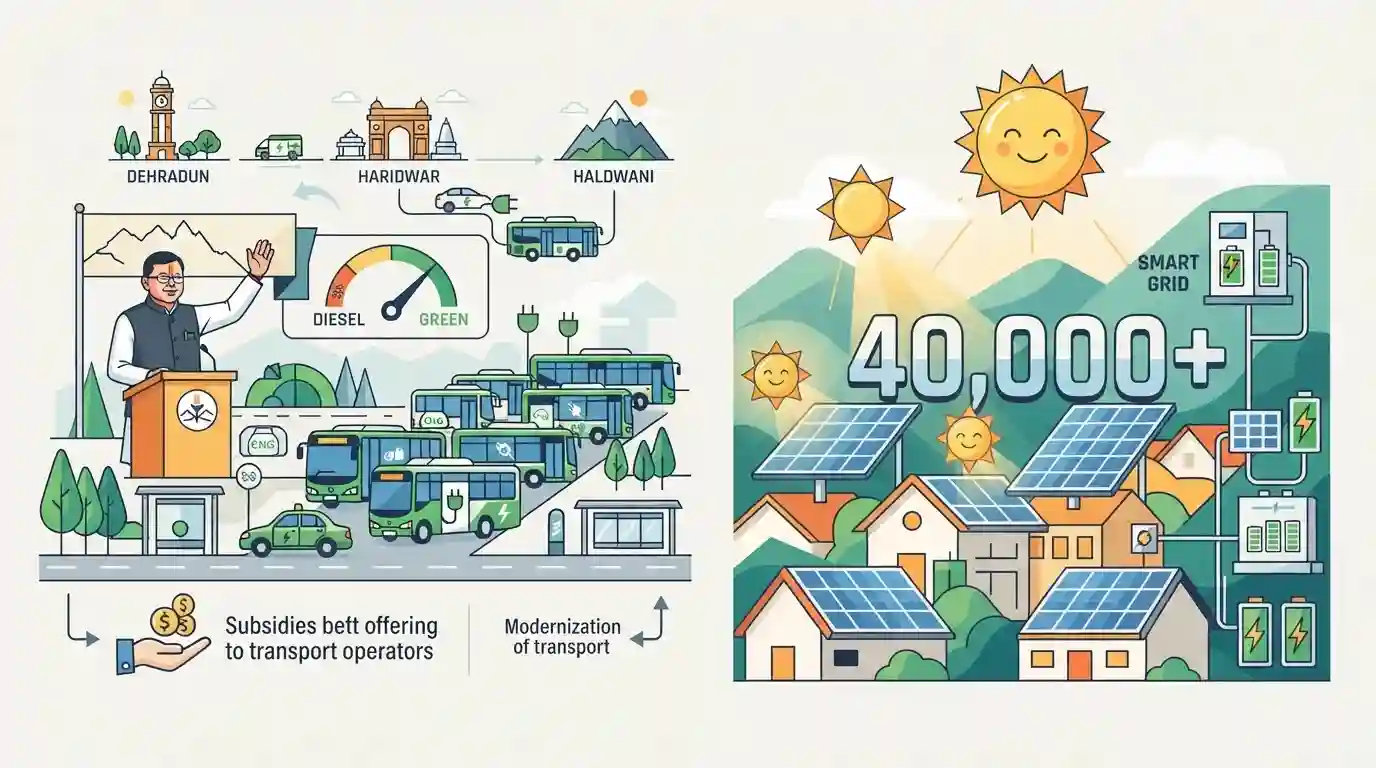
Uttarakhand's Chief Minister Pushkar Singh Dhami launched a clean mobility drive by flagging off 11 green fuel vehicles under the state's Clean Mobility Transformation Policy-2024. The initiative is designed to modernize urban public transport, reduce carbon emissions, and decrease reliance on diesel by encouraging CNG and electric vehicles. To facilitate this transition, subsidies are being offered to transport operators. Electric buses are also slated for introduction in major cities like Dehradun, Haridwar, and Haldwani. Additionally, the state celebrated exceeding its PM Surya Ghar Yojana goals by facilitating over 40,000 rooftop solar installations.
Key Points
- Chief Minister Pushkar Singh Dhami flagged off 11 green fuel vehicles in Uttarakhand to promote clean public transport.
- The drive is part of the Uttarakhand Clean Mobility Transformation Policy-2024, aiming to modernize urban transport and lower emissions.
- Subsidies are being provided to transport operators to transition away from diesel-dependent vehicles towards CNG and EVs.
- The state plans to expand electric bus operations across Dehradun, Haridwar, and Haldwani.
- Uttarakhand surpassed its rooftop solar installation target under the PM Surya Ghar Yojana, achieving over 40,000 installations.
Important Terms
Uttarakhand Clean Mobility Transformation Policy-2024

A state initiative to modernize urban public transport and curb vehicular pollution by incentivizing the phase-out of older diesel vehicles. It offers capital subsidies to transport operators adopting CNG and electric vehicles.
UPSC context
GS Paper 3 (Environment/Infrastructure). Tests knowledge of state-level climate action, sustainable urban mobility, and emission reduction policies.
PM Surya Ghar Yojana
A flagship central government scheme launched in 2024 providing financial assistance for residential rooftop solar installations. It aims to equip one crore households with solar panels, offering up to 300 units of free electricity monthly.
UPSC context
GS Paper 3 (Renewable Energy) and GS Paper 2 (Welfare Schemes). Key for assessing India's transition to 500GW non-fossil capacity.
Government of Uttarakhand
The state-level administrative and executive authority of Uttarakhand. It designs localized frameworks like the Clean Mobility Policy to align state-level infrastructure development with national environmental and sustainability targets.
UPSC context
GS Paper 2 (State Governance/Federalism). Highlights the role of state governments in implementing national sustainability goals and local policy innovations.
Prelims Trap
PM Surya Ghar Yojana is a Centrally Sponsored Scheme requiring matching funds from states.
It is a Central Sector Scheme. Although states like Uttarakhand promote it, the subsidy burden (up to ₹78,000) is 100% borne by the Centre.
Static Concepts Connected
What are the key provisions of PM Surya Ghar Muft Bijli Yojana?
- Target & Benefits: Provides up to 300 units of free electricity per month to one crore households via rooftop solar installations.
- Subsidy Structure: Covers 60% of the cost for up to 2 kW systems and 40% for the third kW, capping at ₹78,000 total subsidy.
- Scheme Type: It is a Central Sector Scheme, meaning the subsidy component is entirely funded by the Union Government.
What are the 'Panchamrit' commitments made by India at COP26?
- Capacity & Share: Reach 500 GW of non-fossil energy capacity and meet 50% of energy requirements from renewable sources by 2030.
- Emissions Reduction: Reduce total projected carbon emissions by one billion tonnes and cut the economy's carbon intensity by 45% by 2030.
- Net Zero: Achieve the ultimate target of net-zero carbon emissions by the year 2070.
Cross-Topic Patterns
PM E-DRIVE + Cooperative Federalism
National EV frameworks (like PM E-DRIVE) combined with local operational subsidies (like Uttarakhand's Clean Mobility policy) highlight how federal synergy is essential for public transport decarbonization.
Black Carbon + Himalayan Glaciers
Replacing diesel with CNG/EVs in Himalayan states is critical, as diesel soot (black carbon) settles on regional glaciers, significantly accelerating their melting rate by reducing surface albedo.

Expect a 2026 Prelims question mixing PM Surya Ghar and PM E-DRIVE, testing the difference between their Central Sector funding mechanisms.
Linked PYQs · 2
Linked PYQs · 2
- 2025UKPSC_PRELIMSGS1
Consider the following statements and select the correct answer from the options given below : Statement 1 : The State Council for Climate Change (SCCC) of Uttarakhand was established in the year 2011. Statement 2 : The responsibility of preparing Uttarakhand Action Plan on Climate Change (UAPCC) was given to the State Revenue Department.
- 2025UKPSC_PRELIMSGS1
'Panchamrit' targets announced by Prime Minister Narendra Modi in Glasgow are related with :
