Uttarakhand Launches Doorstep Governance and Grievance Campaign
Source:indianmasterminds ↗
Why It Matters
This campaign showcases Uttarakhand's citizen-centric governance model and decentralized administrative approach to public grievance redressal. In the UKPSC Prelims and Mains, understanding state initiatives for effective public service delivery, administrative reforms, and the implementation of welfare schemes at the grassroots level is highly important.
Summary
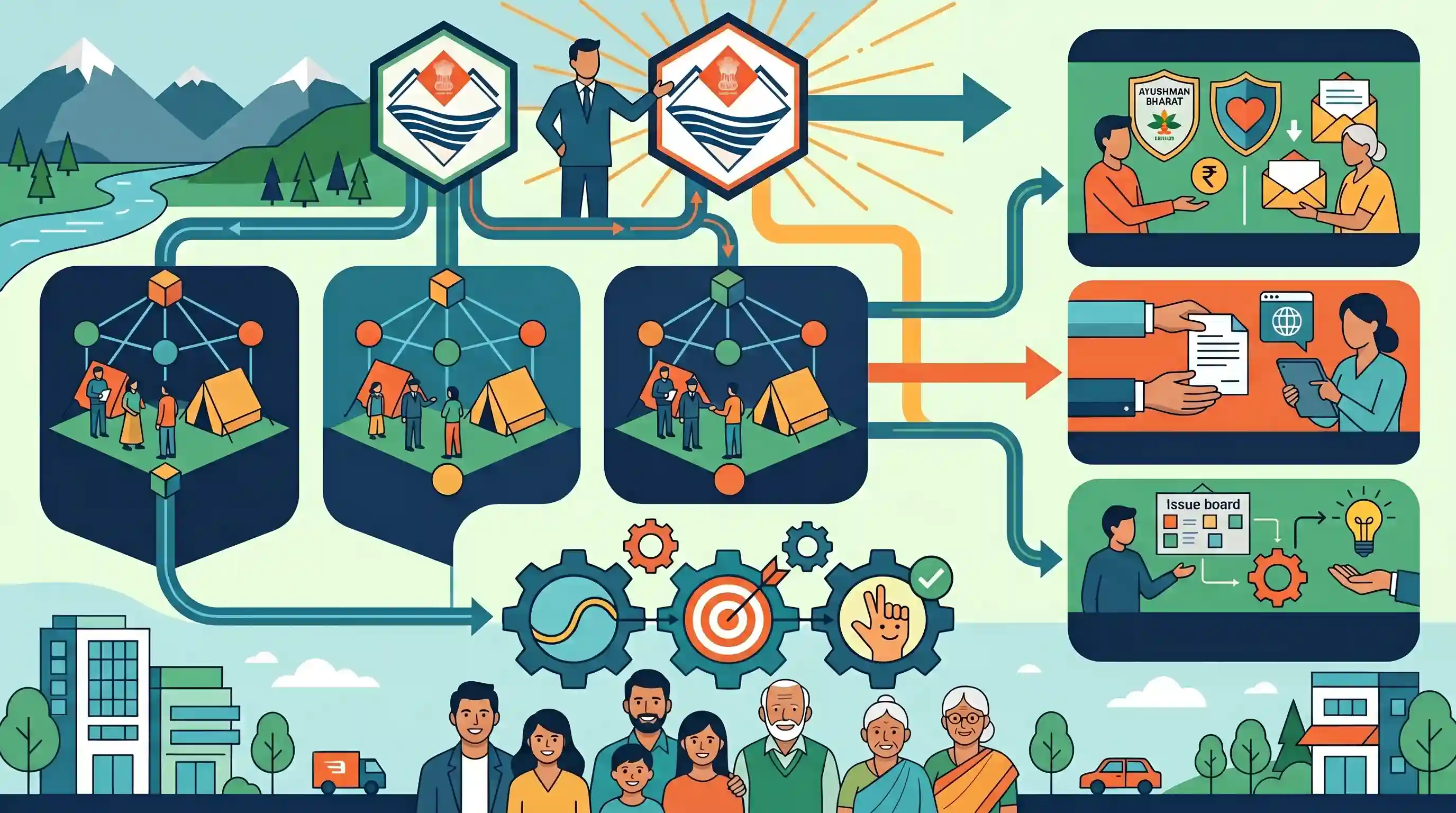
The Uttarakhand government, led by Chief Minister Pushkar Singh Dhami, launched a 15-day statewide campaign called 'Jan-Jan Ki Sarkar, Jan-Jan Ke Dwar' on July 4, 2026. The campaign seeks to institutionalize doorstep delivery of public services and immediate grievance redressal through specialized local camps at district, block, and tehsil levels. Grounded in the philosophy of 'Simplification, Solution, and Satisfaction,' the campaign provides single-location access to welfare schemes (such as Ayushman Bharat cards and pensions) and resolves pending civic infrastructure issues.
Key Points
- Uttarakhand Chief Minister Pushkar Singh Dhami launched the 15-day statewide 'Jan-Jan Ki Sarkar, Jan-Jan Ke Dwar' (Government to Every Doorstep) campaign on July 4, 2026.
- The campaign aims to deliver public services, welfare benefits, and grievance redressal directly to citizens' doorsteps, eliminating the need for repeated visits to government offices.
- Decentralized special camps are organized at the district, block, and tehsil levels to provide services in an integrated, single-window format.
- Key services offered at the camps include Social Welfare Pensions, Ayushman Bharat Health Cards, revenue certificates, agricultural seed/equipment distribution, and health check-ups.
- The campaign also targets prompt resolution of essential local civic grievances, such as drinking water, electricity supply, and road infrastructure.
- The state administration operates under CM Dhami's three-fold governance principle: 'Simplification, Solution, and Satisfaction' (सरलीकरण, समाधान और संतुष्टि).
- The current initiative builds on a successful 45-day predecessor campaign in December last year, which held 681 camps, benefited over 5.33 lakh citizens, and resolved around 33,000 public grievances.
Important Terms
Jan-Jan Ki Sarkar, Jan-Jan Ke Dwar Campaign

A public outreach initiative by the Uttarakhand government to deliver public services and resolve grievances at the doorsteps of citizens via specialized local camps at district, block, and tehsil levels.
UPSC context
GS Paper II: Governance; tests understanding of decentralized public service delivery and citizen-centric governance models.
Ayushman Bharat Scheme
India's flagship public health scheme launched in 2018, providing an annual health cover of ₹5 lakh per family for secondary and tertiary cashless hospitalization to over 12 crore poor and vulnerable families.
UPSC context
GS Paper II: Social Justice; tests knowledge of social security, healthcare financing, and universal health coverage in India.
Citizen-Centric Governance
An administrative model prioritizing the needs, transparency, accountability, and active participation of citizens, transitioning from bureaucratic convenience to citizen satisfaction as the benchmark of public administration.
UPSC context
GS Paper II: Governance; tests principles of administrative reforms, accountability mechanisms, and public service delivery tools.
Good Governance
An administrative approach characterized by transparency, accountability, responsiveness, equity, rule of law, and efficiency, ensuring that public institutions manage public resources effectively for societal welfare.
UPSC context
GS Paper II: Governance; tests core administrative principles, indices (GGI), and mechanisms to enhance institutional trust.
Decentralization
The delegation of planning, decision-making, and administrative authority from central or state governments to local administrative levels (districts, blocks, and tehsils) to improve responsiveness and governance.
UPSC context
GS Paper II: Local Governance; tests concepts of democratic decentralization, devolution of powers, and grassroots administration.
Prelims Trap
The Right to Service Act is a central legislation passed by the Parliament of India to ensure uniform public service delivery.
There is no national or central Right to Service Act in India. While a central bill was introduced in 2011, it lapsed. Service delivery guarantees are governed by independent state-level legislations.
Static Concepts Connected
What is the Sevottam Model of public service delivery?
- Origin & Objective: Created by the Department of Administrative Reforms and Public Grievances (DARPG) in 2006 to evaluate and raise public service standards.
- Three Modules: Comprises three pillars: Citizen's Charters (standards), Public Grievance Redress (remedies), and Service Delivery Capability (infrastructure/capacity).
- 2nd ARC Endorsement: The 2nd Administrative Reforms Commission (ARC) recommended Sevottam for all public-facing departments to institutionalize accountability.
How do state-level Right to Public Service (RPS) Acts function?
- Legal Guarantee: Provides a statutory guarantee of time-bound delivery for notified citizen services, moving from administrative discretion to legal entitlement.
- Appellate Hierarchy: Establishes a clear process of Designated Officers, with two levels of appellate authorities who can penalize delayed delivery.
- Decentralized Origin: Enacted first by Madhya Pradesh in 2010, followed by states like Bihar and Punjab, illustrating state-level leadership in federal governance.
Cross-Topic Patterns
Digital Public Infrastructure + State Welfare Delivery
State-led service delivery campaigns increasingly leverage national DPI (Aadhaar, DigiLocker, and UMANG) to verify identities and process welfare claims instantly in decentralized camps.
2nd ARC + Citizen Centric Administration
Doorstep delivery initiatives actively manifest the 2nd ARC's 12th Report on "Citizen Centric Administration", shifting governance from administrative convenience to citizen entitlement.

State Right to Service Acts and the Sevottam model are likely to feature in a comparative multi-statement Prelims question on GS-2 governance.
Linked PYQs · 3
Linked PYQs · 3
- 2025UKPSC_PRELIMSGS1
Arrange the following states chronologically with respect to enactment of 'Right to Service Act' : (i) Punjab (ii) Assam (iii) Maharashtra (iv) Gujarat
- 2025UKPSC_PRELIMSGS1
Consider the following statements with reference to Uttarakhand and choose the correct answer: 1. The executive of Uttarakhand includes Governor as the head of the state. 2. It also includes the Chief Minister and his/her council of ministers.
- 2025UKPSC_PRELIMSGS1
Consider the following statements about Uttarakhand Human Rights Commission and choose the correct option from the options given below: 1. Uttarakhand Human Rights Commission came into existence on May 13, 2013. 2. The objectives of UHRC was to bring about greater accountability and transparency in governance.
