Mukhyamantri Saur Swarojgar Yojana Boosts Renewable Capacity in State
Source:energetica-india ↗
Why It Matters
The MSSY is a critical state-specific initiative for UKPSC aspirants, demonstrating the intersection of renewable energy transitions, rural enterprise (MSME), and demographic stabilization (preventing hill migration). It sets a notable model for sustainable regional development.
Summary
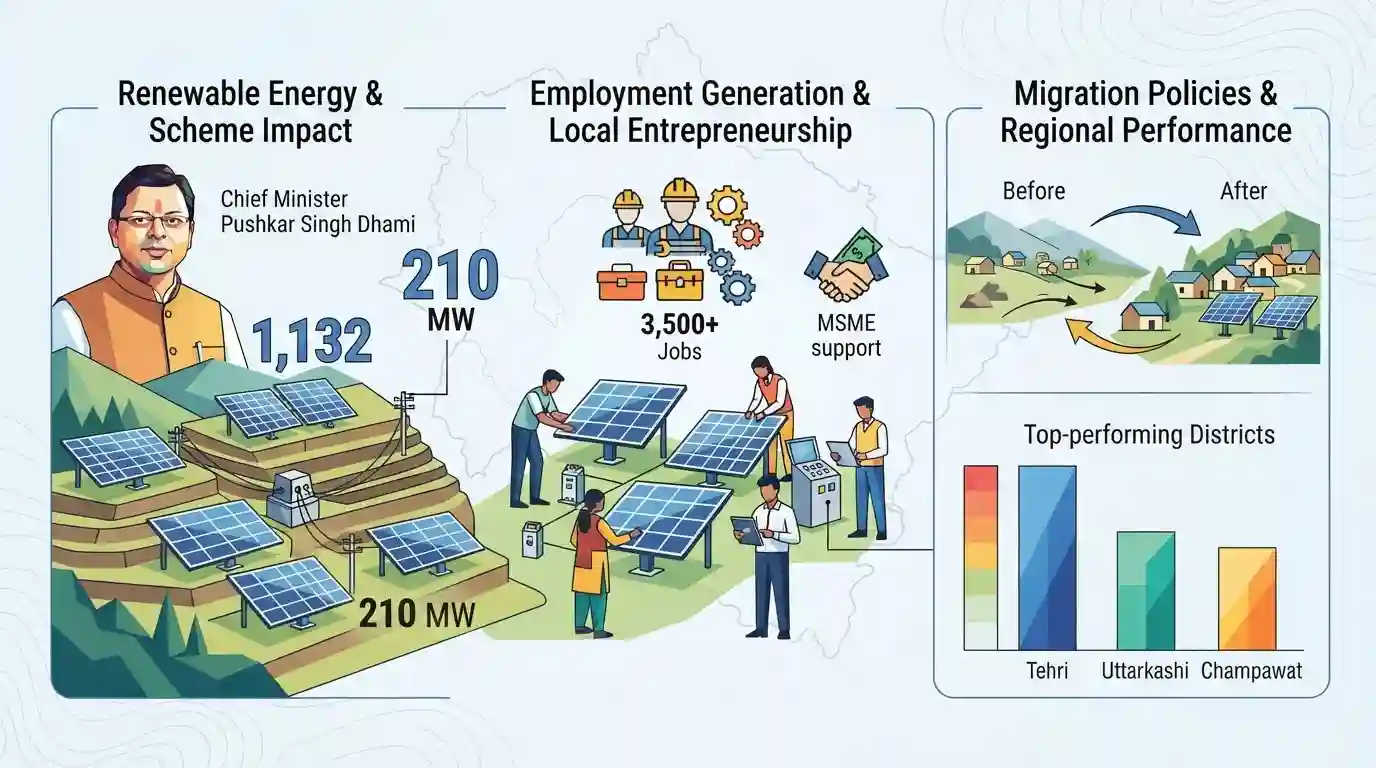
Uttarakhand has achieved significant milestones in renewable energy and rural employment through the Mukhyamantri Saur Swarojgar Yojana (MSSY). Spearheaded by Chief Minister Pushkar Singh Dhami, the initiative has led to the installation of 1,132 solar plants with a combined capacity of 210 MW, generating over 3,500 jobs. By empowering local entrepreneurs under the MSME Policy 2023, MSSY strategically tackles the state's persistent issue of out-migration from its hilly regions. Tehri district is the top performer, followed by Uttarkashi and Champawat.
Key Points
- Uttarakhand has successfully installed 1,132 solar plants generating 210 MW under the Mukhyamantri Saur Swarojgar Yojana (MSSY).
- The scheme has created approximately 3,500 direct and indirect jobs, significantly boosting rural livelihoods.
- A core objective of MSSY is to reduce out-migration from Uttarakhand's hilly regions by fostering local self-employment opportunities.
- The initiative operates under the framework of the state's MSME Policy 2023, offering solar project capacities ranging from 20 kW to 200 kW.
- Tehri district leads the installations with 369 plants, followed by Uttarkashi and Champawat.
Important Terms
Mukhyamantri Saur Swarojgar Yojana (MSSY)

A Uttarakhand state scheme promoting green energy and self-employment. It enables residents to set up solar power plants on barren land and earn steady income by selling electricity to the state power corporation.
UPSC context
Relevant to GS Paper 3 (Renewable Energy) and GS Paper 2; highlights decentralized energy solutions for rural unemployment.
MSME Policy 2023
A state policy framework offering financial incentives, capital access, and subsidies to promote self-employment in the MSME sector, focusing on developing new business clusters and addressing structural challenges in hilly terrains.
UPSC context
Relevant to GS Paper 3 (Economic Development, MSMEs); tests sub-national industrial strategies and inclusive growth in geographically challenging areas.
Government of Uttarakhand
The sub-national executive authority functioning under Part VI of the Constitution, responsible for formulating regional socio-economic policies like MSSY to address state-specific challenges such as rural out-migration.
UPSC context
Relevant to GS Paper 2 (Functions of State Governments); tests understanding of state-led local development and federal policy implementation.
Prelims Trap
MSSY is a sub-scheme of PM-KUSUM designed specifically for agricultural feeder solarisation.
Aspirants often confuse state-level solar schemes with PM-KUSUM. MSSY is a state-specific (Uttarakhand) initiative targeting MSME-led self-employment and migration reversal, not agricultural pumps.
Static Concepts Connected
What are the drivers and impacts of out-migration in the Indian Himalayan Region?
- Push factors: Subsistence agriculture, human-wildlife conflict, limited secondary-sector jobs, and high vulnerability to climate-induced disasters.
- Ghost Villages: Leads to abandoned settlements ('ghost villages'), weakening the local agrarian economy and creating demographic voids in sensitive border zones.
- Human Capital Depletion: While remittances improve family financials, out-migration strips hilly areas of young human capital, hampering local development.
How does Decentralized Renewable Energy (DRE) differ from utility-scale solar?
- Scale & Location: DRE involves smaller scale installations located close to the point of consumption, significantly reducing transmission and distribution (T&D) losses.
- Grid Independence: Can operate off-grid or via mini-grids, making it critical for rugged Himalayan terrains where extending the centralized grid is difficult.
- Socio-Economic Impact: Promotes micro-entrepreneurship and localized 'green jobs' rather than consolidating profits within large centralized power generation utilities.
Cross-Topic Patterns
Renewable Energy + Border Security
Schemes like MSSY conceptually overlap with the Vibrant Villages Programme, using decentralized infrastructure and livelihood generation to reverse out-migration and secure vulnerable Himalayan border demographics.
Climate Action + MSME Integration
Treating small-scale solar plants as MSMEs (20-200 kW) shifts the renewable energy narrative from pure utility infrastructure to rural entrepreneurship and localized employment generation.

Expect a Mains GS1/GS3 question linking Himalayan out-migration ('ghost villages') to decentralized green energy solutions like DRE.
Linked PYQs · 3
Linked PYQs · 3
- 2025UKPSC_PRELIMSGS1
Which programme was approved by the Union Cabinet in April, 2025 to develop border villages ?
- 2025UKPSC_PRELIMSGS1
Arrange the following social welfare schemes in chronological order: i. Integrated Rural Development Programme (IRDP) ii. Rural Employment Generation Programme (REGP) iii. Prime Minister Rojgar Yojana (PMRY) iv. Rural Landless Employment Guarantee Programme (RLEGP)
- 2025UKPSC_PRELIMSGS1
Consider the following statements and select the correct answer from the options given below : Statement 1 : Uttarakhand is highly vulnerable to climate change. Statement 2 : Climate change is causing water stress and depleting biodiversity in Uttarakhand.
