Uttarakhand Bureaucratic Reshuffle and IAS Officer Transfers
Source:indianmasterminds ↗
Why It Matters
Bureaucratic reshuffles illustrate the operational mechanism of state administration and underscore the critical role of All India Services in policy implementation, resource management, and effective public service delivery.
Summary
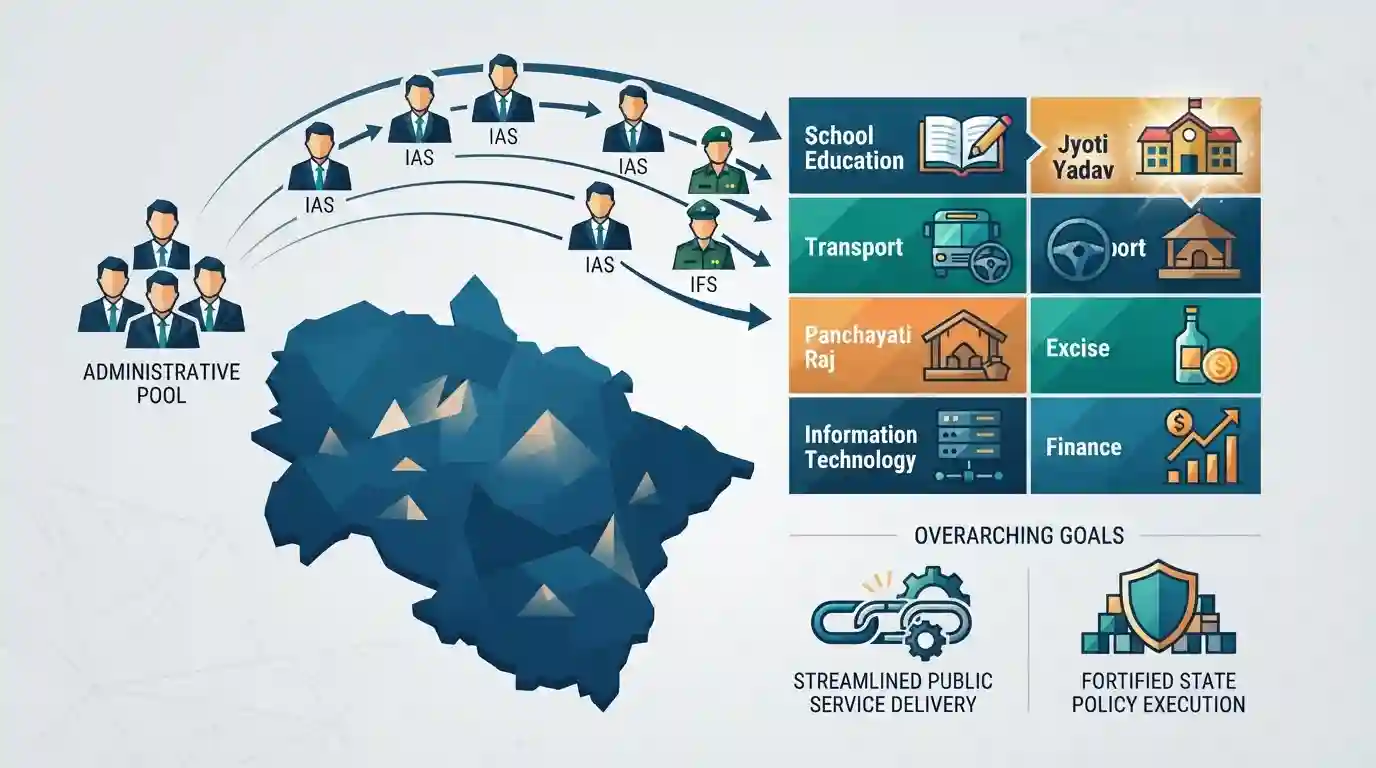
The Uttarakhand government has executed a significant bureaucratic reshuffle, transferring ten IAS officers and one IFS officer to optimize administrative efficiency and governance. Key reallocations include the appointment of Jyoti Yadav as Secretary of School Education, alongside major changes across departments such as Transport, Panchayati Raj, Excise, Information Technology, and Finance. The overarching goal of these transfers is to streamline public service delivery and fortify the execution of state policies.
Key Points
- The Uttarakhand government transferred 10 Indian Administrative Service (IAS) officers and 1 Indian Forest Service (IFS) officer in a major reshuffle.
- The changes aim to strengthen governance, ensure effective implementation of government programmes, and streamline public service delivery.
- Jyoti Yadav was appointed as Secretary of School Education (Primary and Secondary), a key post aimed at strengthening the state's education sector.
- Other key reassignments involved vital state departments including Transport, Panchayati Raj, Information Technology, Excise, and Finance.
Important Terms
Indian Administrative Service (IAS)

The premier administrative civil service of India, constituting one of the three All India Services. Its officers hold key strategic and leadership positions in both Union and State governments, implementing policies and driving governance.
UPSC context
Highly relevant for GS Paper 2 (Role of Civil Services in a Democracy, Governance, and State Administration).
Indian Forest Service (IFoS/IFS)
One of the three All India Services, established to scientifically manage and conserve the country's forests, wildlife, and natural resources. IFoS officers implement the National Forest Policy and ensure ecological stability.
UPSC context
Tests knowledge of All India Services (GS Paper 2) and environmental governance/conservation efforts (GS Paper 3).
Uttarakhand Government
The elected administrative body governing the Indian state of Uttarakhand. It exercises executive authority over state-level departments and implements policies through the state civil administration.
UPSC context
Relevant as a case study for State Administration, Federalism, and Public Service Delivery under GS Paper 2.
Prelims Trap
"The recommendations of the Civil Services Board regarding IAS transfers are binding on the State Government."
While the Supreme Court mandated the creation of CSBs to check arbitrary transfers, their recommendations are purely advisory. The State Government (Chief Minister) retains the ultimate authority.
Static Concepts Connected
What is the constitutional framework governing All India Services (AIS)?
- Article 312: Empowers Parliament to create new All India Services if the Rajya Sabha passes a resolution supported by a two-thirds majority of members present and voting.
- Dual Control: Immediate control lies with the State government they serve, but ultimate disciplinary control rests with the Union government.
- Dismissal Authority: Under Article 311, an AIS officer cannot be dismissed or removed by an authority subordinate to that by which they were appointed (the President).
What are the key directives from the TSR Subramanian vs. UoI case (2013)?
- Civil Services Board: Directed the constitution of CSBs at Central and State levels to recommend transfers and postings, aiming to curb political interference.
- Written Orders: Officers should not act on verbal orders from political executives; instructions must be recorded in writing to ensure transparency and accountability.
- Fixed Tenure: Advocated for a minimum assured tenure for civil servants (as recommended by the 2nd ARC) to prevent arbitrary and frequent transfers.
Cross-Topic Patterns
Right to Service vs Frequent Transfers
States enact Right to Public Service Acts to guarantee timely delivery, but frequent bureaucratic reshuffles often disrupt the administrative continuity required to meet these legal obligations.
Federal friction over AIS control
The state's power to transfer officers often intersects with the Centre's ultimate disciplinary control, periodically sparking debates on administrative federalism and AIS deputation rules.

Disciplinary control over AIS officers and the advisory nature of Civil Services Boards remain high-yield for 2026 Prelims statement Qs.
Linked PYQs · 2
Linked PYQs · 2
- 2025UKPSC_PRELIMSGS1
Arrange the following states chronologically with respect to enactment of 'Right to Service Act' : (i) Punjab (ii) Assam (iii) Maharashtra (iv) Gujarat
- 2024UKPSC_PRELIMSGS1
Which of the following parts of the Indian Constitution deals with the relations between the Union and the State ?
