Uttarakhand High Court upholds 50% women quota in student polls
Source:newindianexpress ↗
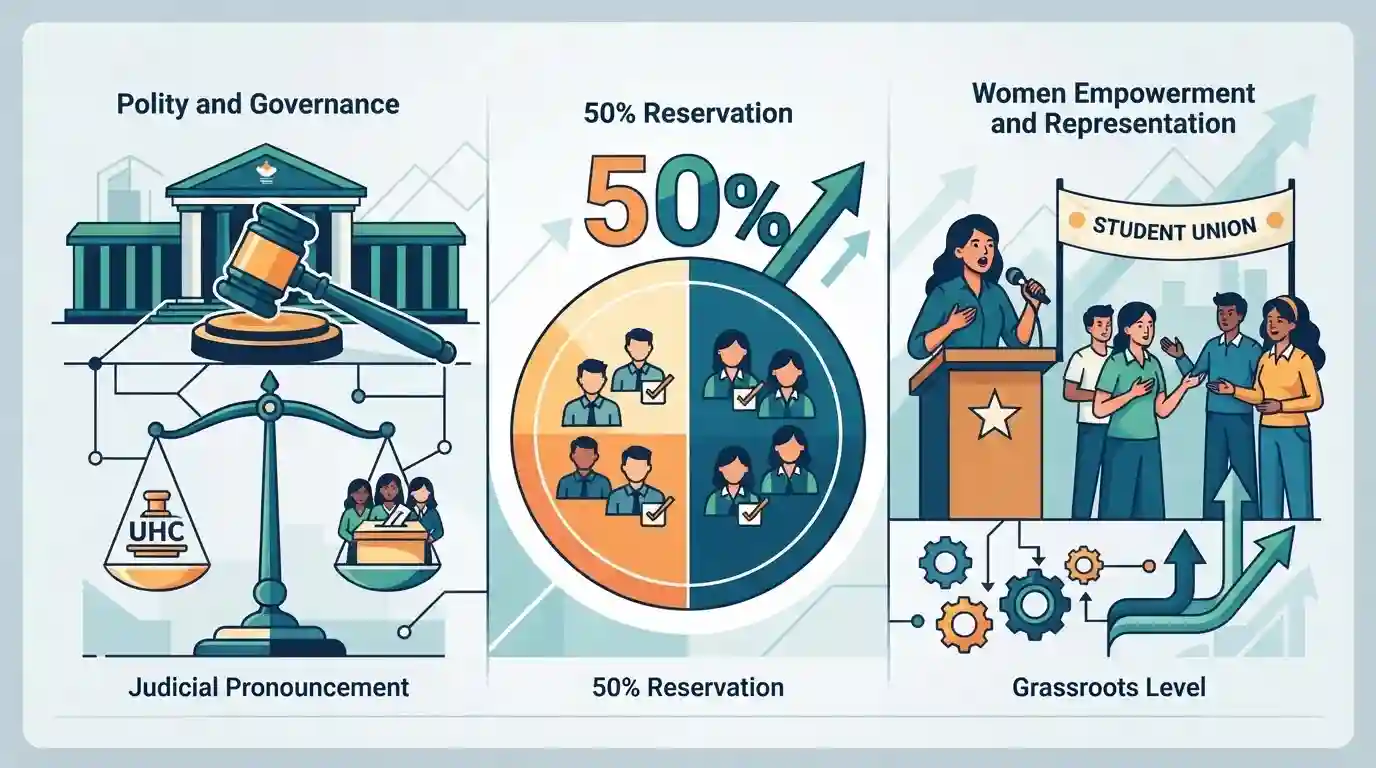
Why It Matters
This high court ruling is crucial for understanding women's reservation policies, judicial review of affirmative action in state educational spaces, and grassroots democratic representation in Uttarakhand.
Summary
The Uttarakhand High Court has delivered a significant ruling upholding the 50% reservation quota for women in student union elections within the state's educational institutions, strengthening women's political participation and representation at the grassroots level.
Key Points
- The Uttarakhand High Court upheld the 50% reservation quota for women in student union elections across universities and colleges in the state.
- The ruling reinforces gender representation, social equity, and women empowerment within educational institutions and democratic student bodies.
- It addresses legal challenges surrounding reservation implementation in campus politics, affirming the state's institutional framework.
Important Terms
Uttarakhand High Court

The highest judicial authority in Uttarakhand, exercising original, appellate, and writ jurisdictions under Article 226 of the Constitution of India.
UPSC context
UKPSC Prelims/Mains (Polity and Governance, Judiciary): Tests awareness of landmark state-level judicial pronouncements affecting governance, rights, and decentralised democracy.
Static Concepts Connected
What constitutional provisions empower states to make special provisions for women?
- Article 15(3): Enables the State to make special provisions for women and children in any sphere, including education and governance.
- Article 39(a): Directs the State to secure that citizens, men and women equally, have the right to an adequate means of livelihood.
- Articles 243D & 243T: Mandates not less than one-third reservation for women in Panchayats and Municipalities across India.
Cross-Topic Patterns
Campus Quotas to Grassroots Panchayati Raj
Student politics quotas connect with Article 243D reservations for women in Panchayats, tracing grassroots leadership training from campuses to local governance bodies.
Demographic Dividend and Higher Education Trends
The demographic reality of ~65.8% female enrollment in Uttarakhand higher education mirrors broader national trends where women outnumber men in graduation rates.

UKPSC may test state-specific reservation milestones or constitutional provisions enabling affirmative action in educational institutions.
Linked PYQs · 2
Linked PYQs · 2
- 2024UKPSC_PRELIMSGS1
How many of the following women M.L.A.s were there in the first Legislative Assembly of Uttarakhand ?
- 2025UKPSC_PRELIMSGS1
Consider the following statements about Uttarakhand Human Rights Commission and choose the correct option from the options given below: 1. Uttarakhand Human Rights Commission came into existence on May 13, 2013. 2. The objectives of UHRC was to bring about greater accountability and transparency in governance.
