Uttarakhand HC Seeks Reply on AIS Officer Transfers
Source:newindianexpress ↗
Why It Matters
It addresses vital questions concerning bureaucratic accountability, transparency in public administration, statutory transfer norms for All India Services, and the judicial oversight of executive discretion via PILs.
Summary
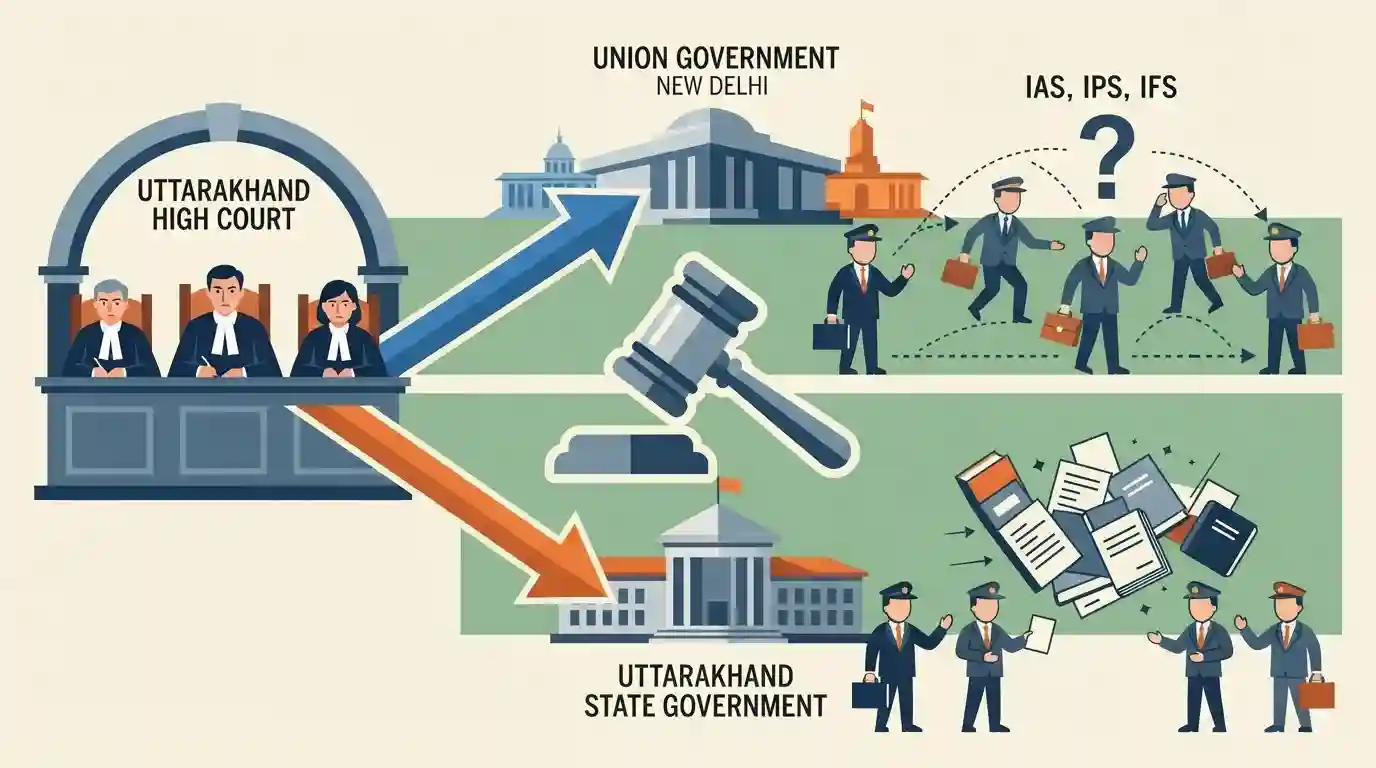
The Uttarakhand High Court has sought responses from both the Central and State governments on a PIL alleging that rules and transfer guidelines concerning IAS, IPS, and IFS officers are being violated in the state.
Key Points
- The Uttarakhand High Court sought replies from the Centre and the Uttarakhand state government on a Public Interest Litigation (PIL).
- The PIL alleges violations of established rules and guidelines in the transfers and postings of All India Services officers (IAS, IPS, and IFS) in the state.
- The petition highlights concerns regarding transparency, bureaucratic stability, and adherence to statutory norms governing officer transfers.
Important Terms
All India Services Act

An Act enacted under Article 312 of the Constitution that governs the recruitment, service conditions, and cadre rules of the All India Services—IAS, IPS, and IFS.
UPSC context
Relevant for UKPSC Mains GS Paper II (Indian Polity, Civil Services, and Governance). Tests understanding of bureaucracy and statutory rules.
Uttarakhand High Court
The highest constitutional court in Uttarakhand, exercising original, appellate, and writ jurisdictions under Articles 226 and 227 of the Constitution of India.
UPSC context
Relevant for UKPSC Mains GS Paper II (Judiciary, Judicial Activism, and PIL). Tests knowledge of state-level judicial bodies and constitutional remedies.
Public Interest Litigation (PIL)
A legal mechanism allowing any public-spirited individual or organization to approach the court for the protection of public interest and enforcement of fundamental or statutory rights.
UPSC context
Relevant for UKPSC Mains GS Paper II (Judiciary and Governance). Tests understanding of judicial activism, locus standi, and public accountability.
Prelims Trap
statutory norms governing officer transfers set directly by the All India Services Act
Aspirants often assume minimum tenures for All India Services officers are statutory acts passed by Parliament, when they were actually introduced via executive amendments to Cadre Rules post-2013 SC verdict.
Static Concepts Connected
What are the key constitutional provisions and institutional mechanisms governing All India Services in India?
- Constitutional Basis: Article 312 empowers Parliament to create one or more All India Services common to the Union and States upon a Rajya Sabha resolution.
- Statutory Foundation: The All India Services Act, 1951 empowers the Central government, in consultation with state governments, to make rules for the regulation of service conditions.
- CSB Mechanism: Civil Services Boards (CSBs) were mandated by the Supreme Court in 2013 to recommend transfers and postings to insulate bureaucrats from political pressure.
Cross-Topic Patterns
Civil Services Reforms + Judicial Activism via PIL
The Supreme Court's TSR Subramanian ruling is a bridge between administrative autonomy in civil services and judicial activism via PILs in federal states.
AIS Transfers + Uttarakhand Disaster Management Efficiency
Uttarakhand's hilly topography and disaster-prone terrain make bureaucratic stability and fixed tenures critical for effective disaster management governance.

Expect a multi-statement question on Civil Services Boards (CSBs), their statutory origin, and minimum tenure rules post-TSR Subramanian.
Linked PYQs · 2
Linked PYQs · 2
- 2012UKPSC_PRELIMSGS1
Where the Public Interest Litigation (PIL) can be filed?
- 2025UKPSC_PRELIMSGS1
Under Article 32 in which case 'Wifull non-compliance' with court order was declared as contempt of the court ?
