Uttarakhand High Court relocation verdict reserved
Source:hindustantimes ↗
Why It Matters
Important for understanding judicial administration, state governance, and infrastructure planning specific to Uttarakhand.
Summary
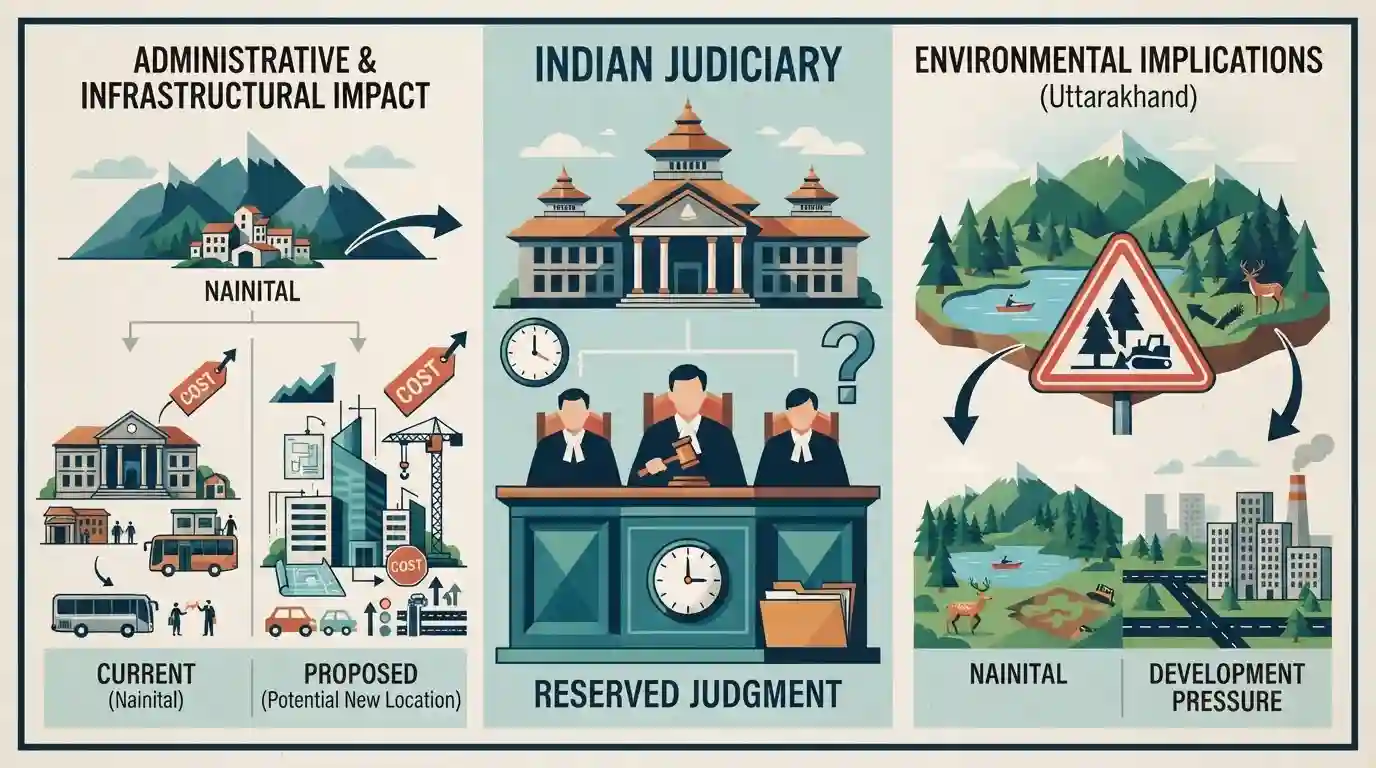
The Uttarakhand High Court bench has reserved its judgment on the high-profile relocation row concerning the shifting of the state's High Court out of Nainital, a move that carries significant administrative, infrastructural, and environmental implications for the state.
Key Points
- The Uttarakhand High Court bench reserved its verdict on the contentious relocation row involving the shifting of the High Court from Nainital.
- The proposal to relocate the High Court has sparked debates concerning infrastructure, administrative convenience, and environmental impact on prospective sites like Haldwani.
- The legal and public debate highlights the balance between regional development, judicial accessibility, and ecological preservation in Uttarakhand.
Important Terms
Uttarakhand High Court

The apex judicial institution of the state of Uttarakhand, established under Article 214 of the Constitution, exercising original and appellate civil/criminal jurisdiction across the state.
UPSC context
UKPSC GS Paper II (Indian Polity & State Governance): Tests knowledge of state judiciary organization, writ jurisdiction, and administrative governance in Uttarakhand.
Supreme Court of India
The apex judicial tribunal of India, functioning as the ultimate court of appeal, guarantor of Fundamental Rights, and interpreter of the Constitution under Part V.
UPSC context
UKPSC/UPSC GS Paper II: Tests federal structure, judicial review, constitutional jurisdictions (Articles 32, 131, 136, 142), and the checks-and-balances framework.
Prelims Trap
Shifting a state High Court requires a formal constitutional amendment passed by a two-thirds majority in Parliament.
Aspirants often assume shifting a High Court requires a constitutional amendment by Parliament, whereas the Supreme Court ruled it an administrative/executive matter involving consultation with the Chief Justice of India.
Static Concepts Connected
What is the constitutional basis and procedure for the establishment and relocation of High Courts in India?
- Article 214: Article 214 mandates that there shall be a High Court for each State.
- Parliamentary Power: Parliament has the power by law to establish a common High Court for two or more states (Article 231).
- Administrative Nature: The Supreme Court has clarified that the relocation of a principal seat of a High Court within a state is primarily an executive/administrative decision taken in consultation with the Chief Justice of India and the Governor.
Cross-Topic Patterns
Himalayan Infrastructure vs Eco-Sensitiveness
The Uttarakhand HC relocation highlights the recurring tension in Himalayan states between establishing modern infrastructure and protecting fragile forest ecosystems like elephant corridors.
Judicial Administration & Constitutional Frameworks
Under Article 214 and 231, High Court establishment involves a complex interplay between executive administrative decisions and legislative/constitutional frameworks.

UKPSC Mains GS Paper 2/5 may test the executive-judiciary balance in shifting state capitals/HGs and ecological trade-offs in fragile hill states.
Linked PYQs · 2
Linked PYQs · 2
- 2025UKPSC_PRELIMSGS1
Which of the following districts of Uttarakhand has the highest agricultural land ?
- 2024UKPSC_PRELIMSGS1
Which district of Uttarakhand has highest forest cover share percentage to its total geographical area ?
