Uttarakhand High Court Rejects Bail in Ankita Bhandari Case
Source:etvbharat ↗
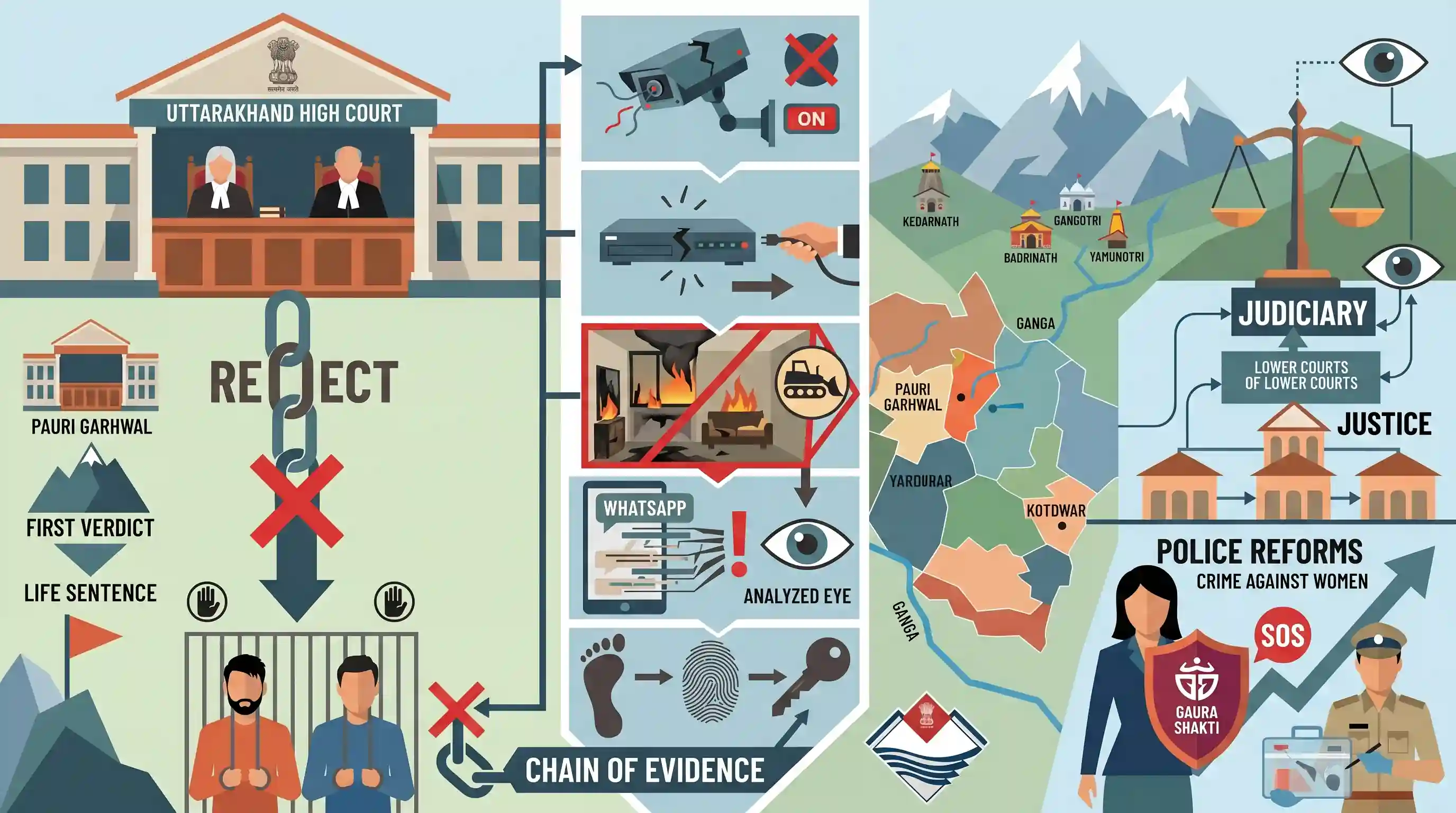
Why It Matters
The case represents a significant judicial intervention in crime against women in Uttarakhand. In UKPSC exams, the geography, administrative units, and demography of districts such as Pauri Garhwal (which witnessed negative population growth in 2001-2011 and represents one of the major Lok Sabha seats) are high-yield areas.
Summary
The Uttarakhand High Court rejected the bail applications of Pulkit Arya and Saurabh Bhaskar, who were sentenced to life imprisonment by a Kotdwar court in May 2025 for the 2022 murder of Ankita Bhandari, an employee at Vanantra Resort in Pauri Garhwal. The High Court bench comprising Justices Ravindra Maithani and Siddharth found the circumstantial evidence presented by the prosecution—including disabled resort CCTVs, tampered DVRs, destroyed hotel room evidence, and incriminating WhatsApp chats—sufficient to reject the defense's arguments of suicide and lack of direct eyewitnesses.
Key Points
- The Uttarakhand High Court division bench of Justice Ravindra Maithani and Justice Siddharth rejected the bail plea of convicts Pulkit Arya and Saurabh Bhaskar in the high-profile 2022 Ankita Bhandari murder case.
- The accused were previously convicted and sentenced to life imprisonment on May 30, 2025, by the Kotdwar lower court under Indian Penal Code (IPC) Sections 302 (murder), 354A (sexual harassment), and 201 (disappearance/destruction of evidence).
- The victim, Ankita Bhandari, was a resident of Dobh Shrikot in Pauri Garhwal district and worked at the Vanantra Resort where she was murdered by the resort's owner, Pulkit Arya, along with Saurabh Bhaskar and Ankit.
- The prosecution successfully countered the defense's suicide theory and claims of no eyewitnesses by presenting strong circumstantial evidence, including the demolition of the hotel room, arson to destroy evidence, disabled CCTV cameras, tampered digital video recorders (DVRs), and incriminating WhatsApp communications.
Important Terms
Uttarakhand High Court

The apex judicial body of the state of Uttarakhand, established in November 2000 with its seat at Nainital, responsible for administering justice and supervising subordinate state courts.
UPSC context
GS Paper II: Structure and functioning of the Judiciary. Tests knowledge of the High Court's jurisdiction and state judicial structure.
Indian Penal Code (IPC) Section 302
A statutory provision under the Indian Penal Code, 1860, defining and prescribing punishment for murder, which includes rigorous life imprisonment or the death penalty.
UPSC context
GS Paper II: Criminal Justice Reforms. Tests understanding of basic substantive criminal law provisions and sentencing guidelines in India.
Indian Penal Code (IPC) Section 201
A penal provision that criminalizes causing the disappearance of crime evidence or giving false information to screen an offender from legal punishment.
UPSC context
GS Paper II: Criminal Justice Reforms. Tests understanding of laws penalizing evidence tampering and obstruction of justice.
Indian Penal Code (IPC) Section 354A
A legal provision added to the IPC defining the offense of sexual harassment—including unwelcome physical contact, sexual demands, and remarks—and prescribing its punishments.
UPSC context
GS Paper II: Social Justice and Crimes Against Women. Tests understanding of gender-related safety laws and legal mechanisms.
Prelims Trap
All mountainous or high-altitude districts of Uttarakhand recorded negative decadal population growth in the 2011 Census.
Only Almora and Pauri Garhwal recorded negative decadal growth in Census 2011; other mountainous districts like Rudraprayag and Chamoli maintained slow but positive growth rates.
Static Concepts Connected
What are the legal principles governing the grant or rejection of bail post-conviction?
- Statutory Basis: Post-conviction bail falls under Section 389 of the CrPC (now corresponding provisions in BNSS), where the appellate court can suspend the sentence pending appeal.
- Presumption of Guilt: Unlike pre-trial bail where 'innocent until proven guilty' dominates, post-conviction bail requires the court to find exceptional circumstances to overcome the presumption of guilt established by trial.
- Judicial Discretion: Courts assess gravity of crime, tampering history, and probability of appeal disposal before granting suspension of sentence.
What is the demographic phenomenon of 'Ghost Villages' in the Indian Himalayan Region?
- Primary Cause: Severe and continuous out-migration of working-age population to urban plains due to lack of employment, healthcare, and educational infrastructure in rugged terrains.
- Socio-Economic Impact: Leads to skewed sex ratios (more women left behind), an aging regional demographic, and abandoned agricultural terrace lands.
- Ecological Consequence: Widespread land abandonment exacerbates forest fires, soil erosion, and human-wildlife conflict as wilderness encroaches on human habitats.
Cross-Topic Patterns
Hill Migration + Gender Vulnerability
Out-migration of males from hill districts shifts economic burdens to women, increasing their vulnerability to insecure local service-sector employment in remote, unregulated ecotourism zones.
Digital Evidence + Police Reforms
Destruction of physical crime scenes forces reliance on digital forensics and electronic records under BSA (Bharatiya Sakshya Adhiniyam), highlighting the need for technological upskilling in rural police divisions.

Mains 2026 may link the demographic stress of Himalayan out-migration with gender-vulnerability and unregulated ecotourism growth.
Linked PYQs · 2
Linked PYQs · 2
- 2021UKPSC_PRELIMSGS1
Which districts of Uttarakhand state recorded negative population growth during 2001-2011 as per Census of India, 2011 ?
- 2024UKPSC_PRELIMSGS1
Which parliament seat of Uttarakhand State is reserved for Scheduled Caste ?
