Uttarakhand government transfers nine senior IPS officers
Source:legendofficers ↗
Why It Matters
Understanding state-level administrative divisions, crucial postings, and institutions (such as SDRF, CID, and SHRC) is key to answering governance, security, and state-specific administration questions in the UKPSC civil services exams.
Summary
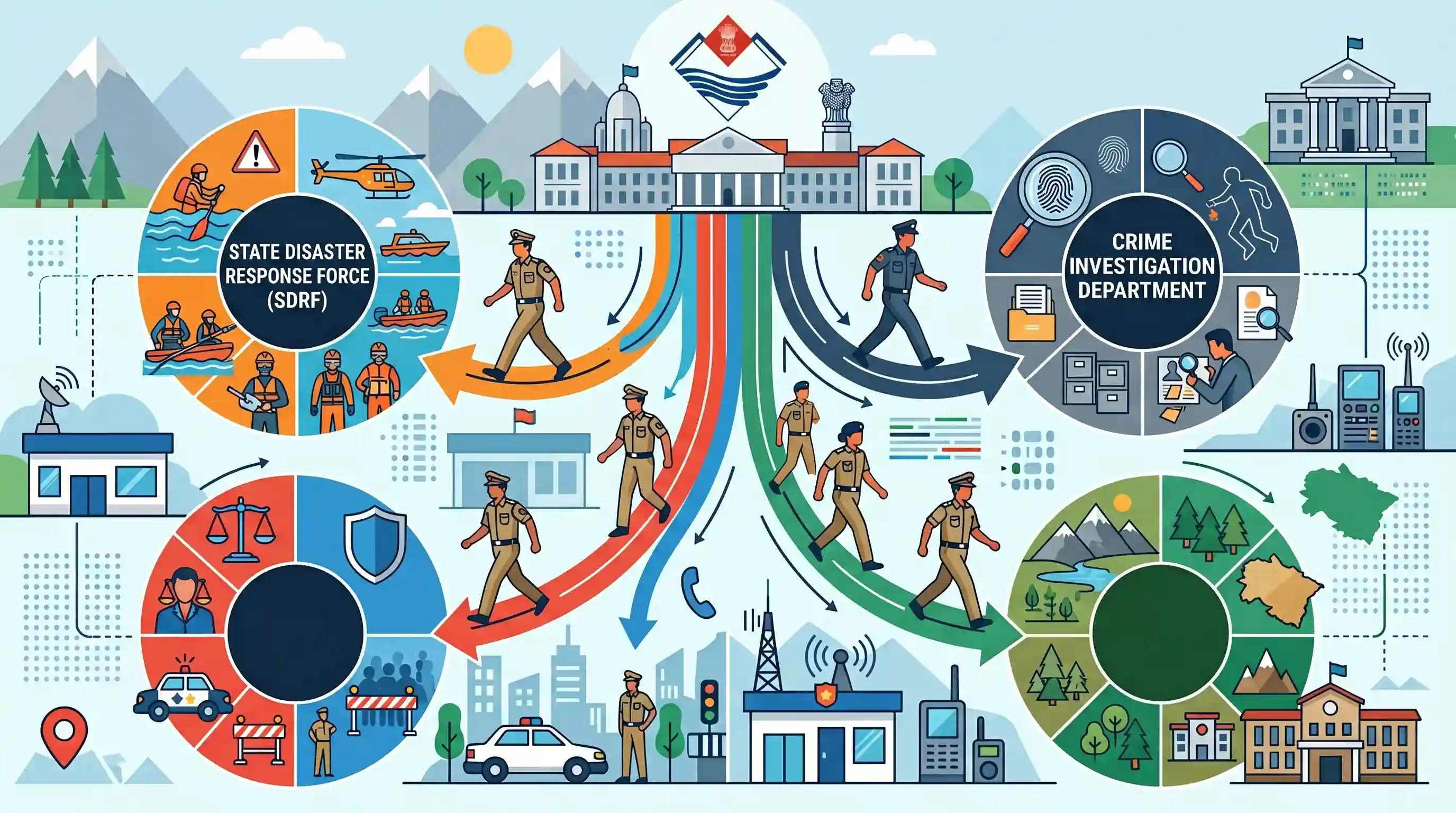
The Uttarakhand government has reshuffled nine senior Indian Police Service (IPS) officers across key administrative and specialized divisions, including Law & Order, the State Disaster Response Force (SDRF), the Crime Investigation Department (CID), and the Kumaon Range.
Key Points
- The Uttarakhand state government issued transfer and posting orders for nine senior IPS officers on June 5, 2026.
- IPS officer Ridhima Aggrawal (2005 batch) has been appointed as the new IGP for Law & Order, as well as handling CCTNS and SCRB.
- Yogendra Singh Rawat (2007 batch), previously serving as IGP Kumbh-2027 in Haridwar, has been reassigned as the IGP for the State Disaster Response Force (SDRF).
- Nivedita Kukreti Kumar (2008 batch) has been transferred from the SDRF to serve as the new IGP for the Kumaon Range in Nainital.
- Anant Shankar Takwale (2006 batch) will take on the additional charge of IGP, CID, alongside his existing responsibilities in Training and the State Human Rights Commission.
Important Terms
Protection of Human Rights Act, 1993

A statutory act providing the framework for human rights protection in India by establishing the National Human Rights Commission, State Human Rights Commissions, and Human Rights Courts.
UPSC context
GS Paper II (Polity): Tests statutory bodies and legislative frameworks protecting fundamental liberties.
Disaster Management Act, 2005
Landmark legislation providing a comprehensive legal and institutional framework for disaster preparedness, mitigation, and response in India, creating national, state, and district-level management authorities.
UPSC context
GS Paper III (Disaster Management): Tests statutory executive powers and institutional frameworks during crises.
State Disaster Response Force (SDRF)
A specialized, state-level tactical police force (modeled on the NDRF) trained for rapid deployment, rescue, and relief operations during natural or man-made calamities.
UPSC context
GS Paper III (Disaster Management): Tests sub-national institutional capacity and specialized responder forces in crisis relief.
State Human Rights Commission (SHRC)
A state-level statutory body constituted under the Protection of Human Rights Act, 1993, to inquire into human rights violations regarding subjects under the State and Concurrent Lists.
UPSC context
GS Paper II (Polity): Tests statutory bodies, federalism, and sub-national human rights enforcement mechanisms.
Crime Investigation Department (CID)
A specialized investigation wing of the state police force tasked with probes into complex, organized, and serious offenses that span across multiple districts.
UPSC context
GS Paper III (Internal Security): Tests state police reforms, division of law enforcement, and federal-state coordination.
Crime and Criminal Tracking Network & Systems (CCTNS)
An e-governance initiative connecting police stations nationwide to share and track real-time criminal records and FIRs on a unified digital platform.
UPSC context
GS Paper II (Governance): Tests e-governance, digital public infrastructure, and administrative reforms in policing.
State Crime Records Bureau (SCRB)
A state-level police department wing responsible for collecting, maintaining, and analyzing crime statistics, coordinating with the National Crime Records Bureau (NCRB) and implementing CCTNS.
UPSC context
GS Paper III (Internal Security): Tests technology implementation in policing and data-driven security administration.
Prelims Trap
The Chairperson and members of a State Human Rights Commission (SHRC) are appointed and can be removed by the Governor.
While the Governor appoints them, they can only be removed by the President of India under the Protection of Human Rights Act.
Static Concepts Connected
What are the key jurisdictional and operational limitations of a State Human Rights Commission (SHRC)?
- Subject limit: Restricted to investigating human rights violations related to subjects in the State List and Concurrent List.
- Time bar: Cannot investigate any complaint filed after one year from the date of the alleged violation.
- No duplication: Prevented from taking up cases already under investigation by the NHRC or other statutory commissions.
How is the State Disaster Response Fund (SDRF) constituted and funded?
- Statutory backing: Established under Section 48(1)(a) of the Disaster Management Act, 2005 as each state's primary response fund.
- Funding split: Central contribution is 75% for general states, rising to 90% for special category (Himalayan/NE) states.
- CAG Audit: SDRF accounts must undergo mandatory annual auditing by the Comptroller and Auditor General of India.
Cross-Topic Patterns
Disaster Finance + Fiscal Federalism
The 90:10 SDRF funding pattern for Himalayan states highlights how ecological vulnerability dictates asymmetric fiscal devolution within India's federal structure.
Internal Security + E-Governance
Deploying CCTNS under MHA bridges state-level policing with centralized federal security databases, aligning local law enforcement with national cyber-infrastructure.

Multi-statement questions on SHRC limits and SDRF's 90:10 Himalayan state funding ratio are highly probable in federalism-themed papers.
Linked PYQs · 2
Linked PYQs · 2
- 2012UKPSC_PRELIMSGS1
When did the Protection of Human Rights Act come into force in India?
- 2025UKPSC_PRELIMSGS1
Arrange the following states chronologically with respect to enactment of 'Right to Service Act' : (i) Punjab (ii) Assam (iii) Maharashtra (iv) Gujarat
