Uttarakhand launches student e-dialogue scheme
Source:aninews ↗
Why It Matters
State-level initiatives emphasizing e-governance, youth empowerment, and participatory policymaking are crucial for UKPSC Prelims and Mains (Polity and Governance). Questions often target newly launched schemes by the Chief Minister and their specific target demographics or objectives.
Summary
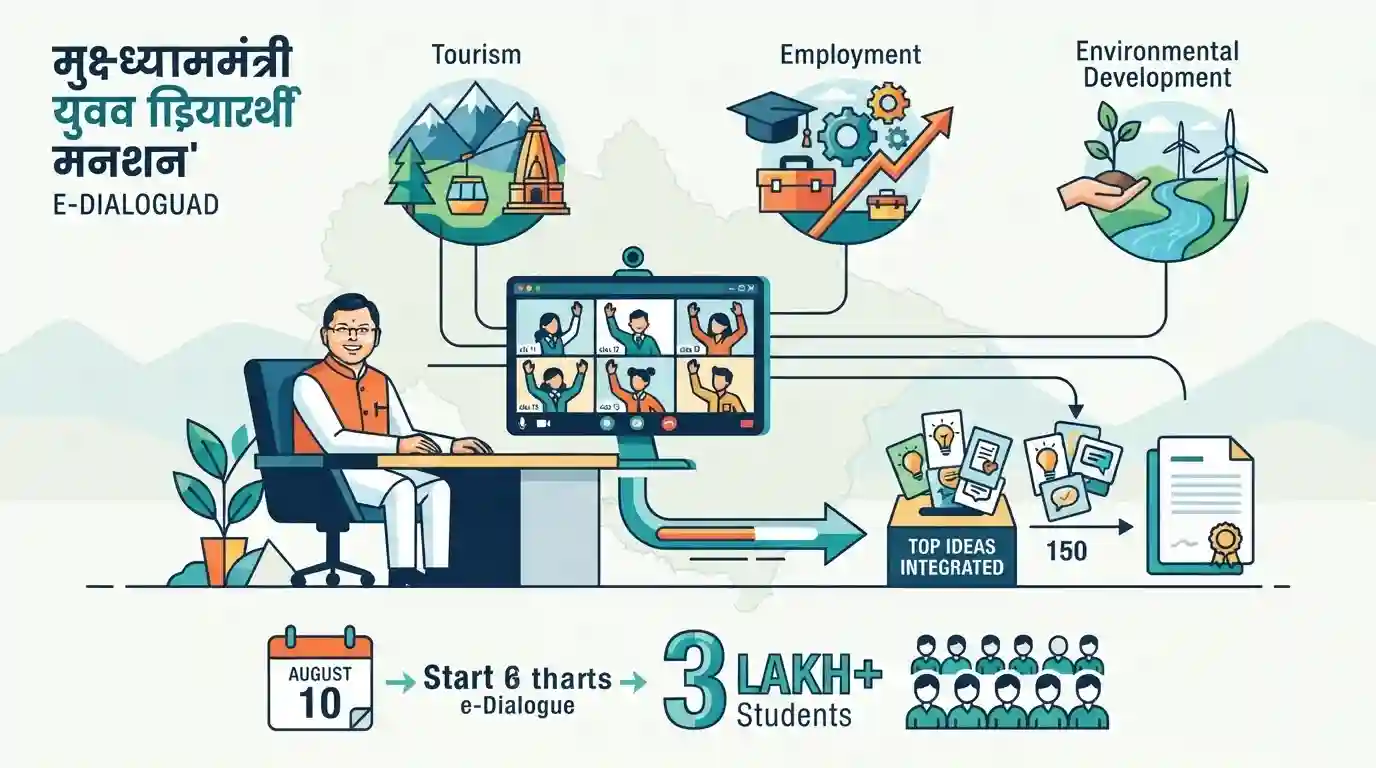
The Uttarakhand government is set to launch 'Mukhyamantri Yuva Vidyarthi Manthan', an e-dialogue program starting August 10. The initiative aims to connect Chief Minister Pushkar Singh Dhami directly with students from classes 11 and 12 to discuss vital state issues such as tourism, employment, and environmental development. By involving over 3 lakh students and incorporating the top 150 ideas into policy discussions, the state government seeks to integrate youth perspectives into its governance and future planning.
Key Points
- The 'Mukhyamantri Yuva Vidyarthi Manthan' initiative will launch on August 10 to foster direct interaction between the state's Chief Minister and students.
- The program targets students of classes 11 and 12 who were born after the formation of Uttarakhand state.
- Over 3 lakh students from more than 2,800 schools will participate in discussions covering tourism, employment, education modernization, and environmental conservation.
- The top 150 entries will be selected for detailed presentations to the Chief Minister and departmental secretaries, aiming to integrate youth perspectives into state policymaking.
Important Terms
Mukhyamantri Yuva Vidyarthi Manthan

An e-dialogue initiative by the Uttarakhand government connecting the Chief Minister with Class 11 and 12 students to gather ideas on state development and integrate youth suggestions into policymaking.
UPSC context
Relevant for GS-2 (Governance), illustrating participatory governance, youth empowerment, and state-specific e-governance policy interventions.
Participatory Governance
A public administration approach prioritizing active citizen involvement in policy-making, demonstrated by the government incorporating youth perspectives and ideas into future state planning.
UPSC context
Key GS-2 (Governance) concept, highlighting democratic decentralization, bottom-up policy formulation, and citizen-centric governance models.
E-Governance
The use of digital platforms and information technology by the government to communicate directly with citizens, as seen in Uttarakhand's online portal for student-policy dialogues.
UPSC context
Core GS-2 topic; evaluates the role of technology in enhancing administrative transparency, accountability, and direct democratic participation.
Youth Empowerment
Policies and initiatives that enable young people to actively participate in decision-making and socio-economic development, ensuring their perspectives shape future state governance.
UPSC context
Crucial for GS-1 (Society) and GS-2 (Social Justice), focusing on harnessing India's demographic dividend and inclusive policy formulation.
Prelims Trap
A national e-governance initiative under the Ministry of Education
Aspirants often confuse large-scale student interactions with PM Modi's Pariksha Pe Charcha or central Ministry of Education schemes. This is strictly a state scheme.
Static Concepts Connected
What are the core interaction models in e-governance?
- G2C (Gov to Citizen): Direct digital interaction between administration and citizens (e.g., MyGov platform, state e-dialogues, grievance redressal portals).
- G2B (Gov to Business): Online interactions to ease doing business (e.g., MCA21, e-Procurement portals, single-window clearances).
- G2G (Gov to Gov): Internal data sharing and administration within government departments (e.g., e-Office, PRAGATI portal).
Under what Constitutional provisions was the state of Uttarakhand formed?
- Article 3: Parliament has the power to form a new state by separation of territory from any state.
- UP Reorganisation Act 2000: Carved out of Uttar Pradesh as India's 27th state on November 9, 2000, under this specific parliamentary act.
Cross-Topic Patterns
Demographic Dividend & Participatory E-Governance
State initiatives leveraging 'digital natives' mirror national platforms like MyGov. Integrating youth directly into policy planning transitions them from mere beneficiaries to active governance stakeholders.
Crowdsourcing Himalayan Eco-Policy
Tasking local youth to ideate on conservation reflects a crucial bottom-up approach to climate resilience, especially vital for ecologically fragile Himalayan states like Uttarakhand.

Mains GS2 may test e-participation and bottom-up policy formulation, contrasting central platforms (MyGov) with state-level innovations.
Linked PYQs · 2
Linked PYQs · 2
- 2025UKPSC_PRELIMSGS1
Consider the following statements with reference to Uttarakhand and choose the correct answer: 1. The executive of Uttarakhand includes Governor as the head of the state. 2. It also includes the Chief Minister and his/her council of ministers.
- 2024UKPSC_PRELIMSGS1
UTDB is established in Uttarakhand to promote:
