उत्तराखंड कैबिनेट ने मदरसा वित्तीय अनुदान समाप्त करने को मंजूरी दी
स्रोत:organiser ↗
क्यों मायने रखता है
यह विकास राज्य की शिक्षा नीति में एक बड़े संरचनात्मक बदलाव का प्रतिनिधित्व करता है, जो धार्मिक-अल्पसंख्यक संस्थानों के सीधे राज्य वित्तपोषण (funding) से केंद्रीकृत विनियमन, मानकीकरण और डेटाबेस एकीकरण (U-DISE) की ओर संक्रमण को रेखांकित करता है। यह भारतीय संविधान के अनुच्छेद 29 और 30 के तहत धर्मनिरपेक्षता, राज्य-वित्तपोषित शिक्षा और अल्पसंख्यक अधिकारों के इर्द-गिर्द मुख्य संवैधानिक बहसों को छूता है, जिससे यह UKPSC Prelims और Mains दोनों के लिए अत्यधिक प्रासंगिक हो जाता है।
सारांश
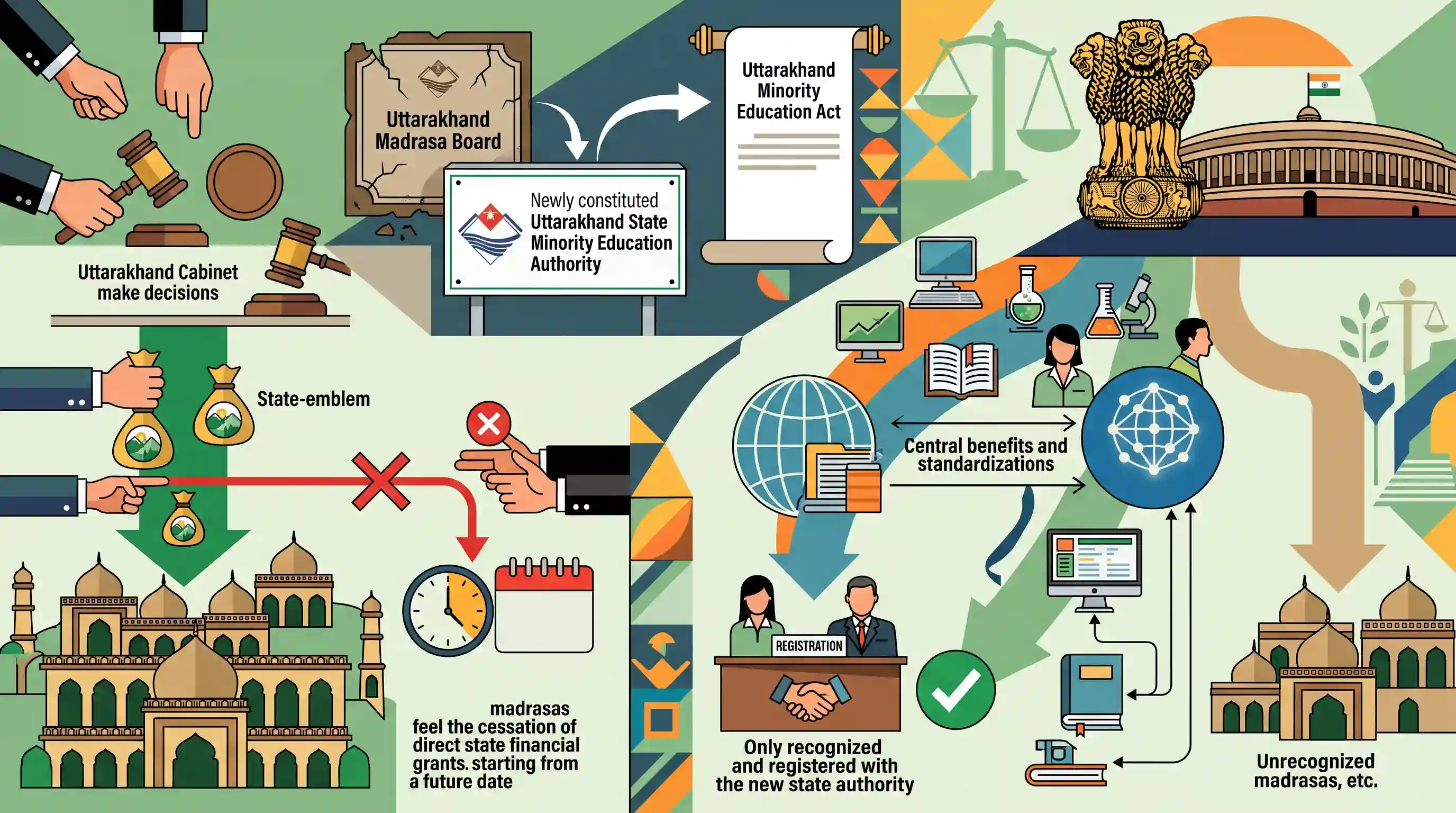
उत्तराखंड कैबिनेट ने वित्तीय वर्ष 2027-28 से 456 मदरसों को दिए जाने वाले प्रत्यक्ष राज्य वित्तीय अनुदान को बंद करने के प्रस्ताव को मंजूरी दे दी है। यह निर्णय उत्तराखंड मदरसा बोर्ड के उन्मूलन के बाद लिया गया है, जिसके स्थान पर उत्तराखंड अल्पसंख्यक शिक्षा अधिनियम के तहत नवनिर्मित उत्तराखंड राज्य अल्पसंख्यक शिक्षा प्राधिकरण का गठन किया गया था। यद्यपि राज्य के अनुदानों को चरणबद्ध तरीके से समाप्त किया जा रहा है, नए राज्य प्राधिकरण के साथ पंजीकृत मान्यता प्राप्त मदरसे अभी भी केंद्र सरकार की U-DISE योजना के तहत केंद्रीय लाभ और मानकीकरण प्राप्त करने के पात्र होंगे।
मुख्य बिंदु
- मुख्यमंत्री पुष्कर सिंह धामी के नेतृत्व में, उत्तराखंड राज्य सरकार ने राज्य भर के 456 मदरसों के लिए राज्य वित्तीय अनुदान को समाप्त करने का निर्णय लिया है।
- यह बजटीय समाप्ति वित्तीय वर्ष 2027-28 से लागू होगी।
- यह निर्णय उत्तराखंड मदरसा बोर्ड के विघटन और उत्तराखंड अल्पसंख्यक शिक्षा अधिनियम के कार्यान्वयन के बाद लिया गया है।
- हाल ही में स्थापित एक निकाय, 'उत्तराखंड राज्य अल्पसंख्यक शिक्षा प्राधिकरण' (जो जुलाई 2026 में चालू हुआ), ने सभी अल्पसंख्यक शैक्षणिक संस्थानों की मान्यता, विनियमन और निगरानी की देखरेख के लिए मदरसा बोर्ड का स्थान ले लिया है।
- जबकि प्रत्यक्ष राज्य अनुदानों को समाप्त किया जा रहा है, नए राज्य अल्पसंख्यक शिक्षा प्राधिकरण (State Minority Education Authority) से संबद्ध मान्यता प्राप्त मदरसे भारत सरकार की केंद्रीय U-DISE (Unified District Information System for Education) योजना के तहत सुविधाओं और लाभों के लिए पात्र बने रहेंगे।
- यह नीतिगत बदलाव 'एक राष्ट्र, एक शिक्षा' के सिद्धांत के तहत अल्पसंख्यक शिक्षा को मानकीकृत करने के उद्देश्य से किए गए सुधारों के अनुरूप है।
महत्वपूर्ण शब्द
उत्तराखंड अल्पसंख्यक शिक्षा अधिनियम

एक राज्य विधान जिसने मदरसा बोर्ड अधिनियम को निरस्त कर दिया और उत्तराखंड में सभी छह अधिसूचित अल्पसंख्यक समुदायों द्वारा संचालित शैक्षणिक संस्थानों को शासित, मान्यता प्राप्त और मानकीकृत करने के लिए एक एकल नियामक प्राधिकरण की स्थापना की।
UPSC context
GS Paper II (राजव्यवस्था और शासन) के लिए प्रासंगिक, विशेष रूप से अनुच्छेद 30 (अल्पसंख्यक शैक्षणिक संस्थान) और राज्यों में शैक्षिक सुधारों के संबंध में।
उत्तराखंड राज्य अल्पसंख्यक शिक्षा प्राधिकरण
उत्तराखंड में सभी छह अधिसूचित अल्पसंख्यक समुदायों द्वारा संचालित स्कूलों और मदरसों की मान्यता, पाठ्यक्रम विकास और प्रशासन की निगरानी के लिए गठित एक 12-सदस्यीय नियामक निकाय, जिसने भंग किए जा चुके मदरसा बोर्ड का स्थान लिया है।
UPSC context
GS Paper II (सांविधिक निकाय) और अल्पसंख्यक शिक्षा तथा प्रशासन से संबंधित सामाजिक न्याय की नीतियों के लिए महत्वपूर्ण।
U-DISE (यूनिफाइड डिस्ट्रिक्ट इंफॉर्मेशन सिस्टम फॉर एजुकेशन)
भारत के शिक्षा मंत्रालय द्वारा प्रबंधित एक केंद्रीकृत डिजिटल डेटाबेस, जो शैक्षिक मापदंडों की योजना बनाने, संसाधन आवंटित करने और उनका आकलन करने के लिए देश भर में वास्तविक समय (real-time) में स्कूल-स्तरीय डेटा एकत्र करता है।
UPSC context
GS पेपर II (सरकारी नीतियां और हस्तक्षेप) और GS पेपर III (शिक्षा में ई-गवर्नेंस और डिजिटल पहल) के लिए प्रासंगिक।
उत्तराखंड मदरसा बोर्ड_
उत्तराखंड का तत्कालीन वैधानिक निकाय जो इस्लामी शैक्षणिक मदरसों को विनियमित और मान्यता देता था, जिसे एक एकीकृत अल्पसंख्यक शिक्षा नियामक ढांचे का मार्ग प्रशस्त करने के लिए 2026 में भंग कर दिया गया था।
UPSC context
यह सामान्य अध्ययन (GS) प्रश्नपत्र II (अल्पसंख्यक अधिकार और शासन) के लिए उपयोगी है, जो राज्य द्वारा संचालित अल्पसंख्यक शैक्षिक प्रणालियों में प्रशासनिक परिवर्तनों का परीक्षण करता है।
उत्तराखंड का अल्पसंख्यक कल्याण विभाग
एक राज्य सरकार का विभाग जो विकास कार्यक्रमों, छात्रवृत्तियों और कौशल-प्रशिक्षण पहलों के माध्यम से अधिसूचित अल्पसंख्यक समुदायों के सामाजिक-आर्थिक, आर्थिक और शैक्षिक उत्थान के लिए जिम्मेदार है।
UPSC context
GS पेपर II (कमजोर वर्गों के लिए कल्याणकारी योजनाएं) और अल्पसंख्यक अधिकारों की रक्षा करने वाले शासन तंत्र के लिए प्रासंगिक।
प्रारंभिक ट्रैप
अनुच्छेद 30(2) सभी अल्पसंख्यक संचालित संस्थानों के लिए राज्य से वित्तीय सहायता प्राप्त करने के पूर्ण मौलिक अधिकार की गारंटी देता है।
अनुच्छेद 30(2) केवल सहायता प्रदान करने में भेदभाव को प्रतिबंधित करता है। सुप्रीम कोर्ट ने बार-बार स्पष्ट किया है कि राज्य सहायता प्राप्त करना एक पूर्ण मौलिक अधिकार नहीं है।
संबंधित अवधारणाएँ
अनुच्छेद 30 के तहत अल्पसंख्यक शैक्षणिक संस्थानों को राज्य सहायता की संवैधानिक स्थिति क्या है?
- अनुच्छेद 30(2) का शासनादेश: वित्तीय सहायता अनुदान (grants-in-aid) वितरित करते समय राज्य को अल्पसंख्यक-प्रबंधित संस्थानों के खिलाफ भेदभाव करने से रोकता है।
- सहायता निरपेक्ष नहीं है: सुप्रीम कोर्ट ने फैसला सुनाया है कि राज्य से सहायता प्राप्त करना कोई मौलिक अधिकार नहीं है; राज्य इस पर नियामक शर्तें लगा सकते हैं।
- स्वीकार्य विनियमन: राज्य अल्पसंख्यक सहायता प्राप्त स्कूलों में अनुच्छेद 30 का उल्लंघन किए बिना शैक्षणिक मानकों, शिक्षकों की योग्यताओं और स्वच्छता को विनियमित कर सकता है।
अल्पसंख्यक शिक्षा मानकों के संबंध में संविधान विधायी शक्तियों का विभाजन किस प्रकार करता है?of_the_above_options_are_correct` refers to the context where multiple statements are evaluated, and we need to determine how many of them are correct. Let's break down each statement based on standard political science and constitutional concepts: 1. **"The power of the state is not a unified whole; it is divided into different branches."** * **Analysis:** This refers to the principle of **Separation of Powers** (usually associated with theorists like Montesquieu). In most democratic systems (like India or the US), the state's power is indeed divided into three distinct branches: the Legislature (makes laws), the Executive (enforces laws), and the Judiciary (interprets laws). Rather than being a single, unchecked concentration of power, it is distributed. * **Status:** This statement is **correct**. 2. **"The legislature is responsible for enforcing laws."** * **Analysis:** In a constitutional system, the **Legislature** is responsible for *making* or *enacting* laws (legislation). The responsibility of *enforcing* or *implementing* those laws lies with the **Executive** branch. * **Status:** This statement is **incorrect** (it confounds the role of the Legislature with that of the Executive). 3. **"The judiciary is responsible for interpreting laws."** * **Analysis:** The primary function of the **Judiciary** (courts) is to interpret the laws, resolve disputes, and ensure that laws and executive actions align with the Constitution (Judicial Review). * **Status:** This statement is **correct**. --- ### Conclusion: * Statement 1 is **correct**. * Statement 2 is **incorrect**. * Statement 3 is **correct**. Therefore, **two** of the statements are correct. *(If this is a UPSC-style question where the options are: (a) Only one, (b) Only two, (c) All three, (d) None; the correct answer would be **(b) Only two**).*of_the_above_options_are_correct` indicates that this is a multiple-choice question where we need to evaluate the correctness of the given statements. Let's analyze each statement step-by-step: ### **Statement 1: "The power of the state is not a unified whole; it is divided into different branches."** * **Analysis:** This statement refers to the principle of the **Separation of Powers**, famously formulated by Montesquieu. In modern democratic states, power is not concentrated in a single authority (which could lead to tyranny). Instead, it is distributed among three distinct branches: the Legislature, the Executive, and the Judiciary. This prevents the abuse of power through a system of checks and balances. * **Verdict:** **Correct** --- ### **Statement 2: "The legislature is responsible for enforcing laws."** * **Analysis:** This statement incorrectly defines the role of the legislature. * The **Legislature** is responsible for **formulating and enacting laws** (law-making). * The **Executive** (e.g., the President, Prime Minister, Cabinet, and bureaucracy) is responsible for **enforcing and implementing** those laws. * **Verdict:** **Incorrect** --- ### **Statement 3: "The judiciary is responsible for interpreting laws."** * **Analysis:** This is the core function of the judicial branch. The **Judiciary** (courts) interprets the laws enacted by the legislature, applies them to specific cases, resolves disputes, and ensures that these laws do not violate the Constitution (Judicial Review). * **Verdict:** **Correct** --- ### **Summary of Analysis:** * **Statement 1:** Correct * **Statement 2:** Incorrect * **Statement 3:** Correct ### **Answer:** Since **two** out of the three statements are correct (Statements 1 and 3): * **"Only two"** of the above options/statements are correct.
- प्रविष्टि 25 सूची-III: संसद और राज्यों दोनों को शिक्षा पर कानून बनाने की अनुमति देता है, जिसमें धार्मिक संस्थानों में धर्मनिरपेक्ष पाठ्यक्रम मानकों को विनियमित करना भी शामिल है।
- प्रविष्टि 66 सूची-I: उच्च शिक्षा में मानकों के निर्धारण का अधिकार संसद के पास सुरक्षित रखता है, जो उच्च डिग्री प्रदान करने का प्रयास करने वाले राज्य के कानूनों को खारिज (अधिभावी) करता है।
- RTE छूट: RTE अधिनियम की धारा 1(4) और 1(5) विशेष रूप से मदरसों, वैदिक पाठशालाओं और धार्मिक शिक्षण संस्थानों को बाहर रखती हैं।of_the_same_name_as_the_original_class_in_python_and_java_and_c++.py class BaseClass: p class DerivedClass(BaseClass): pass ass
अंतर-विषय पैटर्न
अनुच्छेद 30 बनाम समवर्ती सूची की प्रविष्टि 25
यह विश्लेषण करता है कि न्यायिक व्याख्याएं धार्मिक स्कूलों में अल्पसंख्यक प्रशासनिक स्वायत्तता और धर्मनिरपेक्ष पाठ्यक्रम को मानकीकृत करने की राज्य की विधायी शक्तियों के बीच किस प्रकार संतुलन बनाती हैं।
संघीय स्कूली शिक्षा में डेटाबेस का केंद्रीयकरण
यह दर्शाता है कि कैसे स्थानीय राज्य अनुदानों से यू-डीआईएसई (U-DISE) जैसे केंद्रीय पोर्टलों की ओर संक्रमण, ऐतिहासिक रूप से स्थानीयकृत धार्मिक संस्थानों पर प्रत्यक्ष केंद्रीय निरीक्षण को बढ़ाता है।

अल्पसंख्यक सहायता को राज्य द्वारा वापस लिए जाने की संवैधानिक वैधता बनाम अनुच्छेद 30(2) के तहत प्राप्त संरक्षण, 2026 में GS-2 के लिए एक प्रमुख संभावित प्रश्न है।
संबद्ध PYQ · 2
संबद्ध PYQ · 2
- 2025UKPSC_PRELIMSGS1
Consider the following statements about 'Right to Education' and choose the correct answer : 1. It try to achieve the aim of 'Education for All'. 2. Earlier a provision of free and compulsory education was provided in Part IV of the Constitution. 3. It became Fundamental Right after 91ˢᵗ Constitutional Amendment.
- 2012UKPSC_PRELIMSGS1
Under which article of the Constitution reservations in admission to educational institutions, including private and unaided, to OBCs/ST/SC is made?
