Uttarakhand Cabinet Approves Termination of Madrasa Financial Grants
Source:organiser ↗
Why It Matters
This development represents a major structural shift in state education policy, highlighting the transition from direct state funding of religious-minority institutions to centralized regulation, standardization, and database integration (U-DISE). It touches upon core constitutional debates around secularism, state-funded education, and minority rights under Articles 29 and 30 of the Indian Constitution, making it highly relevant for both UKPSC Prelims and Mains.
Summary
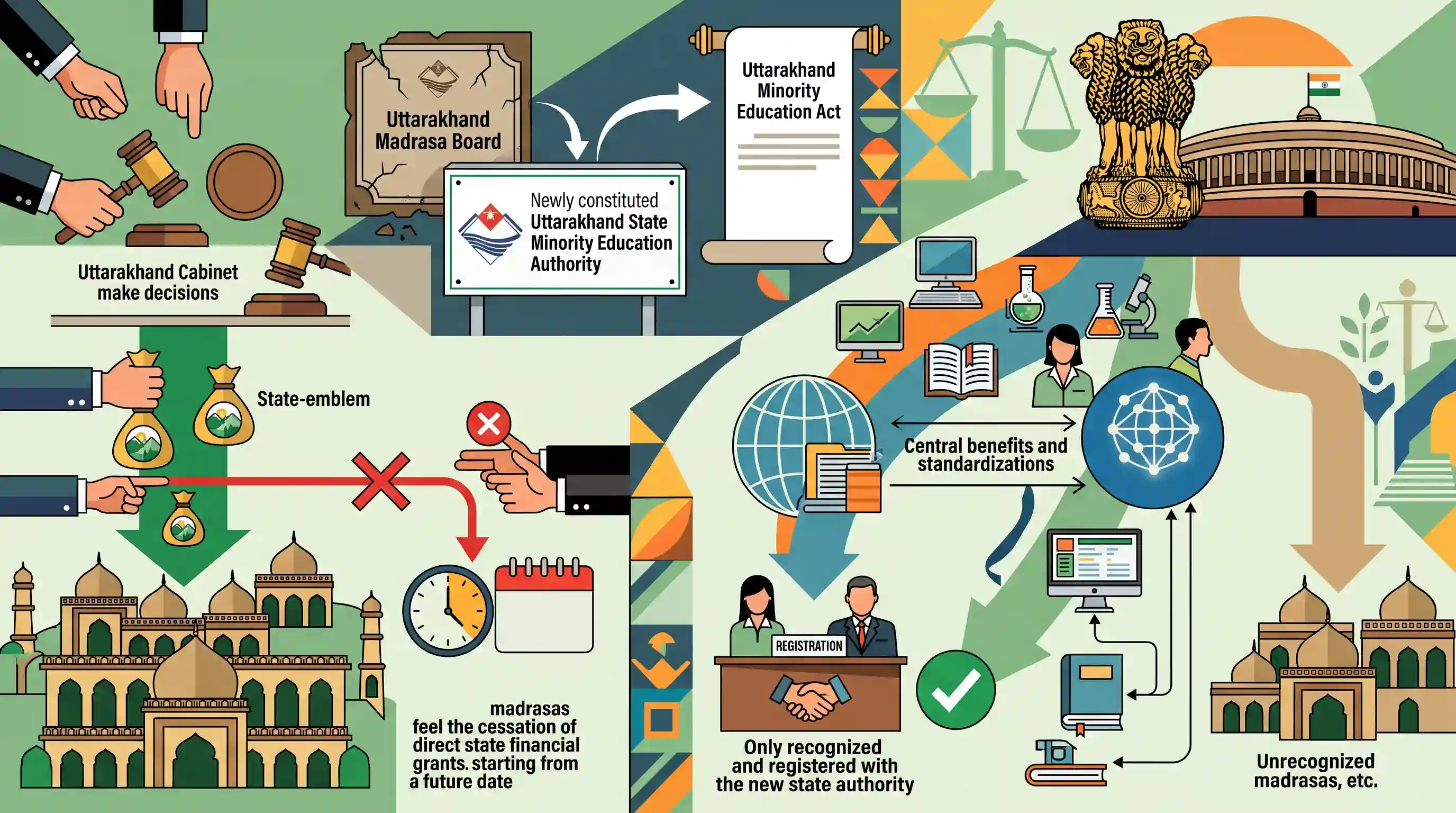
The Uttarakhand Cabinet has approved a proposal to discontinue direct state financial grants to 456 madrasas from the 2027–28 financial year. This decision comes after the abolition of the Uttarakhand Madrasa Board, which was replaced by the newly constituted Uttarakhand State Minority Education Authority under the Uttarakhand Minority Education Act. While state grants are being phased out, recognized madrasas registered with the new state authority will still be eligible to receive central benefits and standardizations under the Union Government's U-DISE scheme.
Key Points
- The Uttarakhand state government, under Chief Minister Pushkar Singh Dhami, has decided to end state financial grants for 456 madrasas across the state.
- This budgetary discontinuation will go into effect from the 2027–28 financial year.
- The decision follows the dissolution of the Uttarakhand Madrasa Board and the implementation of the Uttarakhand Minority Education Act.
- A newly established body, the Uttarakhand State Minority Education Authority (which became operational in July 2026), has replaced the Madrasa Board to oversee the recognition, regulation, and monitoring of all minority educational institutions.
- While direct state grants are being abolished, recognized madrasas affiliated with the new State Minority Education Authority will remain eligible for facilities and benefits under the Government of India's central U-DISE (Unified District Information System for Education) scheme.
- The policy change is aligned with reforms aimed at standardizing minority education under the principle of 'One Nation, One Education'.
Important Terms
Uttarakhand Minority Education Act

A state legislation that repealed the Madrasa Board Act and established a single regulatory authority to govern, recognize, and standardize educational institutions run by all six notified minority communities in Uttarakhand.
UPSC context
Relevant for GS Paper II (Polity and Governance), specifically regarding Article 30 (Minority Educational Institutions) and educational reforms in states.
Uttarakhand State Minority Education Authority
A 12-member regulatory body established in Uttarakhand to oversee the recognition, curriculum development, and administration of schools and seminaries run by all six notified minority communities, replacing the dissolved Madrasa Board.
UPSC context
Important for GS Paper II (Statutory Bodies) and social justice policies concerning minority education and administration.
U-DISE (Unified District Information System for Education)
A centralized digital database managed by India's Ministry of Education that collects real-time school-level data across the nation to plan, allocate resources, and assess educational parameters.
UPSC context
Relevant for GS Paper II (Government Policies and Interventions) and GS Paper III (E-governance & digital initiatives in education).
Uttarakhand Madrasa Board
The erstwhile statutory body in Uttarakhand that governed and recognized Islamic educational seminaries, which was dissolved in 2026 to pave the way for a unified minority education regulatory framework.
UPSC context
Useful for GS Paper II (Minority Rights and Governance), examining administrative changes in state-run minority educational systems.
Minority Welfare Department of Uttarakhand
A state government department responsible for the socioeconomic, economic, and educational upliftment of notified minority communities through development programs, scholarships, and skill-training initiatives.
UPSC context
Relevant for GS Paper II (Welfare Schemes for Vulnerable Sections) and governance mechanisms protecting minority rights.
Prelims Trap
Article 30(2) guarantees an absolute fundamental right to receive financial aid from the State for all minority-run institutions.
Article 30(2) only prohibits discrimination in granting aid. The Supreme Court has repeatedly clarified that receiving state aid is not an absolute fundamental right.
Static Concepts Connected
What is the constitutional status of state aid to minority educational institutions under Article 30?
- Article 30(2) mandate: Prohibits the State from discriminating against minority-managed institutions when distributing financial grants-in-aid.
- Aid not absolute: The Supreme Court has ruled that receiving state aid is not a fundamental right; states can impose regulatory conditions.
- Permissible regulation: State can regulate academic standards, teacher qualifications, and hygiene in aided minority schools without violating Article 30.
How does the Constitution divide legislative powers regarding minority education standards?
- Entry 25 List-III: Allows both Parliament and States to legislate on education, including regulating secular curriculum standards in religious institutions.
- Entry 66 List-I: Reserves determination of standards in higher education to Parliament, overriding state laws attempting to grant higher degrees.
- RTE Exemptions: Sections 1(4) and 1(5) of the RTE Act specifically exclude madrasas, Vedic pathshalas, and religious instruction institutions.
Cross-Topic Patterns
Article 30 vs Concurrent List Entry 25
Examines how judicial interpretations balance minority administrative autonomy in religious schools against state legislative powers to standardize secular curricula.
Centralizing databases in federal schooling
Shows how transitioning from local state grants to central portals like U-DISE increases direct central oversight over historically localized religious institutions.

Constitutional validity of State withdrawal of minority aid versus Article 30(2) protections is a prime potential GS-2 question in 2026.
Linked PYQs · 2
Linked PYQs · 2
- 2025UKPSC_PRELIMSGS1
Consider the following statements about 'Right to Education' and choose the correct answer : 1. It try to achieve the aim of 'Education for All'. 2. Earlier a provision of free and compulsory education was provided in Part IV of the Constitution. 3. It became Fundamental Right after 91ˢᵗ Constitutional Amendment.
- 2012UKPSC_PRELIMSGS1
Under which article of the Constitution reservations in admission to educational institutions, including private and unaided, to OBCs/ST/SC is made?
