Uttarakhand Statehood Movement History and Regional Disparities
Source:Indian Express ↗
Why It Matters
The 25th anniversary of Uttarakhand provides a prime case study for UPSC Mains questions evaluating the rationale and outcomes of creating smaller states, the roots of regionalism, and the specific socio-economic and environmental challenges of hill states.
Summary
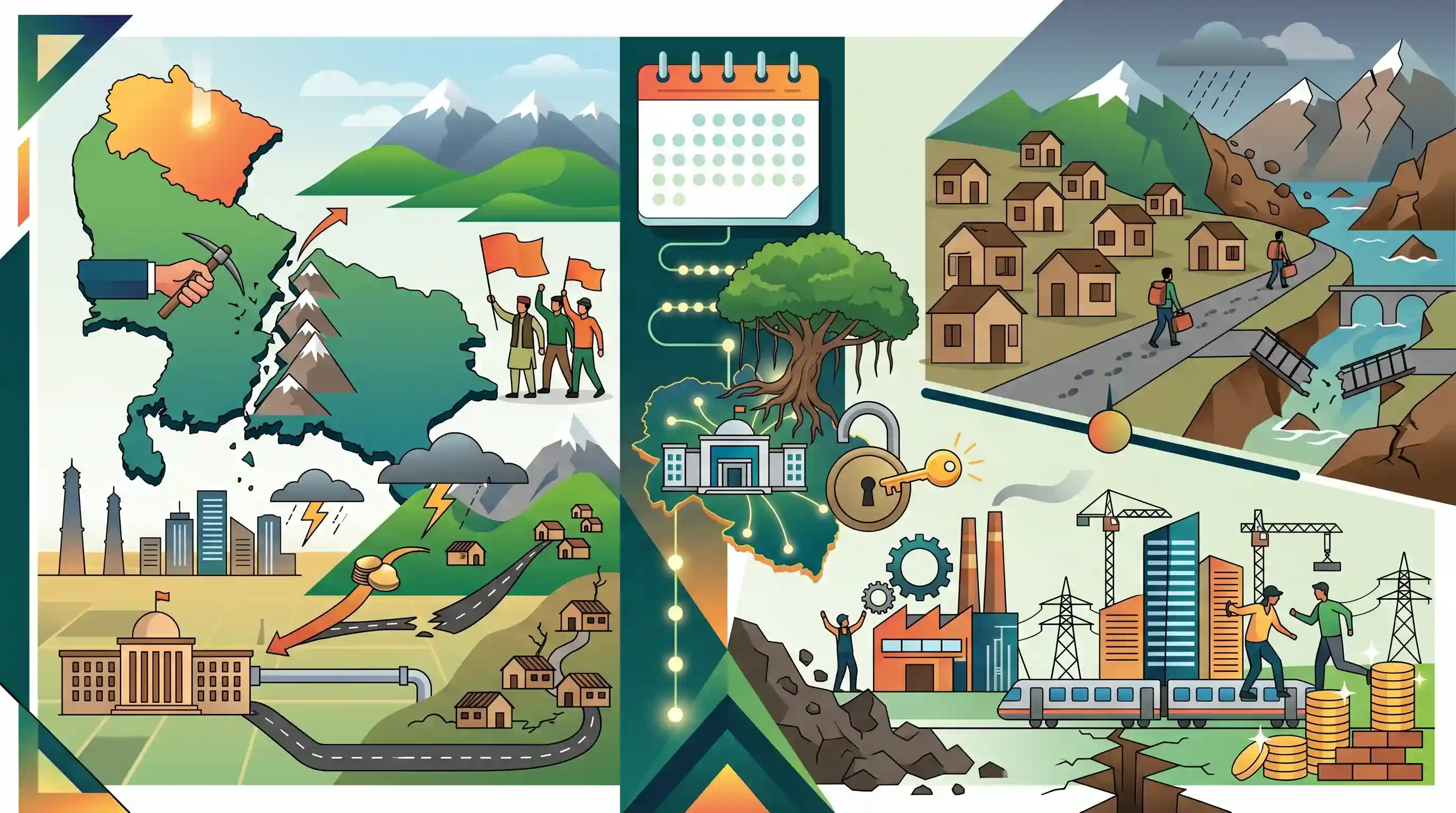
Uttarakhand's completion of 25 years as a separate state provides a critical juncture to evaluate the success and limitations of state reorganization in India. Carved out of Uttar Pradesh in 2000, the statehood movement was fundamentally rooted in regionalism fueled by geographical distinctness, cultural uniqueness, and severe developmental neglect by the plains-centric administration in Lucknow. Over the past two and a half decades, Uttarakhand has experienced distinct governance trajectories compared to Uttar Pradesh. However, while administrative proximity has improved, the state struggles with acute intra-state disparities—its plains (like Dehradun and Haridwar) have prospered industrially, while the hill districts face massive out-migration ('ghost villages') and frequent ecological disasters. This highlights that while creating smaller states can address historical neglect, it does not automatically resolve complex geographical and environmental developmental challenges.
Key Points
- Uttarakhand was formed on November 9, 2000, as India's 27th state, carved out of the hill districts of Uttar Pradesh following a prolonged statehood movement.
- The demand for statehood was driven by geographical distinctness, cultural differences, and a sense of administrative and developmental neglect by policymakers in distant Lucknow.
- After 25 years, while Uttarakhand has established governance structures tailored to its specific needs, it faces a new set of challenges including severe intra-state disparities between its hill and plain districts.
- Key ongoing issues include massive out-migration from the hills resulting in 'ghost villages', and acute ecological vulnerabilities exacerbated by rapid infrastructure development in the fragile Himalayan ecosystem.
Important Terms
Uttar Pradesh Reorganisation Act, 2000

The 2000 legislation that bifurcated Uttar Pradesh to create Uttarakhand (originally Uttaranchal) as India's 27th state. It established territorial limits, resource distribution, and the separate High Court at Nainital.
UPSC context
GS Paper II/Polity; Relevant for understanding the legal and constitutional process of state creation under Article 3 and federal restructuring.
Regionalism
A socio-political phenomenon where people assert a distinct identity based on geography or culture. In Uttarakhand, this was driven by hill-specific developmental needs and perceived neglect by the plains-centric administration.
UPSC context
GS Paper I/Social Issues; Tests understanding of sub-nationalism, identity politics, and the causes of regional movements in post-independence India.
Uttarakhand Kranti Dal (UKD)
The primary regional political party, founded in 1979, that spearheaded the Uttarakhand statehood movement. It mobilized mass protests based on the unique geographical and cultural identity of the hill regions.
UPSC context
GS Paper I/Post-Independence; Significant for studying the role of regional parties and grassroots mobilization in the evolution of Indian states.
Ghost Villages (Palayan)
A term for depopulated settlements in the hill districts caused by mass out-migration (Palayan). This is fueled by lack of healthcare, education, and employment, alongside frequent ecological disasters.
UPSC context
GS Paper III/Development; Crucial for topics on internal migration, demographic shifts, and the challenges of sustainable development in fragile mountain ecosystems.
State Reorganisation
The process of redefining administrative boundaries. The 2000 reorganization marked a shift from linguistic criteria (1956) toward developmental, geographical, and ethnic considerations for creating smaller, more manageable states.
UPSC context
GS Paper I/History; Essential for tracing the evolution of India’s political map and the administrative logic behind state creation.
Intra-state Disparity
The economic and developmental gap between Uttarakhand's prosperous industrial plains (Dehradun, Haridwar) and its neglected, disaster-prone hill districts. It challenges the assumption that new states ensure equitable growth.
UPSC context
GS Paper III/Economy; Tests the ability to analyze balanced regional growth, resource allocation, and the limitations of administrative restructuring.
Prelims Trap
"The creation of Uttarakhand required a Constitutional Amendment under Article 368 to alter state boundaries."
Laws altering state boundaries (Article 3) are explicitly excluded from Article 368 by Article 4. They only require a simple majority in Parliament.
Static Concepts Connected
What is the constitutional process for creating a new state?
- Presidential recommendation: A bill to form a new state or alter boundaries requires the prior recommendation of the President.
- State Legislature views: The President refers the bill to the concerned State Legislature for its views. These views are non-binding on the Parliament.
- Simple majority: Parliament can pass the state reorganization bill by a simple majority; it does not require a special majority.
Why do smaller states still struggle with developmental deficits?
- Intra-state disparity: Geographical and economic divides often persist within smaller states, as seen between Uttarakhand's prosperous plains and neglected hills.
- Fiscal viability: New states frequently lack a robust revenue base, forcing an over-reliance on central grants or the unsustainable exploitation of natural resources.
- Administrative capacity: While smaller states bring governance closer to the people, they initially suffer from severe shortages in administrative and institutional capacity.
Cross-Topic Patterns
State Reorganization & Ecological Thresholds
The drive for revenue generation in newly formed Himalayan states (via hydropower and mass tourism) often conflicts with SC-mandated 'carrying capacity', triggering ecological disasters like Joshimath's land subsidence.
Ghost Villages & Border Security
Massive out-migration from border hill districts ('ghost villages') creates demographic vacuums, prompting internal security interventions like the Vibrant Villages Programme to secure India's fragile northern frontiers.

Mains 2026: Expect a GS2 question evaluating if the creation of smaller states successfully resolved or merely shifted developmental deficits.
Linked PYQs · 3
Linked PYQs · 3
- 2013MainsGS1
Growing feeling of regionalism is an important factor in generation of demand for a separate State. Discuss.
- 2016MainsGS1
What is the basis of regionalism? Is it that unequal distribution of benefits of development on regional basis eventually promotes regionalism? Substantiate your answer.
- 2018MainsGS1
Discuss whether formation of new states in recent times is beneficial or not for the economy of India.
