Supreme Court Directs High Court Review on Uttarakhand Forest Fires
Source:lawbeat ↗
Why It Matters
Forest fires are a critical, recurring ecological disaster in the fragile Himalayan state of Uttarakhand. Understanding the interplay of natural causes (like pine needles), administrative challenges, and judicial mandates (like Eco-Sensitive Zones) is highly relevant for state-specific environmental governance topics in the UKPSC syllabus.
Summary
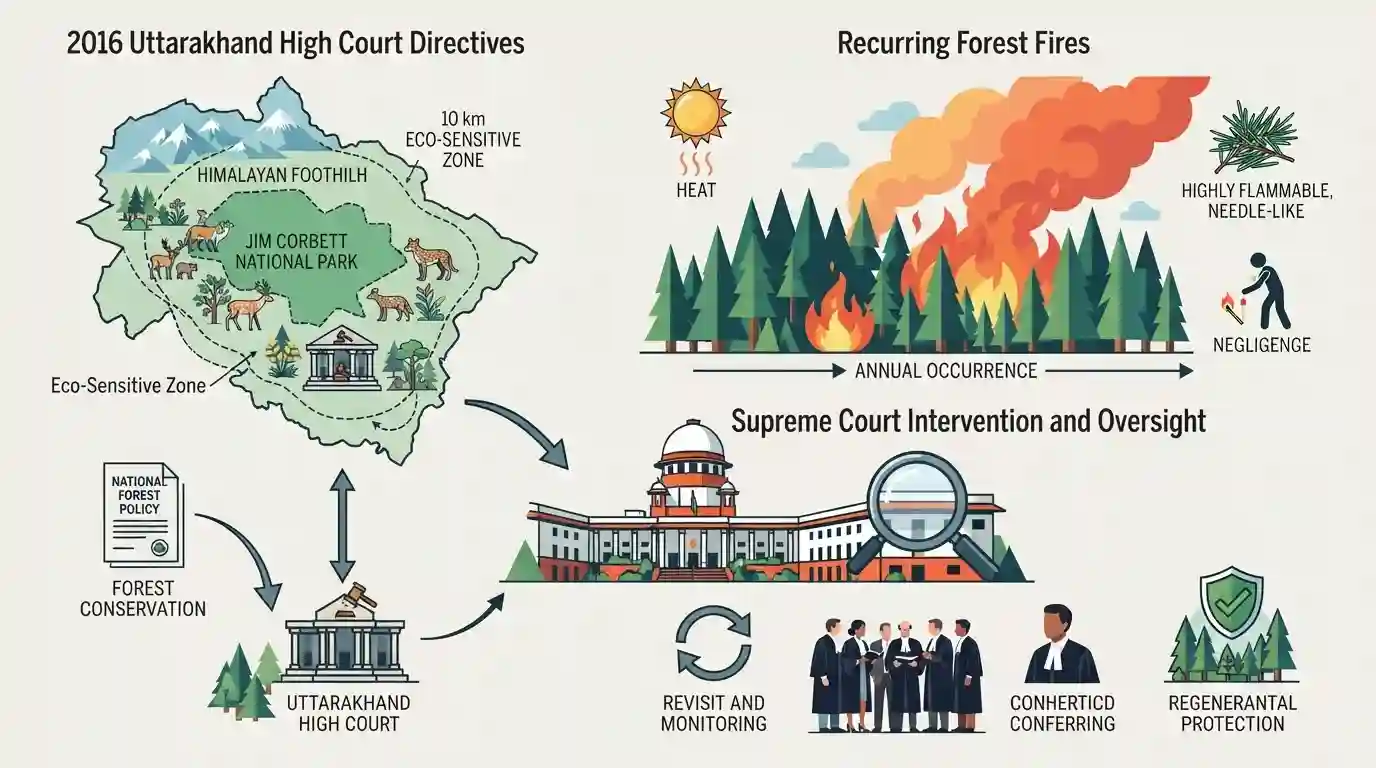
The Supreme Court has directed the Uttarakhand High Court to revisit and monitor its 2016 directions concerning the state's recurring forest fires. Noting that incidents continue annually due to heat, highly flammable pine needles, and alleged negligence, the apex court emphasized the need for updated judicial oversight. The original 2016 High Court ruling comprehensively addressed environmental protection, issuing directives such as formulating a National Forest Policy and establishing a 10 km Eco-Sensitive Zone (ESZ) around Jim Corbett National Park.
Key Points
- The Supreme Court directed the Uttarakhand High Court to revisit and monitor its 2016 directions regarding the state's recurring forest fires.
- The 2016 suo motu proceedings by the High Court were prompted by 922 forest fire incidents in 2015-16, which affected 879 hectares of land.
- The recurrent fires are attributed to excessive heat, highly combustible dry pine needles, large tourist footfall, and alleged activities of forest mafias.
- The Uttarakhand government deployed approximately 12,000 fire watchers and 283 forest rangers to mitigate the crisis.
- The 2016 HC directions included the formulation of a National Forest Policy and the declaration of a 10 km Eco-Sensitive Zone around Jim Corbett National Park.
Important Terms
National Forest Policy

A national framework (notably the 1988 policy) guiding the sustainable management, conservation, and development of India's forest resources, with a core goal of maintaining 33% forest and tree cover for ecological stability.
UPSC context
Crucial for GS Paper 3 (Environment). Evaluates knowledge on India's conservation strategy, afforestation targets, and environmental governance.
Eco-Sensitive Zone (ESZ)
Designated areas up to 10 km around protected parks acting as ecological "shock absorbers." Notified by the MoEFCC under the Environment (Protection) Act, 1986, they regulate anthropogenic activities to minimize environmental depletion and man-animal conflict.
UPSC context
High-yield for GS Paper 3 (Biodiversity) and Prelims. Tests understanding of environmental legislation, buffer zones, and conservation models.
Jim Corbett National Park
Established in 1936 as India's first national park, located in Uttarakhand's sub-Himalayan Terai belt. It boasts rich biodiversity and holds historical significance as the inaugural site for the Project Tiger conservation program in 1973.
UPSC context
Vital for GS Paper 3 (Environment) and Prelims. Tests factual knowledge of India's protected areas, geography, and flagship species initiatives.
Supreme Court of India
The highest judicial tribunal in India. It frequently exercises its powers to issue directives ensuring environmental protection, often interpreting the right to a clean, pollution-free environment as a fundamental right under Article 21.
UPSC context
Essential for GS Paper 2 (Polity). Tests concepts of judicial review, judicial activism, and the apex court's role in environmental jurisprudence.
Project Tiger
A centrally sponsored conservation initiative launched in 1973 to safeguard Bengal tigers. It focuses on in-situ conservation, protecting natural habitats, and establishing dedicated tiger reserves to prevent extinction and mitigate human-tiger conflict.
UPSC context
Important for GS Paper 3 (Conservation). Frequently tested in Prelims regarding tiger conservation history, reserves, and wildlife protection efforts.
Uttarakhand High Court
The state's highest judicial body. It exercises original and appellate jurisdiction, frequently stepping in via suo motu cognizance to mandate executive action on regional ecological issues, such as mitigating recurrent Himalayan forest fires.
UPSC context
Relevant for GS Paper 2 (Polity). Highlights the role of state High Courts in regional environmental governance and judicial oversight.
Prelims Trap
Eco-Sensitive Zones (ESZs) are statutory zones explicitly defined and established under the Wildlife (Protection) Act, 1972.
ESZs are not mentioned in the Wildlife (Protection) Act, 1972. They are declared under the broader Environment (Protection) Act, 1986, using its general powers to restrict industrial operations.
Static Concepts Connected
What is the statutory basis and regulatory framework of Eco-Sensitive Zones (ESZs)?
- Statutory Basis: Notified by the MoEFCC under Section 3 of the Environment (Protection) Act, 1986, rather than the Wildlife Protection Act.
- Purpose: Act as transition zones or "shock absorbers" around National Parks and Wildlife Sanctuaries, generally spanning up to 10 km.
- Activity Categorization: Prohibits commercial mining, highly polluting industries, and major hydro projects; regulates tree felling and hotels; permits ongoing agriculture.
Which constitutional provisions mandate the protection of forests and wildlife in India?
- Article 48A (DPSP): Added by the 42nd Amendment (1976), directing the State to protect and improve the environment and safeguard forests.
- Article 51A(g) (Duty): Imposes a duty on every citizen of India to protect and improve the natural environment, including forests and wildlife.
- Seventh Schedule: Transferred 'Forests' and 'Protection of Wild Animals' from the State List to the Concurrent List via the 42nd Amendment.
Cross-Topic Patterns
Silviculture history and disaster management
Colonial-era promotion of Chir Pine monoculture over native Oak forests directly exacerbates modern dry-season fuel loads, bridging historical geography with disaster risk reduction.
Judicial activism and environmental federalism
Courts directing the executive to draft policies or declare ecological zones tests the separation of powers (Article 50) and demonstrates aggressive judicial oversight in green governance.

Himalayan pine monoculture, the 1986 EPA basis of ESZs, and forest-related DPSPs likely to form a single multi-statement Prelims question.
Linked PYQs · 4
Linked PYQs · 4
- 2024UKPSC_PRELIMSGS1
Which Constitutional Amendment Act relates to the protection and improvement of environment and safeguarding of forests and wildlife ?
- 2025UKPSC_PRELIMSGS1
Given below are two statements, one is Assertion (A) and other is Reason (R). Select the correct answer from the given codes: Assertion (A): Uttarakhand is rich in forest and bio-diversity. Reason (R): Topography and climate primarily determine the forest and bio-diversity.
- 2024UKPSC_PRELIMSGS1
Which of the following National Park of Uttarakhand has been included in Project Tiger Scheme in 2015 ?
- 2025UKPSC_PRELIMSGS1
Consider the following statements and select the correct answer from the options given below : Statement 1 : Uttarakhand is highly vulnerable to climate change. Statement 2 : Climate change is causing water stress and depleting biodiversity in Uttarakhand.
