Uttarakhand faces space crunch for rescued wild animals
Source:etv-bharat ↗
Why It Matters
It tests candidates on state-specific environmental geography (locations of critical rescue centres), understanding of human-wildlife conflict dynamics, and the role of statutory bodies and compensatory funds (CZA, CAMPA) in conservation efforts.
Summary
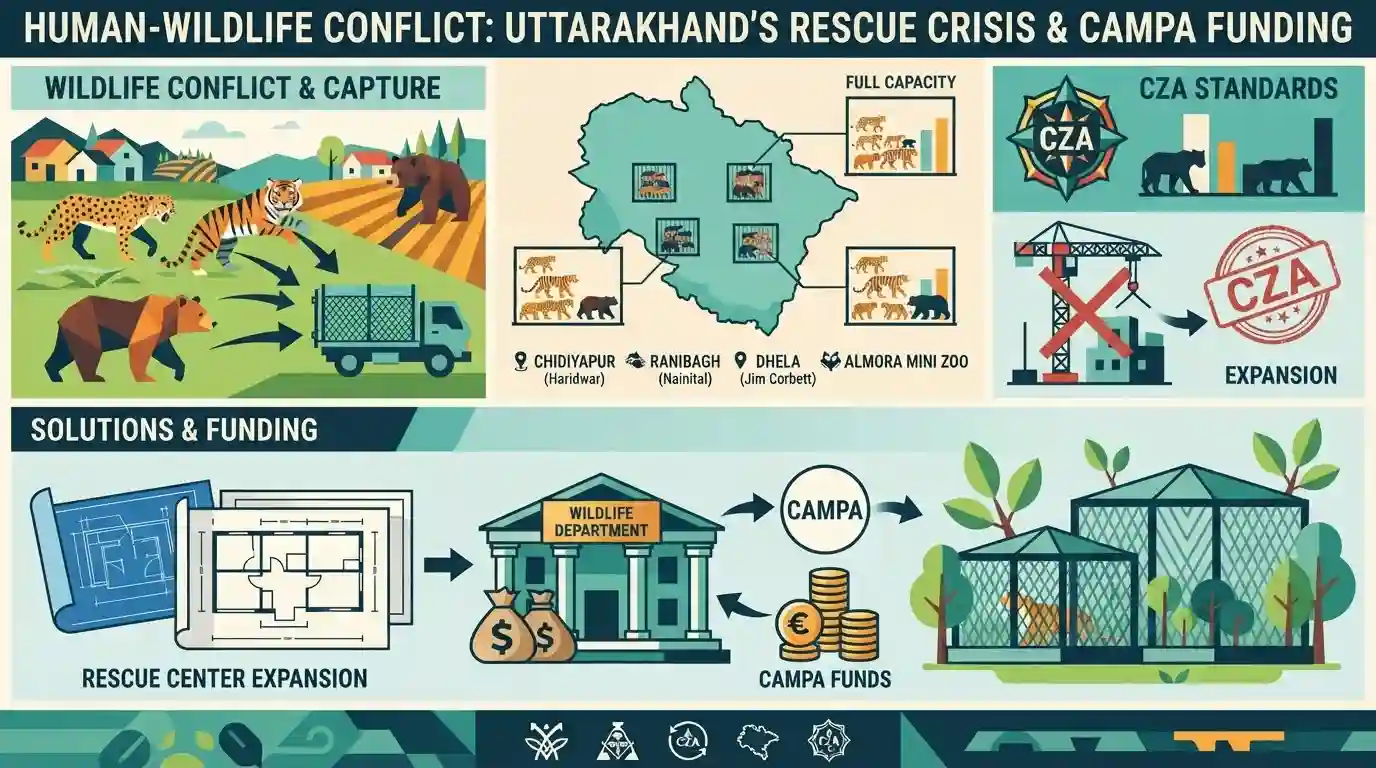
Uttarakhand is grappling with severe space constraints in housing captured man-eating wild animals such as leopards, tigers, and bears. The state's four major rescue centres—Chidiyapur (Haridwar), Ranibagh (Nainital), Dhela (Jim Corbett Tiger Reserve), and the Almora Mini Zoo—are currently running at full capacity, housing over three dozen animals. Due to strict Central Zoo Authority (CZA) standards, building new facilities is difficult. Consequently, the Wildlife Department plans to expand enclosures at the existing centres using funds from the Compensatory Afforestation Fund Management and Planning Authority (CAMPA) scheme.
Key Points
- Uttarakhand is facing acute space constraints for housing captured man-eating leopards, tigers, and bears.
- All four major wildlife rescue centres in the state—Chidiyapur (Haridwar), Ranibagh (Nainital), Dhela (Corbett), and the Almora Mini Zoo—are running at maximum capacity.
- Constructing new rescue centres is challenging due to the strict regulatory standards enforced by the Central Zoo Authority (CZA).
- The forest department has proposed expanding existing enclosures and is awaiting funding approval under the CAMPA scheme.
Important Terms
CAMPA (Compensatory Afforestation Fund Management and Planning Authority)

A statutory body established under the CAF Act, 2016 to manage funds collected when forest land is diverted for non-forest purposes. These funds are utilized for afforestation, wildlife protection, and mitigating human-wildlife conflict.
UPSC context
Highly relevant for GS-3 (Environment). UPSC tests its statutory backing, fund allocation rules (90% State, 10% Centre), and permissible uses.
Central Zoo Authority (CZA)
A statutory body under the Ministry of Environment, Forest and Climate Change, established in 1992 under the Wildlife (Protection) Act, 1972. It enforces minimum standards for animal upkeep, grants zoo recognition, and regulates animal transfers.
UPSC context
Important for GS-3 (Environment). UPSC frequently questions statutory bodies established under the Wildlife Protection Act and their specific conservation mandates.
Project Tiger
Launched in 1973, it is a Centrally Sponsored Scheme to protect Bengal tigers and their natural habitats. Administered by the statutory National Tiger Conservation Authority (NTCA), it manages tiger reserves using a core-buffer zoning strategy.
UPSC context
Core GS-3 (Environment) topic. Prelims and Mains frequently cover NTCA's statutory status, core-buffer regulations, and tiger census methodologies.
Prelims Trap
"CAMPA funds are exclusively restricted to compensatory afforestation and cannot be used for wildlife rescue infrastructure."
Under the CAF Act, 2016, CAMPA funds are explicitly permitted for wildlife habitat management, animal rescue operations, and mitigating human-wildlife conflicts, not just planting trees.
Static Concepts Connected
What is the statutory mandate of the Central Zoo Authority (CZA)?
- Statutory basis: Constituted under Section 38A of the Wildlife (Protection) Act, 1972 (via the 1991 amendment).
- Chairmanship: Chaired by the Union Minister of Environment, Forest and Climate Change (MoEFCC).
- Core function: Enforces minimum standards for housing, upkeep, and veterinary care, and grants legal recognition to zoos and rescue centres.
What are the key provisions of the Compensatory Afforestation Fund (CAF) Act, 2016?
- Fund distribution: 90% of the funds collected for forest land diversion are transferred to State CAMPA, and 10% to National CAMPA.
- Permissible uses: Afforestation, wildlife habitat rejuvenation, forest fire prevention, and human-wildlife conflict mitigation (including rescue enclosures).
- Prohibited uses: Cannot be used for paying administrative salaries, travel allowances, or constructing general office buildings.
Cross-Topic Patterns
Conservation success vs. Carrying capacity
The saturation of rescue centres highlights a broader ecological challenge: successful conservation efforts are pushing tiger and leopard populations beyond the carrying capacity of reserves, causing spillover into human settlements.
Institutional overlap in conflict mitigation
Resolving human-wildlife conflict requires dual institutional compliance—CZA for infrastructure standards and CAMPA for funding allocation—demonstrating the complex, multi-layered nature of environmental governance in India.

Expect a multi-statement Prelims question combining the statutory origins of the CZA (WPA 1972) with the permissible uses of CAMPA funds.
Linked PYQs · 5
Linked PYQs · 5
- 2024UKPSC_PRELIMSGS1
Which of the following National Park of Uttarakhand has been included in Project Tiger Scheme in 2015 ?
- 2007UKPSC_PRELIMSGS1
In Uttarakhand which of the following wild life reserve is a Tiger Reserve?
- 2024UKPSC_PRELIMSGS1
Which Constitutional Amendment Act relates to the protection and improvement of environment and safeguarding of forests and wildlife ?
- 2024UKPSC_PRELIMSGS1
Which of the following pairs is not correctly matched ?
- 2025UKPSC_PRELIMSGS1
Which of the following statements about causes of biodiversity loss is/are correct ? 1. Habitat loss and fragmentation are the most important cause driving animals and plants to extinction. 2. Human activities lead to over-exploitation of natural resources. 3. When a species becomes extinct, the plant and animal species associated with it do not become extinct. Choose the correct answer using following options :
