Uttarakhand Transport Subsidy Distribution Under Mobility Policy
Source:livemint ↗
Why It Matters
State-level implementation of clean mobility policies and their alignment with global and national climate targets (like COP26 Net-Zero and LiFE) are critical test areas for UKPSC Prelims under the Environment and State Economy sections.
Summary
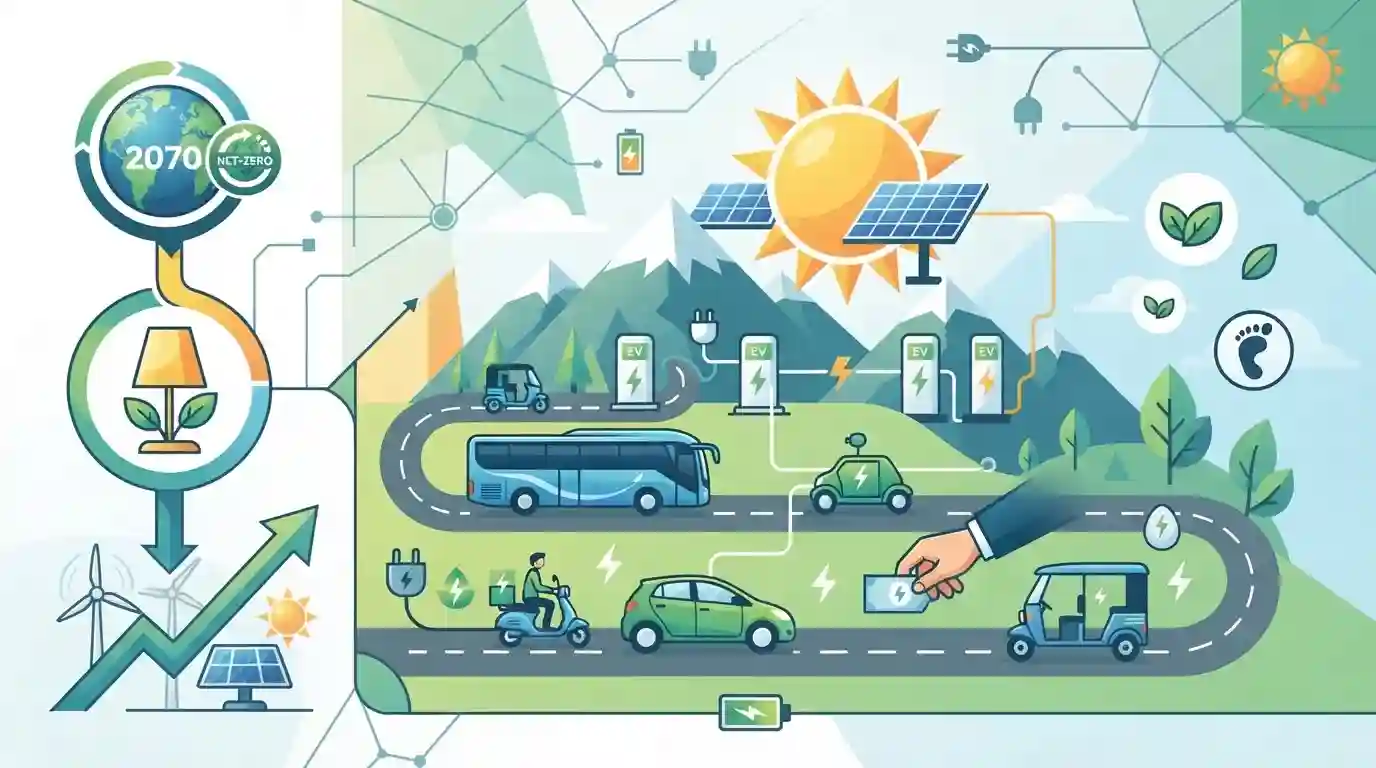
Uttarakhand has expanded its clean energy and environmental sustainability efforts by distributing subsidies under the Clean Mobility Transition Policy, 2024. The initiative aims to accelerate the adoption of electric and clean-fuel vehicles, reducing vehicular emissions across the state. This move is structurally aligned with broader national goals such as India's net-zero target by 2070, the LiFE campaign, and renewable energy integration via the PM Surya Ghar Yojana.
Key Points
- Uttarakhand government has commenced the distribution of subsidies under the newly formulated Clean Mobility Transition Policy, 2024.
- The policy provides financial incentives to transition the public and private transport fleet to electric vehicles (EVs) and other clean fuel alternatives, phasing out older, polluting vehicles.
- The initiative aligns with national climate targets such as achieving net-zero emissions by 2070 and implementing the LiFE (Lifestyle for Environment) campaign.
- Chief Minister Pushkar Singh Dhami emphasized synergy with central government programs like PM e-Bus Sewa and PM Surya Ghar Yojana to promote a comprehensive renewable energy ecosystem in the state.
Important Terms
Uttarakhand Clean Mobility Transition Policy, 2024

A state policy designed to modernize public transit, phase out old polluting diesel vehicles, and incentivize CNG, electric, and clean-fuel vehicles through capital grants and subsidies.
UPSC context
GS Paper III (Infrastructure/Environment); tests knowledge of state-level green transport policies and decentralised climate action.
PM Surya Ghar Yojana
A central sector scheme providing direct financial subsidies to install rooftop solar panels, aiming to provide up to 300 units of free monthly electricity to one crore Indian households.
UPSC context
GS Paper III (Energy/Infrastructure); tests awareness of renewable energy goals, solar capacity expansion, and decentralized power models.
PM e-Bus Sewa
A central government scheme aimed at deploying 10,000 electric buses on a Public-Private Partnership model to improve urban public transportation and reduce vehicular air pollution.
UPSC context
GS Paper III (Infrastructure/Urbanization); tests understanding of green transport systems and public-private sector collaborations.
LiFE (Lifestyle for Environment)
An India-led global mass movement encouraging individuals to adopt environmentally conscious lifestyles, replacing mindful resource utilization over mindless consumption to foster a circular economy.
UPSC context
GS Paper III (Environment); evaluates knowledge of climate change mitigation strategies and individual-centric global ecological campaigns.
Prelims Trap
"PM e-Bus Sewa provides 100% upfront funding for state governments to purchase and own electric buses."
Under the PM e-Bus Sewa PPP model, private operators procure, own, and maintain the buses. The Centre only provides a per-kilometer operational subsidy.
Static Concepts Connected
What is 'Net Metering' in India's rooftop solar ecosystem?
- Mechanism: A billing mechanism that credits solar energy system owners for the surplus electricity they add back to the central grid.
- Significance: Central to schemes like PM Surya Ghar, it incentivizes household adoption by directly offsetting monthly electricity consumption costs.
What are the key 2030 targets of India's 'Panchamrit' climate strategy?
- Energy Mix: Reach 500 GW of non-fossil energy capacity and meet 50% of the country's energy requirements from renewable energy.
- Emissions Reduction: Reduce total projected carbon emissions by one billion tonnes and lower the carbon intensity of the economy by under 45%.
Cross-Topic Patterns
EV Adoption + Grid Management
Linking EV transition with PM Surya Ghar highlights the shift towards charging EVs via decentralized rooftop solar, reducing peak demand stress on the coal-dependent central grid.
PPP Models in Urban Transport
PM e-Bus Sewa demonstrates a shift in urban transport financing. States avoid high upfront capital expenditure by leveraging private operators for procurement while the Centre subsidizes operations.

Expect a 2026 prelims question mixing PM e-Bus Sewa's PPP model, state EV subsidies, and rooftop solar net-metering.
Linked PYQs · 2
Linked PYQs · 2
- 2025UKPSC_PRELIMSGS1
Consider the following statements and select the correct answer from the options given below : Statement 1 : The State Council for Climate Change (SCCC) of Uttarakhand was established in the year 2011. Statement 2 : The responsibility of preparing Uttarakhand Action Plan on Climate Change (UAPCC) was given to the State Revenue Department.
- 2025UKPSC_PRELIMSGS1
Which of the following statements is/are correct about Global Environment Facility (GEF)? 1. Pilot GEF was agreed to setup in 1990. 2. UNDP, UNEP and the World Bank were the initial partners in implementing GEF projects. 3. India is both donor and a recipient of GEF.
