Uttarakhand to Develop Eight Forest Areas as Eco Tourism Hubs
Source:indianmasterminds ↗
Why It Matters
Directly relates to Uttarakhand's state-specific environmental policies, economic development via eco-tourism, and management of forest resources in the Himalayan region.
Summary
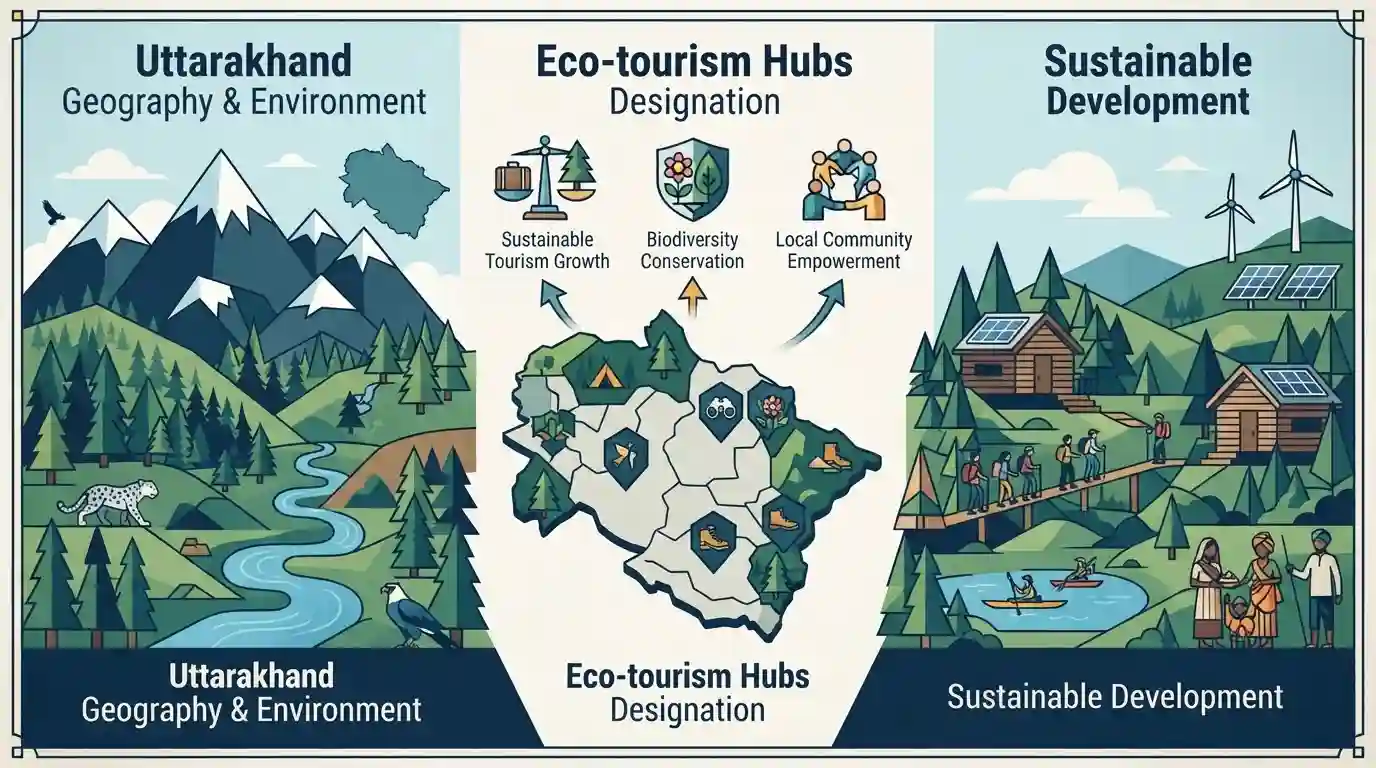
The Uttarakhand government has designated eight forest areas to be developed as eco-tourism hubs, balancing sustainable tourism growth with biodiversity conservation and local community empowerment in the fragile Himalayan state.
Key Points
- Eight forest areas in Uttarakhand are being developed as eco-tourism hubs to promote sustainable tourism.
- The initiative aims to boost local livelihoods, reduce pressure on core wildlife habitats, and preserve ecological balance.
- Focus is laid on community involvement and infrastructure development that respects the fragile Himalayan ecosystem.
Important Terms
Uttarakhand Forest Department

A state government body responsible for protecting forest resources, wildlife conservation, and implementing sustainable initiatives like eco-tourism hubs to balance economic growth with environmental preservation.
UPSC context
Relevant for UKPSC Paper V (Environment, Forestry, and Biodiversity conservation in Uttarakhand) and governance of state natural resources.
Prelims Trap
Eco-tourism hubs are being developed inside core wildlife sanctuaries to boost wildlife tourism revenues.
Aspirants often assume eco-tourism hubs are exclusively established in core national parks or wildlife sanctuaries, whereas they are deliberately sited in buffer and peripheral forest zones to relieve pressure.
Static Concepts Connected
What are the key features of Uttarakhand's Eco-Tourism Policy?
- Policy Focus: Promotes low-impact nature tourism, community involvement, and alternative rural livelihoods across fragile Himalayan landscapes.
- Spatial Strategy: Decentralizes tourist influx from core wildlife areas to peripheral and buffer forest zones.
- Implementation Model: Employs public-private-community partnerships modeled on successful private reserves like Jabarkhet.
Cross-Topic Patterns
Eco-Tourism vs Himalayan Carrying Capacity
The shift from mass religious tourism to decentralized eco-tourism hubs tests Uttarakhand's disaster management carrying-capacity limits established post-Kedarnath.
Van Panchayats and Community Conservation
Community-driven forestry models like Jabarkhet mirror traditional Van Panchayats, bridging colonial forest management and modern participatory conservation.

Uttarakhand eco-tourism policy 2020 + specific hub locations (e.g., Maheshkhan, Jabarkhet model) fit matching or statement-based questions.
Linked PYQs · 2
Linked PYQs · 2
- 2025UKPSC_PRELIMSGS1
Given below are two statements, one is Assertion (A) and other is Reason (R). Select the correct answer from the given codes: Assertion (A): Uttarakhand is rich in forest and bio-diversity. Reason (R): Topography and climate primarily determine the forest and bio-diversity.
- 2025UKPSC_PRELIMSGS1
Consider the following statements and select the correct answer from the options given below : Statement 1 : Uttarakhand is highly vulnerable to climate change. Statement 2 : Climate change is causing water stress and depleting biodiversity in Uttarakhand.
