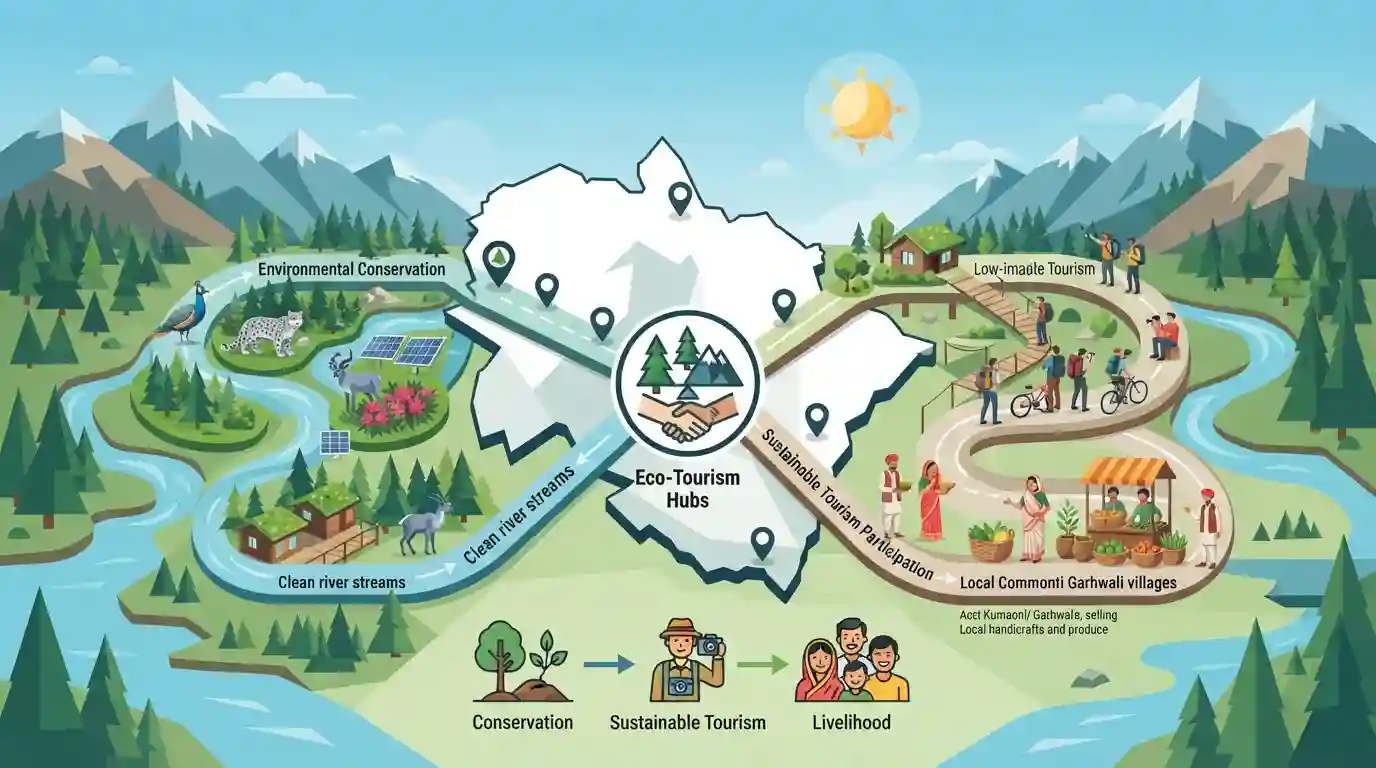
Uttarakhand designates forest areas as eco-tourism hubs
Source:indianmasterminds ↗
Why It Matters
This initiative directly impacts Uttarakhand's environmental management, local economy, and state-level policy on sustainable development and forest management, making it crucial for state-specific public service examinations.
Summary
The Uttarakhand government has identified eight forest areas to be developed as eco-tourism hubs, focusing on sustainable tourism, environmental conservation, and enhancing local community participation and livelihood opportunities.
Key Points
- Uttarakhand government has designated eight forest areas across the state as eco-tourism hubs.
- The initiative aims to promote sustainable tourism, boost local livelihoods, and protect the state's rich biodiversity.
- It focuses on balancing ecological preservation with economic development through community-driven eco-tourism models.
Important Terms
Uttarakhand Forest Department

The state government agency responsible for protecting, managing, and developing Uttarakhand's forest resources, wildlife habitats, and implementing eco-tourism and environmental conservation initiatives.
UPSC context
UKPSC Paper V (Environment & Forestry): Tests knowledge of state forest governance, wildlife management, and sustainable development policies.
Jabarkhet Nature Reserve
India's first privately owned nature reserve near Mussoorie, serving as the benchmark model for Uttarakhand's new community-driven eco-tourism hubs.
UPSC context
UKPSC Uttarakhand Special (Geography & Tourism): Tests awareness of innovative private-public conservation models and nature-based tourism in the state.
Sustainable Tourism
A development approach balancing ecological preservation, biodiversity conservation, and local community livelihoods through low-impact tourist activities like trekking and bird watching.
UPSC context
UKPSC Paper V (Economic and Environmental Issues): Evaluates candidate understanding of green economy strategies and eco-friendly development in fragile Himalayan regions.
Static Concepts Connected
What are the key pillars and forest cover statistics of Uttarakhand relevant to its environmental geography?
- Forest Cover: Uttarakhand possesses approximately 71.05% recorded forest cover, providing a critical ecological foundation for sustainable development and nature-based tourism.
- Jabarkhet Model: The eco-tourism model draws inspiration from private-public community initiatives like the Jabarkhet Nature Reserve near Mussoorie, pioneering private reserve management.
- Policy Focus: The Uttarakhand Tourism Policy 2023-2030 emphasizes reducing hill out-migration by promoting local homestays and community-led green tourism.
Cross-Topic Patterns
Eco-Tourism & Rural Out-Migration in Uttarakhand
Uttarakhand's eco-tourism push aligns with the Uttarakhand Tourism Policy 2023, directly aiming to curb rural out-migration by generating local livelihood opportunities through community-driven models.

UKPSC frequently tests recorded forest cover percentages and specific nature reserve models; expect a matching-list or assertion-reason question.
Linked PYQs · 3
Linked PYQs · 3
- 2025UKPSC_PRELIMSGS1
Given below are two statements, one is Assertion (A) and other is Reason (R). Select the correct answer from the given codes: Assertion (A): Uttarakhand is rich in forest and bio-diversity. Reason (R): Topography and climate primarily determine the forest and bio-diversity.
- 2025UKPSC_PRELIMSGS1
Consider the following statements and select the correct answer from the options given below : Statement 1 : Uttarakhand is highly vulnerable to climate change. Statement 2 : Climate change is causing water stress and depleting biodiversity in Uttarakhand.
- 2016UKPSC_PRELIMSGS1
In Uttarakhand, Oak-Rhododendron are characteristic plants of
