Uttarakhand Declares Fully Literate State Status Under ULLAS
Source:timesofindia ↗
Why It Matters
Uttarakhand achieving the status of a fully literate state under the central ULLAS scheme is a monumental socio-economic milestone. Demographics, literacy figures, and social welfare schemes are frequent areas of assessment in the UKPSC PCS Prelims.
Summary
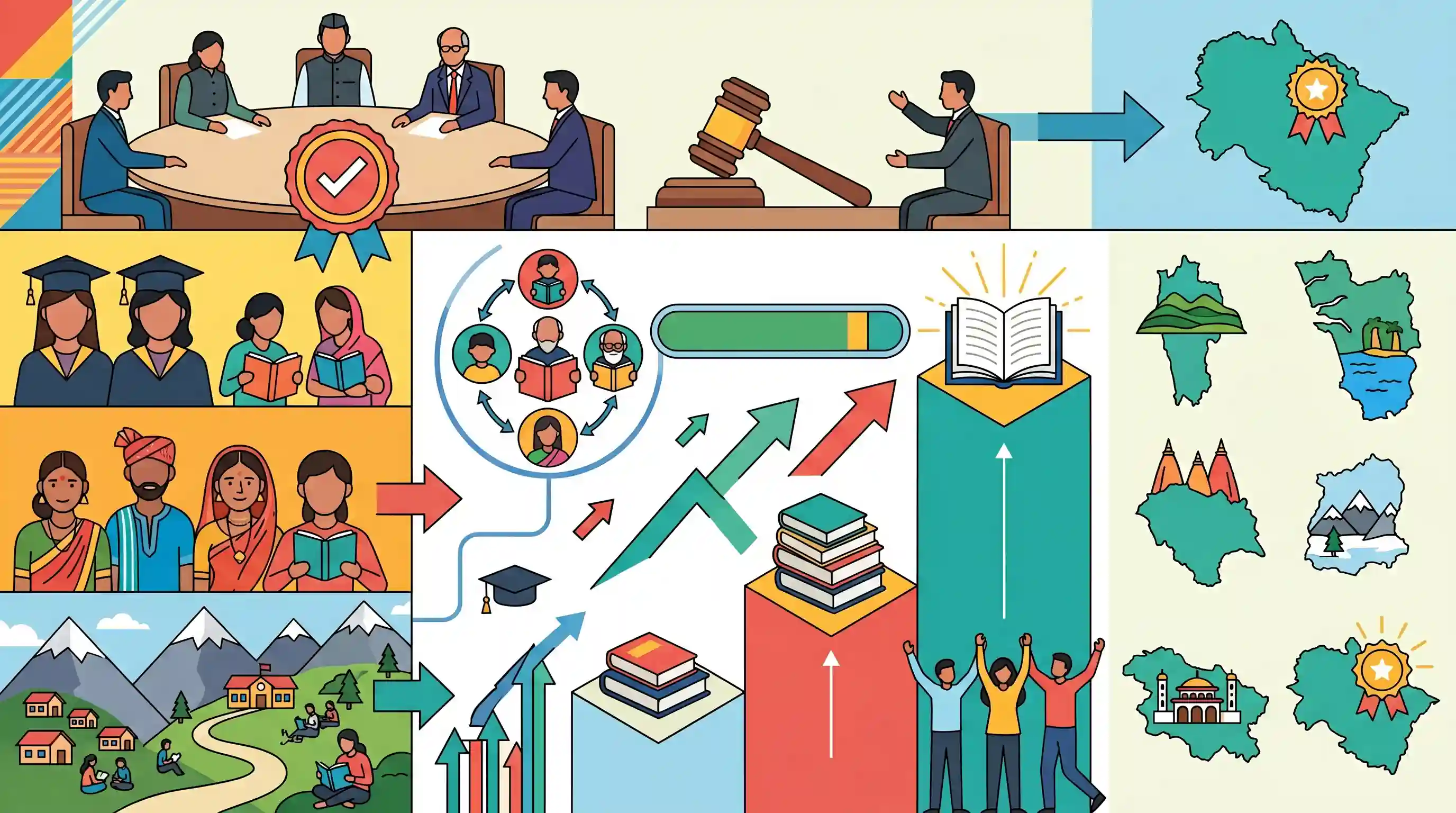
The Uttarakhand Cabinet approved a landmark proposal declaring the state 'fully literate' under the central government's ULLAS (Understanding Lifelong Learning for All in Society) scheme, as its literacy rate crossed 98%. Under this programme, a state is considered fully literate when the adult education rate for individuals above 15 years of age achieves 95% or more. With this cabinet nod, Uttarakhand is set to become the sixth state in India to attain this status, joining Mizoram, Goa, Tripura, Himachal Pradesh, and Sikkim, while Ladakh is the first certified UT. The state's literacy rate has significantly grown from 71.6% in 2001 to 78.8% in 2011, and now to over 98% under targeted initiatives focusing on women, SC/ST communities, and remote hilly areas.
Key Points
- The Uttarakhand Cabinet approved a proposal declaring the state 'fully literate' under the Union Government's ULLAS initiative, after the state's literacy rate crossed 98%.
- Under the ULLAS (Understanding Lifelong Learning for All in Society) programme, a state or region is certified as fully literate when its adult education rate (for individuals aged above 15 years) reaches 95% or higher, along with educating previously non-literate residents.
- Uttarakhand has become the sixth state in India to achieve this fully literate milestone, joining Mizoram, Goa, Tripura, Himachal Pradesh, and Sikkim.
- Ladakh holds the unique distinction of being the first Union Territory (UT) to get fully certified under the ULLAS scheme.
- Uttarakhand's historical census literacy figures show significant growth: from 71.6% in the 2001 Census to 78.8% in the 2011 Census (which was higher than the national average of 74%).
- The state possesses a robust educational network, with over 16,400 government schools, 11 state universities, and Hemwati Nandan Bahuguna Garhwal University as its sole central university.
Important Terms
Understanding Lifelong Learning for All in Society (ULLAS) programme

A centrally sponsored scheme (2022–2027) by the Ministry of Education to provide foundational literacy, numeracy, critical life skills, and digital/financial literacy to individuals aged 15 and above.
UPSC context
Relevant for GS Paper II (Social Justice/Education) and GS Paper III, assessing literacy, adult education initiatives, and socio-economic empowerment.
National Education Policy (NEP)
India's comprehensive education framework aimed at transforming primary, secondary, and higher education, emphasizing holistic, flexible, multidisciplinary learning and lifelong adult education.
UPSC context
Highly crucial for GS Paper II (Education & Governance), testing candidates on structural reforms in India's education sector.
Union Ministry of Education
The executive ministry responsible for implementing national policies on education, overseeing primary, secondary, adult, and higher education institutions across India.
UPSC context
Relevant for GS Paper II (Governance and Institutional Frameworks), testing executive roles in development and human resource sectors.
Hemwati Nandan Bahuguna Garhwal University
Established in 1973, it is Uttarakhand's sole Central University, playing an active role in regional higher education and community outreach programs like ULLAS.
UPSC context
Relevant for GS Paper II (Social Sector & Education) and State PSC exams, testing regional educational infrastructure and institutional roles.
Uttarakhand Cabinet
The executive decision-making body of Uttarakhand, chaired by the Chief Minister, responsible for approving state-level policies, legislative proposals, and landmark resolutions.
UPSC context
Relevant for GS Paper II (State Legislature and Executive), testing the functioning and executive powers of state cabinets.
Prelims Trap
The Indian Census defines a literate person as anyone aged 5 years and above who can read and write with understanding.
The Census of India's minimum age threshold for literacy is 7 years, whereas the ULLAS scheme specifically targets adult literacy for individuals aged 15 and above.
Static Concepts Connected
What are the official parameters for measuring literacy in the Census of India?
- Age Threshold: A person aged seven and above who can both read and write with understanding in any language is considered literate.
- Effective Literacy: Literacy rates are calculated by dividing the literate population by the total population aged seven and above, excluding the 0-6 age group.
- Declaration Criteria: An individual does not need formal education; functional capability to read and write without formal schooling suffices for census classification.
Cross-Topic Patterns
Federalism and CSS execution
Examines how states implement Centrally Sponsored Schemes like ULLAS to hit regional development indices, illustrating cooperative federalism in competitive literacy outcomes.
Gender gap and labor economics
Links regional female literacy gaps with lower Female Labor Force Participation Rates, highlighting why adult education is vital for economic productivity.

Expect a 2026 question contrasting the ULLAS target demographic (15+) with standard Census literacy metrics (7+) to test demographic concepts.
Linked PYQs · 3
Linked PYQs · 3
- 2012UKPSC_PRELIMSGS1
As per 2011 Census, literacy rate of Uttarakhand State is:
- 2024UKPSC_PRELIMSGS1
As per census 2011, which of the following district of Uttarakhand had lowest female literacy rate ?
- 2024UKPSC_PRELIMSGS1
Districts are arranged in ascending order in terms of female literacy rate. Choose the correct option :
