Suspected Malware Attack Disruption Hits Uttarakhand Portals
Source:the420 ↗
Why It Matters
Highlights systemic vulnerabilities in state-level digital infrastructure and the need for robust cybersecurity measures for e-governance platforms, which are increasingly targeted by advanced malware attacks. Understanding cybersecurity concepts like malware/viruses and digital governance initiatives is crucial for GS-III (Internal Security & Technology).
Summary
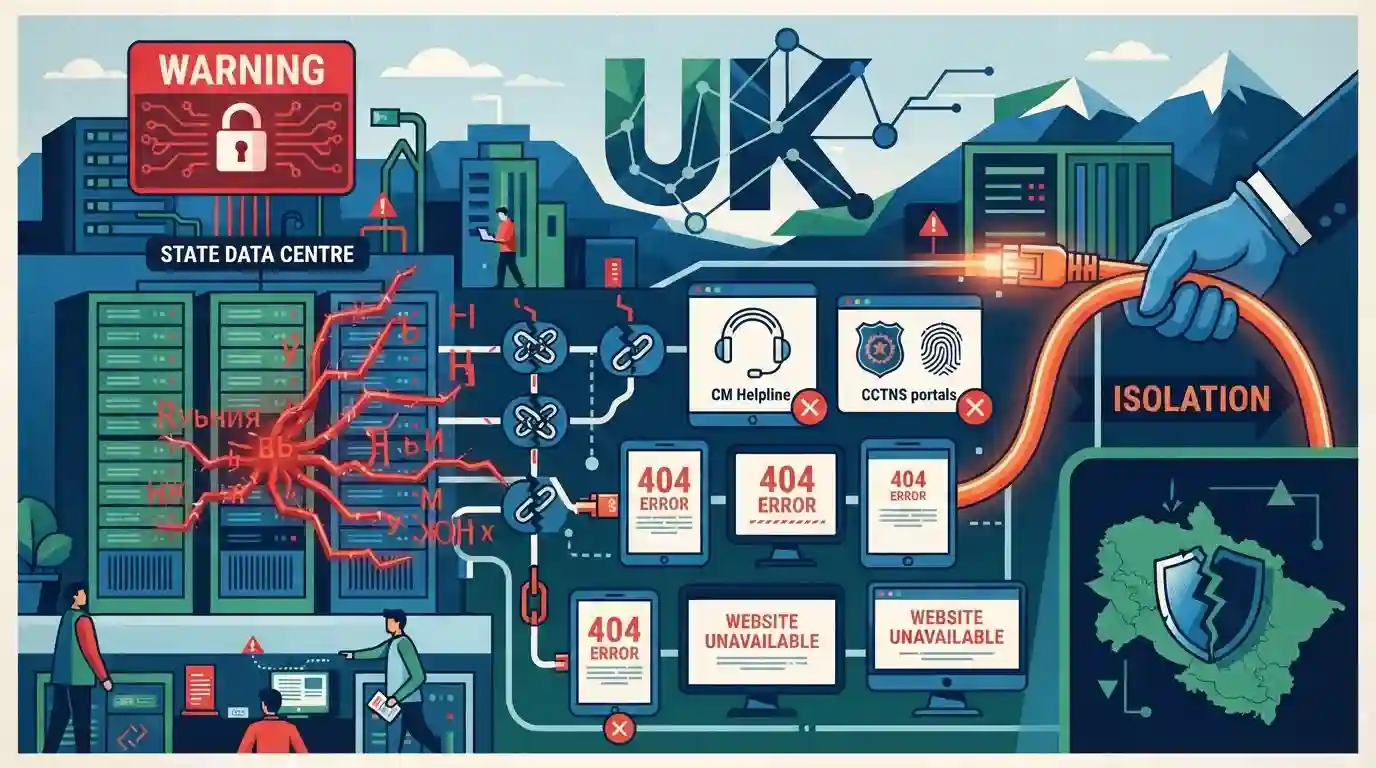
A major cyberattack involving suspected Russian malware hit the Uttarakhand State Data Centre, shutting down over 20 state government portals, including the CM Helpline and the Crime and Criminal Tracking Network System (CCTNS). The Information Technology Development Agency (ITDA) isolated servers to mitigate the spread, highlighting significant vulnerabilities in the state's digital infrastructure and raising concerns over repeated cybersecurity breaches in government data centres.
Key Points
- A cyberattack affected the Uttarakhand State Data Centre, disrupting crucial e-governance portals like 'Apuni Sarkar', CM Helpline, and e-Office.
- The state's Crime and Criminal Tracking Network and Systems (CCTNS) was severely impacted, crippling online police operations.
- The ITDA (Information Technology Development Agency) shut down servers and isolated the network to contain what is suspected to be a Russian malware variant.
- This incident follows a similar ransomware attack on Uttarakhand government websites in October 2024, raising critical concerns over state cybersecurity resilience, data backup protocols, and network segmentation.
Important Terms
Crime and Criminal Tracking Network and Systems (CCTNS)

A nationwide e-governance project connecting police stations across India to a centralized database. It digitizes crime records, FIRs, and investigations to enable seamless inter-state data sharing and tracking.
UPSC context
Crucial for GS Paper 3 (Internal Security) and GS Paper 2 (e-Governance) to evaluate digital police modernization and data vulnerability.
Apuni Sarkar
Uttarakhand's unified e-governance portal integrating multiple citizen-centric services like certificates and land records into a single digital framework. It promotes faceless, paperless, and cashless administrative delivery.
UPSC context
Relevant to GS Paper 2 (e-Governance). Highlights state-level digital service delivery and the impact of cyberattacks on public administration.
Information Technology Development Agency (ITDA)
The nodal agency in Uttarakhand responsible for implementing and monitoring state IT and e-governance initiatives under the National e-Governance Plan, including the operation of the State Data Centre.
UPSC context
Fits GS Paper 2 (Governance) and GS Paper 3 (Cybersecurity), focusing on the administrative frameworks securing state digital infrastructure.
State Data Centre (SDC)
Core IT infrastructure established under the National e-Governance Plan (NeGP). It acts as a secure, centralized physical repository for hosting state-level e-governance applications, portals, and citizen databases.
UPSC context
Highly relevant for GS Paper 3 (Cybersecurity, Infrastructure). Tests understanding of centralized data hosting benefits versus systemic malware vulnerabilities.
Prelims Trap
"CCTNS is a nodal project implemented by MeitY to secure state police networks."
Aspirants often link all digital platforms to MeitY. However, CCTNS is a Mission Mode Project implemented by the National Crime Records Bureau (NCRB) under the Ministry of Home Affairs.
Static Concepts Connected
What is the Crime and Criminal Tracking Network & Systems (CCTNS)?
- Nodal Agency: Implemented by the National Crime Records Bureau (NCRB) under the Ministry of Home Affairs.
- Core Objective: Aims to create a comprehensive, integrated national database for policing by digitally connecting over 16,000 police stations.
- ICJS Linkage: It is a foundational pillar of the Interoperable Criminal Justice System (ICJS), linking police data with eCourts, ePrisons, and forensics.
How do core malware types differ in UPSC terminology?
- Ransomware: Malware that encrypts victim data or locks systems, demanding payment (often cryptocurrency) for a decryption key (e.g., WannaCry, Petya).
- Trojans: Malicious software disguised as legitimate programs. Unlike worms, Trojans do not self-replicate but rely on user execution.
- Zero-Day Exploit: An attack exploiting a software vulnerability previously unknown to the vendor, meaning no patch exists on "day zero".
Cross-Topic Patterns
Federal gaps in critical IT infrastructure
Attacks on State Data Centres reveal federal gaps; while CERT-In and NCIIPC operate nationally, states often lack robust cyber-resilience frameworks despite managing sensitive citizen databases and local e-governance portals.
DPI vulnerabilities in e-Governance
The disruption of 'Apuni Sarkar' highlights how India's rapid push for paperless governance and Digital Public Infrastructure (DPI) creates massive single points of failure without adequately air-gapped backups.

Expect a multi-statement question linking ransomware definitions, CERT-In reporting mandates under IT Rules, and CCTNS architecture in 2026.
Linked PYQs · 2
Linked PYQs · 2
- 2012UKPSC_PRELIMSGS1
A program that has capability to infect other program and make copies of itself and spread into other programs is called:
- 2025UKPSC_PRELIMSGS1
What is the objective of 'DigiLocker' service?
