Uttarakhand Congress flags Form 7 misuse in voter list revision
Source:daily-pioneer ↗
Why It Matters
This issue highlights the grassroots mechanics of electoral roll management and the potential for voter disenfranchisement through procedural loopholes. Understanding the roles of the ECI, Chief Electoral Officers (CEO), Electoral Registration Officers (ERO), and forms like Form-7 is critical for GS Paper 2 (Polity and Governance - Elections).
Summary
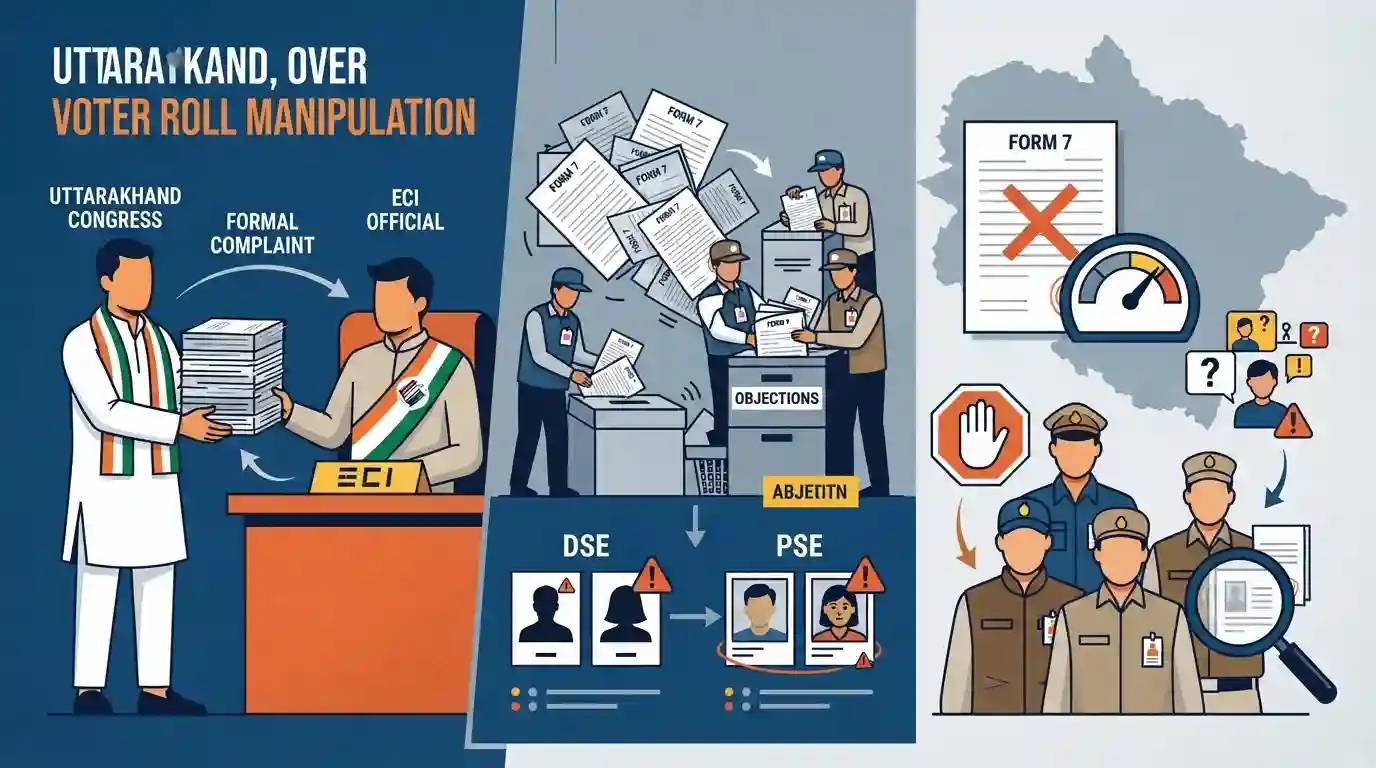
The Uttarakhand Congress has filed a formal complaint with the Election Commission of India (ECI), alleging the widespread misuse of 'Form-7' during the Special Intensive Revision (SIR) of electoral rolls. Party leaders claim that political agents are illegally submitting thousands of objections to delete voters categorized under 'Demographically Similar Entries' (DSE) and 'Photo Similar Entries' (PSE). The Congress emphasizes that election rules cap the number of objections a single individual or Booth Level Agent-2 (BLA-2) can file, and has warned that state electoral officers will be held accountable for any unauthorized disenfranchisement of eligible voters.
Key Points
- The Uttarakhand Congress has approached the Election Commission, alleging misuse of 'Form-7' to delete eligible voters from the electoral rolls.
- The controversy arises during the Special Intensive Revision (SIR) process, where objections are raised against 'Demographically Similar Entries' (DSE) and 'Photo Similar Entries' (PSE).
- Congress claims unauthorized individuals and political agents (BLA-2) are submitting mass objections beyond the legally permitted limits (10 for ordinary voters, 30 for BLA-2).
- The party warned that local electoral officers (CEO and ERO) would be held responsible if legitimate voters are disenfranchised without proper verification.
Important Terms
Special Intensive Revision (SIR)

A comprehensive process conducted by the Election Commission to update and purify electoral rolls through house-to-house enumeration, adding new voters and removing deceased, shifted, or duplicate entries.
UPSC context
Relevant for GS Paper 2 (Elections/RPA). Tests knowledge of electoral roll preparation and the ECI's mandate.
Form-7
A statutory application under the Registration of Electors Rules, 1960, used to object to proposed inclusions or request the deletion of a name from the existing electoral roll.
UPSC context
Important for GS Paper 2 (Representation of People Act). Tests understanding of voter registration and safeguards against disenfranchisement.
Election Commission of India
A permanent constitutional body established under Article 324, responsible for the superintendence, direction, and control of elections to Parliament, State Legislatures, and the offices of the President and Vice-President.
UPSC context
Core GS Paper 2 topic (Constitutional Bodies). Tests knowledge of free and fair electoral mechanisms and independent institutions.
Demographically Similar Entries (DSE)
Potential duplicate voters identified in electoral rolls by matching demographic details like names, ages, and addresses. Suspect entries are manually verified by election officials to purify the voter database.
UPSC context
GS Paper 2 (Electoral Reforms/Technology in Elections). Highlights efforts to eliminate duplicate voting and ensure accurate electoral rolls.
Booth Level Agent (BLA)
An authorized representative appointed by a recognized political party at a specific polling station to scrutinize draft electoral rolls and assist Booth Level Officers in identifying dead or shifted electors.
UPSC context
GS Paper 2 (Elections). Tests understanding of political parties' formal statutory roles in maintaining grassroots electoral transparency.
Prelims Trap
The preparation and periodic revision of electoral rolls are governed by the Representation of the People Act, 1951.
The RPA 1950 deals with the preparation of electoral rolls and voter qualifications, whereas the RPA 1951 governs the actual conduct of elections and election disputes.
Static Concepts Connected
What is the primary difference in scope between RPA 1950 and RPA 1951?
- RPA 1950: Governs the allocation of seats, delimitation of constituencies, qualifications of voters, and preparation of electoral rolls.
- RPA 1951: Deals with the actual conduct of elections, qualifications/disqualifications for membership, election offenses, and resolving election disputes.
What are the key statutory forms used by the ECI for electoral roll revisions?
- Form 6: Application for the registration of new voters or inclusion of names in the electoral roll.
- Form 7: Application used for objecting to a proposed inclusion or seeking deletion of an existing name.
- Form 8: Application used for shifting residence, correction of entries, updating details, or replacement of EPIC.
Cross-Topic Patterns
AI in Electoral Integrity (DSE/PSE)
The ECI's use of AI via ERONET for detecting Photo and Demographically Similar Entries (PSE/DSE) links technology governance directly with constitutional electoral mandates.
Article 324 vs Statutory Election Rules
While Article 324 provides constitutional backing for ECI's superintendence, granular processes like voter deletion (Form-7) flow from statutory instruments like the Registration of Electors Rules, 1960.

Questions distinguishing RPA 1950 vs 1951 provisions, specifically regarding electoral roll preparation and Form-7, are highly probable.
Linked PYQs · 2
Linked PYQs · 2
- 2011UKPSC_PRELIMSGS1
The Chief Election Commissioner of India is appointed by
- 2012UKPSC_PRELIMSGS1
What is the tenure of Chief Election Commissioner of India?
