Uttarakhand Infrastructure Projects Deadline Set Ahead of Elections
Source:uniindia ↗
Why It Matters
This article highlights state-level administrative governance, the executive powers of the Chief Minister and Chief Secretary, and how electoral cycles influence public infrastructure delivery timelines, which are recurrent themes in the UKPSC GS-1 (Polity and State-specific) syllabus.
Summary
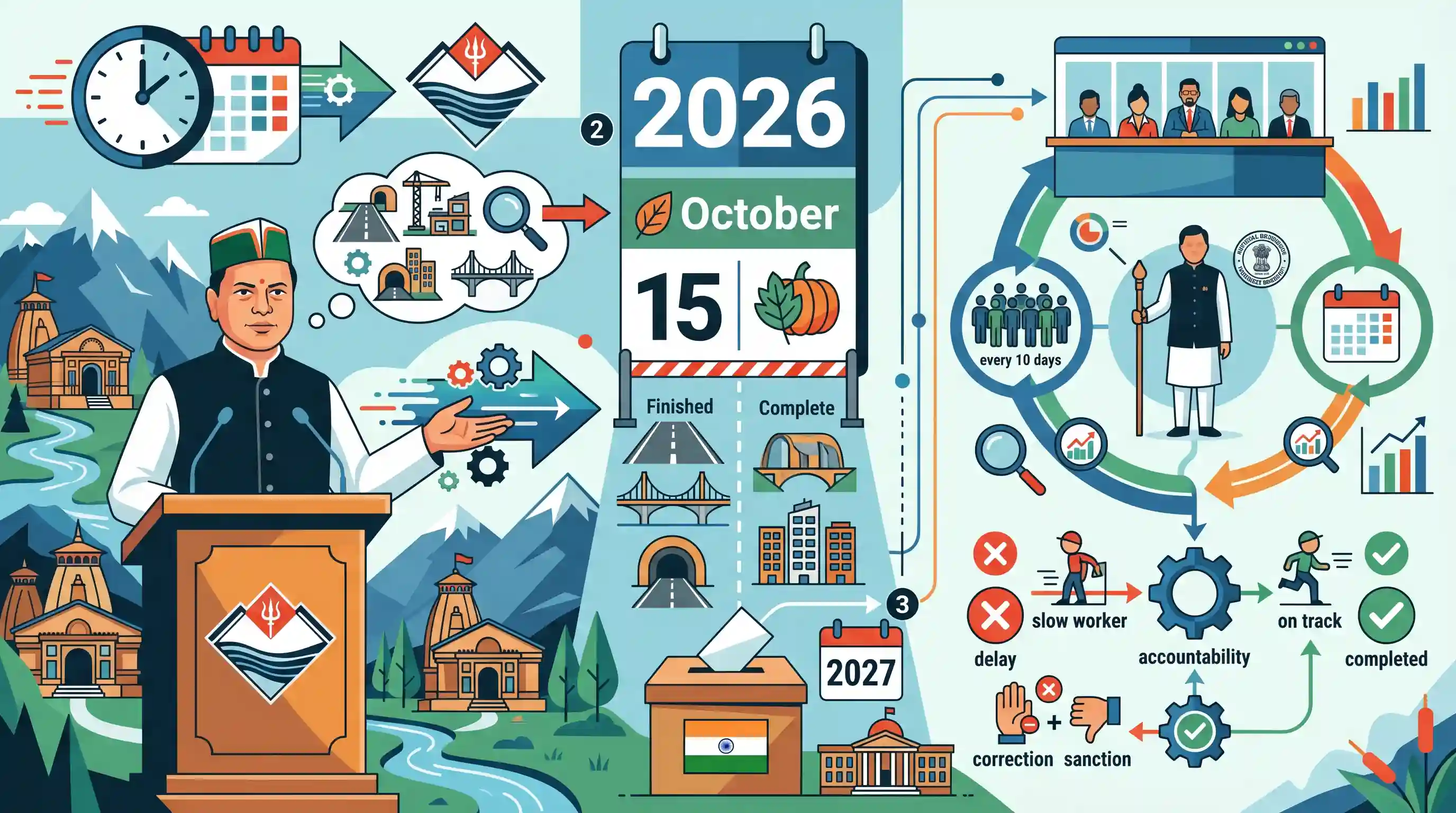
Uttarakhand Chief Minister Pushkar Singh Dhami has instructed state officials to expedite all ongoing infrastructure and construction projects, setting a strict completion deadline of October 15, 2026. This order aligns with preparations for the state legislative assembly elections scheduled for early 2027. To maintain oversight, high-level review meetings will be held every 10 days under the guidance of the Chief Secretary, and strict accountability will be enforced for any delays.
Key Points
- Uttarakhand Chief Minister Pushkar Singh Dhami directed officials to complete all ongoing construction projects in the state before October 15, 2026.
- The accelerated timeline is set in anticipation of the Uttarakhand State Assembly elections, which are likely to be held in early 2027.
- The CM mandated review meetings to be held every 10 days under the leadership of the Chief Secretary, in his presence, to closely monitor progress.
- For projects that are already over 50% complete, a strict deadline of October 15, 2026, has been established, and accountability will be fixed for any delays with strict actions against negligent officials.
Important Terms
Chief Secretary

The highest-ranking civil servant and administrative head of an Indian state, acting as the chief advisor to the Chief Minister and directing the state's administrative machinery.
UPSC context
GS Paper II (Polity/Governance): Tests state administrative structures, center-state coordination, and the role of civil services in democracy.
State Secretariat
The apex administrative headquarters of a state government in India, where political executives and career bureaucrats collaborate to formulate, coordinate, and monitor public policies.
UPSC context
GS Paper II (State Administration): Tests the structural functioning of state-level executives, policy formulation dynamics, and administrative coordination.
Model Code of Conduct
A set of guidelines issued by the Election Commission of India to regulate the conduct of political parties and candidates during elections, ensuring a level playing field.
UPSC context
GS Paper II (Electoral Processes): Tests mechanisms for free and fair elections, Article 324, and level playing field enforcement.
State Legislative Assembly
The directly elected lower house of a state legislature in India, responsible for lawmaking on state subjects, passing state budgets, and overseeing the state executive.
UPSC context
GS Paper II (State Legislature): Examines federal division of powers, legislative processes, and accountability of the executive.
Uttarakhand Government
The constitutional governing authority of Uttarakhand, consisting of an executive (Governor, Chief Minister, Cabinet), a unicameral legislature, and a regional judiciary.
UPSC context
GS Paper II (Polity & Federalism): Tests the application of constitutional federal principles and state governance mechanisms.
Prelims Trap
The Chief Secretary of a State is appointed by the Governor and has a legally fixed tenure of five years.
The Chief Secretary is selected directly by the Chief Minister and appointed in the Governor's name, but has no constitutionally or legally fixed tenure. UPSC often falsely claims they have a fixed tenure.
Static Concepts Connected
What is the constitutional status, role, and tenure of a State Chief Secretary?
- Appointment: He/she is chosen directly by the Chief Minister and formally appointed in the name of the Governor. It is an administrative, non-constitutional post.
- Tenure: The Chief Secretary does not have a constitutionally or legally fixed tenure and serves at the pleasure of the state executive.
- Role: Acts as the administrative head of the state secretariat, principal advisor to the Chief Minister, and head of the state cadre civil services.
What are the key changes introduced by the 104th Constitutional Amendment Act, 2019?
- Anglo-Indian Reservation: It ended the nomination-based reservation of seats for the Anglo-Indian community in both the Lok Sabha and State Legislative Assemblies.
- SC/ST Extension: It extended the reservation of seats for Scheduled Castes (SCs) and Scheduled Tribes (STs) in the Lok Sabha and State Assemblies until January 25, 2030.
Cross-Topic Patterns
Infrastructure CapEx and state electoral cycles
Analyzes how state governments accelerate capital expenditure (CapEx) and project deadlines in the immediate run-up to elections, often impacting state fiscal deficits.
Political executive vs administrative accountability
Explores the tension between political mandates (tight pre-election timelines) and administrative protocols, testing the neutrality and executive load of state civil services.

UPSC may test the comparative powers, appointment, and tenure rules of the State Chief Secretary versus the Union Cabinet Secretary.
Linked PYQs · 2
Linked PYQs · 2
- 2024UKPSC_PRELIMSGS1
How many of the following women M.L.A.s were there in the first Legislative Assembly of Uttarakhand ?
- 2024UKPSC_PRELIMSGS1
In which of the seven phases announced by the Election Commission of India for the General Elections-2024, the elections were held in Uttarakhand ?
