Uttarakhand CM Reviews Kanwar Yatra Crowd Management
Source:ani ↗
Why It Matters
The Kanwar Yatra and Char Dham Yatra are critical components of Uttarakhand's spiritual tourism and cultural heritage. Understanding the state's administrative responses—such as AI surveillance, deployment of SDRF/NDRF, and environmental drives like the plastic ban—is highly relevant for the UKPSC PCS Prelims, which frequently tests knowledge on state-specific governance, major festivals, and tourism infrastructure.
Summary
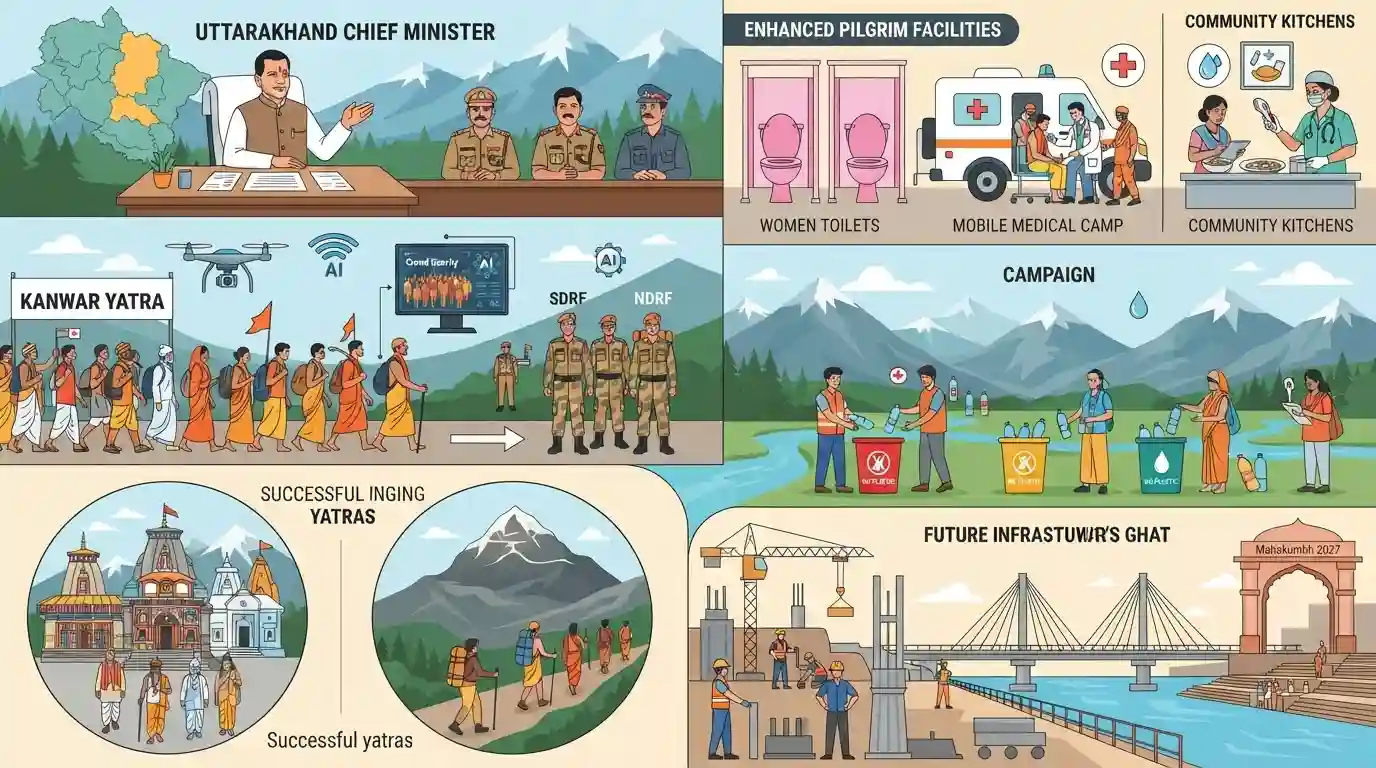
Uttarakhand Chief Minister Pushkar Singh Dhami directed officials to ensure comprehensive arrangements for the Kanwar Yatra starting July 30. The administration's strategy focuses on robust crowd management through AI and drone surveillance, deployment of SDRF and NDRF, and specialized traffic plans without VIP disruptions. Enhancing pilgrim facilities involves setting up pink toilets, medical camps, and monitoring food quality at community kitchens. A strict 'no-plastic' campaign will be enforced to maintain environmental sanctity. Additionally, the Chief Minister highlighted the successful ongoing Char Dham and Adi Kailash yatras and stressed that infrastructure projects for the upcoming Mahakumbh 2027 in Haridwar must progress efficiently alongside the Kanwar Yatra preparations.
Key Points
- Uttarakhand Chief Minister Pushkar Singh Dhami reviewed the preparations for the upcoming Kanwar Yatra, beginning on July 30, emphasizing adequate facilities for pilgrims (Kanwariyas).
- Key administrative measures include establishing pink toilets for women every 20-25 km, regular health camps, water ambulances, and ensuring strict food quality checks at hotels and community kitchens (bhandaras).
- To manage large crowds and ensure safety, the state will deploy SDRF, NDRF, and water police, complemented by a robust surveillance system using CCTV cameras, drones, and AI technologies.
- The administration is strictly enforcing a 'no-plastic' campaign along the Yatra route to maintain cleanliness and protect the environment.
- The state continues to focus on spiritual tourism, noting record footfall in the ongoing Char Dham and Adi Kailash yatras, while simultaneously gearing up infrastructure for the Haridwar Mahakumbh in 2027.
Important Terms
Kanwar Yatra

An annual Hindu pilgrimage during Shravan month where devotees (Kanwariyas) carry sacred Ganga water barefoot from holy sites to offer at local Shiva temples.
UPSC context
GS Paper I (Indian Culture) and GS Paper III (Disaster Management); tests knowledge of cultural traditions and crowd-management challenges.
Char Dham Yatra
A sacred Himalayan pilgrimage circuit in Uttarakhand consisting of four holy Hindu shrines: Yamunotri, Gangotri, Kedarnath, and Badrinath, visited traditionally in a clockwise direction.
UPSC context
GS Paper I (Art & Culture) and GS Paper III (Disaster Management); tests understanding of ecological-development dilemmas in fragile zones.
Mahakumbh 2027
A major Hindu congregation and pilgrimage scheduled in Haridwar for 2027, featuring mass ritual bathing (Shahi Snans) and extensive civic-spiritual infrastructure development.
UPSC context
GS Paper I (Indian Culture) and GS Paper III (Disaster Management); assesses administrative planning, infrastructure, and crowd logistics during mass gatherings.
National Disaster Response Force (NDRF)
A specialized, federal multi-disciplinary force constituted under the Disaster Management Act, 2005, tasked with delivering rapid, expert response to natural and man-made disasters.
UPSC context
GS Paper III (Disaster Management); evaluates knowledge of India’s legislative and institutional crisis-response frameworks.
State Disaster Response Force (SDRF)
A state-level disaster response unit in India, modeled after the NDRF, tasked with carrying out immediate local rescue, relief, and emergency coordination.
UPSC context
GS Paper III (Disaster Management); tests knowledge of decentralized disaster response mechanisms and state-level security execution.
Prelims Trap
"Adi Kailash is located in the trans-Himalayan region of Tibet."
Aspirants often confuse Adi Kailash (Uttarakhand, India) with Mount Kailash (Tibet, China). Adi Kailash lies in the Kumaon Himalayas near the Indo-Tibetan border.
Static Concepts Connected
What are the 4 venues of the Kumbh Mela and their respective rivers?
- Haridwar: Held on the banks of the Ganga river.
- Prayagraj: Held at the Triveni Sangam (confluence of Ganga, Yamuna, and the mythical Saraswati).
- Ujjain: Held on the banks of the Shipra river.
- Nashik: Held on the banks of the Godavari river.
What are the key pillars of NDMA's Crowd Management Guidelines?
- Capacity Planning: Assess venue limits to prevent spatial and structural overload.
- Tech Monitoring: Deploy CCTV, drones, and AI for real-time crowd density tracking and bottleneck identification.
- Risk Communication: Ensure clear public address systems and directional signage to avert panic-induced stampedes.
- Inter-agency Coordination: Establish clear coordination between police, medical teams (like water ambulances), and NDRF/SDRF units.
Cross-Topic Patterns
Eco-tourism vs. Carrying Capacity
The 'no-plastic' mandate links to recent Supreme Court and NGT concerns over exceeding the ecological carrying capacity of fragile Himalayan pilgrimage towns.
AI in Crowd Management
Deployment of AI and drone surveillance in religious yatras reflects a broader shift towards predictive disaster management and algorithmic crowd control under the NDMA framework.

Expect a GS3 mains question on managing religious tourism's footprint in the Himalayas, or a Prelims mapping pair on the Pancha Kailash.
Linked PYQs · 2
Linked PYQs · 2
- 2025UKPSC_PRELIMSGS1
As per Uttarakhand Budget 2025-26, the amount allocated for Char Dham Road network improvement is
- 2024UKPSC_PRELIMSGS1
UTDB is established in Uttarakhand to promote:
