Uttarakhand Chief Minister Completes Five Years and Sets 2035 Vision
Source:indiatoday ↗
Why It Matters
Understanding Uttarakhand's development plans (Vision 2035) and landmark legislative achievements (such as the UCC, anti-cheating and anti-conversion laws) is critical for UKPSC PCS aspirants, as these form a recurring theme in state-specific administrative and polity questions.
Summary
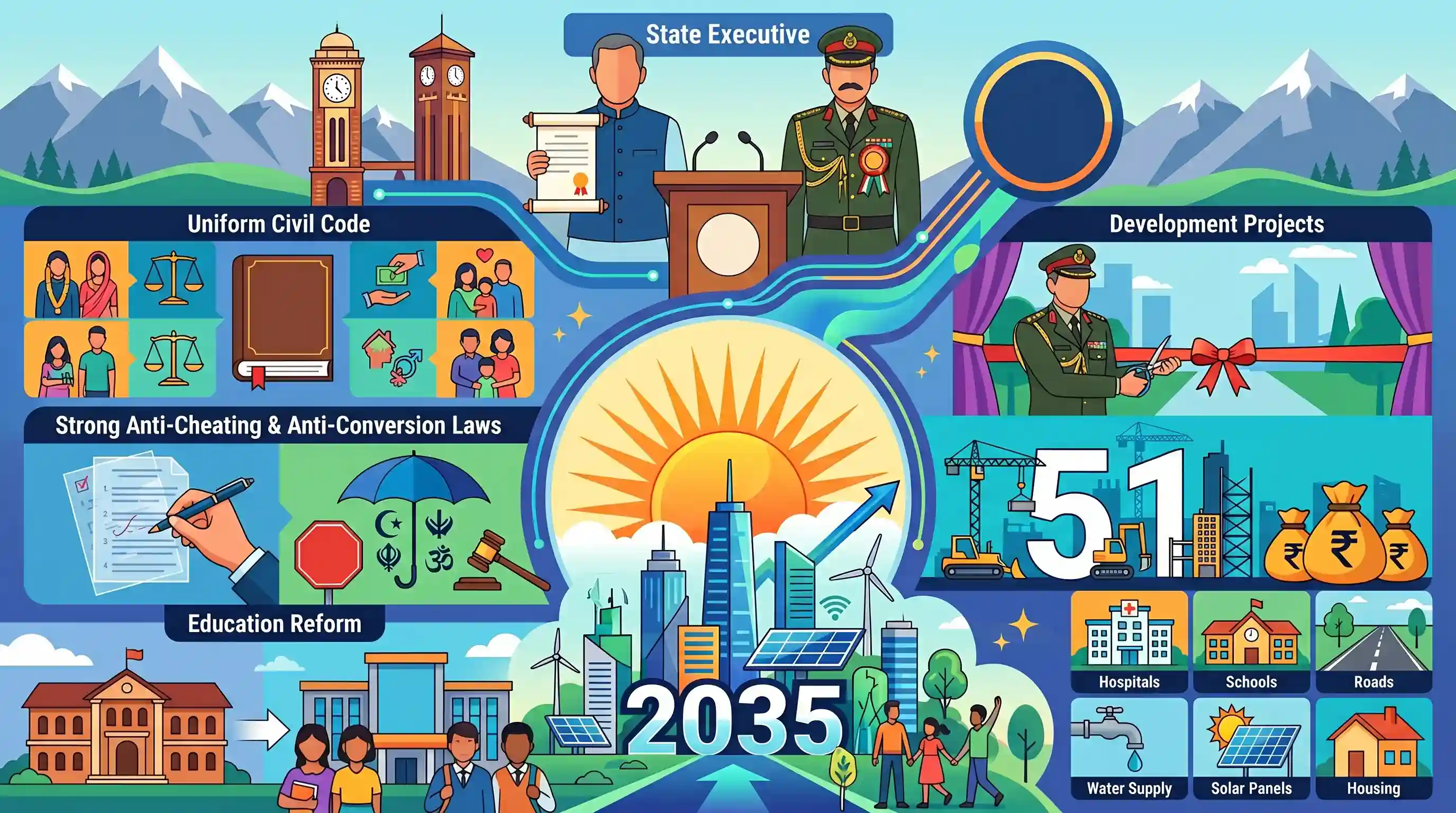
Uttarakhand Chief Minister Pushkar Singh Dhami celebrated completing five years in office (first assuming office on July 4, 2021) by setting a comprehensive development goal for the state to become fully developed and self-reliant by 2035. During the 'Seva, Sushasan evam Samarpan: Jan-Jan ki Sarkar, Jan-Jan ke Dwar' event in Rishikesh, the CM highlighted key legislative and administrative accomplishments, including implementing the Uniform Civil Code, enacting strong anti-cheating and anti-conversion laws, abolishing the Madrasa Board, and setting up the State Minority Education Authority. Governor Lt Gen (Retd) Gurmit Singh was also present to inaugurate 51 development projects valued at over Rs 219 crore in Dehradun.
Key Points
- Chief Minister Pushkar Singh Dhami completed five years in office on July 4, 2026, having first assumed the chief ministership on July 4, 2021.
- The CM announced a vision to make Uttarakhand a fully developed, self-reliant, and prosperous state by the year 2035.
- A public service campaign titled 'Seva, Sushasan evam Samarpan: Jan-Jan ki Sarkar, Jan-Jan ke Dwar' was launched in Rishikesh to boost grassroots-level good governance.
- Key policy initiatives highlighted include the passage of the landmark Uniform Civil Code (UCC), the abolition of the Madrasa Board, the establishment of the State Minority Education Authority, and the implementation of stringent anti-cheating and anti-conversion laws.
- Governor Lt Gen (Retd) Gurmit Singh and CM Dhami inaugurated and laid the foundation stones for 51 infrastructure and development projects worth Rs 219 crore in Dehradun.
Important Terms
Uniform Civil Code (UCC)

A common set of personal laws governing civil matters like marriage, divorce, and inheritance for all citizens, replacing religion-specific personal laws as envisioned under Article 44 of the Constitution.
UPSC context
GS Paper II: Indian Constitution and DPSP. Tests understanding of secularism, gender justice, and federal-state dynamics in personal laws.
Uttarakhand Competitive Examination (Measures for Prevention and Redressal of Unfair Means in Recruitment) Ordinance, 2023
A stringent state-level anti-cheating law that penalizes paper leaks and organized exam malpractices with severe punishments, including life imprisonment and multi-crore fines, to ensure recruitment transparency.
UPSC context
GS Paper II: Governance and Civil Services. Tests administrative measures to prevent corruption and maintain transparency in public examination systems.
Viksit Bharat
The national developmental vision aiming to transform India into a fully developed, high-income, and self-reliant economy by its centenary of independence in 2047.
UPSC context
GS Paper III: Indian Economy. Tests economic planning, growth targets, structural reforms, and challenges like the middle-income trap.
Uttarakhand State Minority Education Authority
A unified state regulatory body established in Uttarakhand that replaced the Madrasa Board to administer, recognize, and standardize schools run by all six notified minority communities.
UPSC context
GS Paper II: Social Justice and Education. Tests state regulatory reforms in minority education rights under Article 30 and NEP implementation.
Prelims Trap
The Uttarakhand UCC applies uniformly to all residents, including Scheduled Tribes, and was enacted solely via the Governor's assent under Article 200.
The UCC explicitly excludes STs. Also, because it conflicted with central personal laws (Concurrent List), the Governor could not directly assent; it required reservation for the President's assent under Article 201.
Static Concepts Connected
What are the constitutional rules governing the reservation of state bills for the President?
- Discretionary power: Under Article 200, the Governor can reserve a bill for the President if it conflicts with Central laws on Concurrent topics, violates the Constitution, or opposes DPSPs.
- Mandatory reservation: The Governor must reserve any state assembly bill that threatens the constitutional position and powers of the state High Court.
- Article 201 power: Once a bill is reserved, the President can either give assent, withhold assent, or direct the Governor to return it to the state legislature under Article 201.
How does Article 44 interface with the constitutional rights of Scheduled Tribes?
- DPSP Status: Article 44 directs the State to secure a Uniform Civil Code for all citizens, but it is a non-justiciable DPSP and cannot override fundamental rights directly.
- Special Protections: Articles like 371A (Nagaland) and 371G (Mizoram), alongside the Sixth Schedule, explicitly protect tribal customary laws from central/state interference in civil matters.
- Exclusion Mechanisms: State-level implementations must carve out explicit exclusions for Scheduled Tribes (notified under Article 342) to prevent legal and constitutional challenges.
Cross-Topic Patterns
Concurrent List & State-level Civil Codes
Personal laws fall under Concurrent List Entry 5. States can enact distinct civil codes, but they require Presidential assent under Article 254(2) if they conflict with existing Union-level personal laws.
Article 30 vs. State Regulatory Supremacy
The dissolution of religious school boards tests the fine line between the state's regulatory power under NEP 2020 and minorities' rights to administer educational institutions under Article 30.

Expect a multi-statement question on Article 201 assent mechanisms and the constitutional exemptions granted to Scheduled Tribes under state civil laws.
Linked PYQs · 4
Linked PYQs · 4
- 2025UKPSC_PRELIMSGS1
Consider the following statements with reference to Uttarakhand and choose the correct answer: 1. The executive of Uttarakhand includes Governor as the head of the state. 2. It also includes the Chief Minister and his/her council of ministers.
- 2024UKPSC_PRELIMSGS1
Who among the following was the first Chief Minister of Uttarakhand ?
- 2025UKPSC_PRELIMSGS1
Which among the following pairs is correctly matched? 1. Chairman of First Finance Commission - Nityanand Swami 2. First Advocate General of Uttarakhand - Nanda Ballabh Tiwari 3. First Chief Minister of Uttarakhand - Indu Kumar Pandey 4. First Woman Governor of Uttarakhand - Margaret Alva
- 2024UKPSC_PRELIMSGS1
Regarding the Directive Principles of State Policy, which one of the following statements is not correct ?
