Second phase of single women selfemployment scheme rolled out in state
Source:uttarakhandtribune ↗
Why It Matters
State-specific welfare schemes are highly relevant for UKPSC PCS Prelims. Understanding the financial structure (75% subsidy), target demographic (single women 21-50), and implementing department is crucial for factual scheme-based questions in the state exam.
Summary
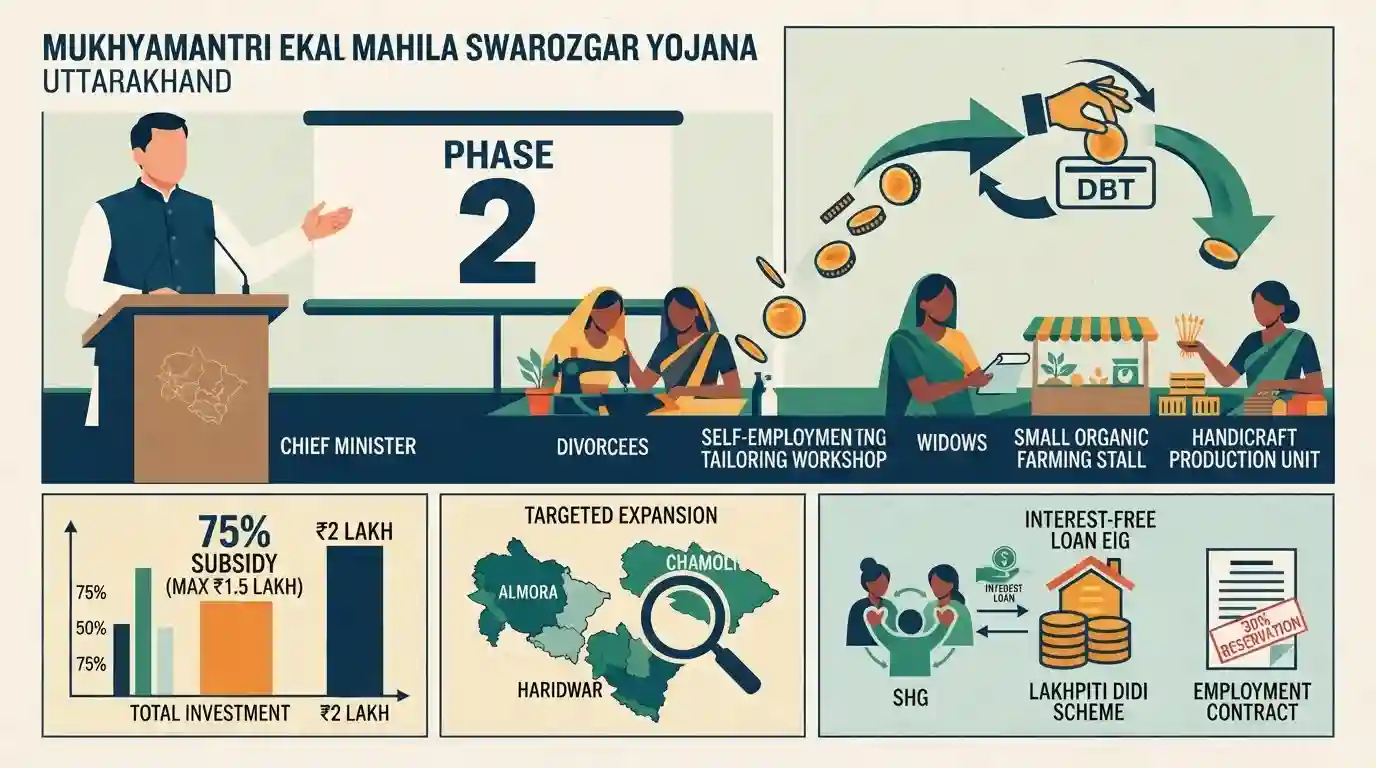
Uttarakhand Chief Minister Pushkar Singh Dhami launched Phase 2 of the Mukhyamantri Ekal Mahila Swarozgar Yojana, a major initiative by the Women Empowerment and Child Development Department. Aimed at fostering self-reliance among single women aged 21-50—including widows, divorcees, and victims of crime—the scheme provides up to ₹2 Lakh for establishing self-employment ventures with a 75% subsidy (maximum ₹1.5 Lakh) via DBT. The expansion covers districts like Almora, Chamoli, and Haridwar. The initiative aligns with broader state efforts for women's empowerment, including the Lakhpati Didi Scheme, interest-free SHG loans, and 30% horizontal reservation in state employment.
Key Points
- Uttarakhand Chief Minister Pushkar Singh Dhami launched Phase 2 of the Mukhyamantri Ekal Mahila Swarozgar Yojana in Dehradun.
- The scheme targets financial independence for single, widowed, divorced, and marginalized women aged 21-50 by supporting self-employment ventures.
- Beneficiaries receive a maximum project cost of ₹2 Lakh with a 75% state subsidy (up to ₹1.5 Lakh) deposited directly via Direct Benefit Transfer (DBT).
- Phase 2 expands the scheme to various districts including Almora, Champawat, Chamoli, Haridwar, Rudraprayag, Pithoragarh, Uttarkashi, and Dehradun.
- The government also highlighted complementary initiatives such as the Lakhpati Didi Scheme, interest-free loans to SHGs, and a 30% horizontal reservation for women in state government jobs.
Important Terms
Mukhyamantri Ekal Mahila Swarozgar Yojana

An Uttarakhand state scheme providing financial assistance of up to ₹2 Lakh, with a 75% subsidy, to help single, destitute, and marginalized women aged 21-50 establish self-employment ventures.
UPSC context
GS Paper II (Social Justice); tests understanding of targeted state welfare, livelihood support, and gender-inclusive economic empowerment.
Lakhpati Didi Scheme
A national initiative under DAY-NRLM (Ministry of Rural Development) aiming to empower rural women members of Self-Help Groups to earn a sustainable annual household income of at least ₹1 Lakh.
UPSC context
GS Paper II & III (Welfare Schemes, Rural Development); tests knowledge of central economic interventions and poverty alleviation strategies.
Horizontal Reservation
An allocation of opportunities (such as for women, veterans, or disabled persons) that applies across vertical reservation categories (SC, ST, OBC), ensuring equal representation within each category.
UPSC context
GS Paper II (Polity & Constitution); tests conceptual understanding of affirmative action, equality of opportunity, and Article 16.
Self Help Groups (SHGs)
Informal, voluntary associations of individuals (typically rural women) who pool their financial resources to access credit, foster financial literacy, and undertake collective livelihood activities.
UPSC context
GS Paper II & III (Governance, Social Justice, Rural Development); tests grassroot mobilization, microfinance architecture, and community-led empowerment models.
Direct Benefit Transfer (DBT)
A technology-driven reform that transfers government subsidies and welfare payments directly into the bank accounts of beneficiaries, reducing leakages, intermediaries, and administrative delays.
UPSC context
GS Paper II & III (Governance, Economic Development); tests knowledge of public service delivery reforms, digital governance, and fiscal efficiency.
Prelims Trap
Horizontal reservations (e.g., for women) are provided over and above vertical quotas, increasing the total overall reservation percentage.
Horizontal reservation (Article 15(3)) cuts across vertical categories. It does not add to the 50% ceiling; candidates are adjusted within their respective vertical quotas (SC/ST/OBC/UR).
Static Concepts Connected
How do horizontal and vertical reservations differ constitutionally?
- Vertical Quotas: Derived from Article 16(4), these apply to distinct social groups (SC, ST, OBC) as standalone, cumulative compartments subject to ceiling limits.
- Horizontal Quotas: Derived from Article 15(3), these apply across categories (women, PwD, veterans) as 'interlocking reservations' fulfilled from within the vertical compartments.
- Judicial Precedent: The Supreme Court (Saurav Yadav v. UP, 2020) clarified that horizontal quota candidates who score highly can migrate to the open/general category.
What is the Lakhpati Didi initiative under DAY-NRLM?
- Target Demographic: Aims to empower rural Self-Help Group (SHG) women by elevating their economic status to 'Lakhpatis'.
- Income Benchmark: Ensures a sustained annual household income of at least ₹1,00,000.
- Measurement Metric: Income is measured over at least four agricultural seasons or business cycles to guarantee a sustained average monthly income above ₹10,000.
Cross-Topic Patterns
State welfare as localized policy laboratories
State-led localized schemes for vulnerable women often act as micro-laboratories for broader Central models, serving as excellent case studies for GS2 decentralized governance and GS1 women empowerment answers.
SHGs evolving into public utility managers
Integrating self-employment funds with state utilities (like Uttarakhand's 'Jalsakhi' managing water distribution) signals a shift of SHGs from mere micro-credit bodies to active pillars of local public service delivery.

Expect a 2026 GS2 Prelims/Mains question on the constitutional mechanics of horizontal vs. vertical reservations spurred by state women quotas.
Linked PYQs · 4
Linked PYQs · 4
- 2025UKPSC_PRELIMSGS1
Arrange the following social welfare schemes in chronological order: i. Integrated Rural Development Programme (IRDP) ii. Rural Employment Generation Programme (REGP) iii. Prime Minister Rojgar Yojana (PMRY) iv. Rural Landless Employment Guarantee Programme (RLEGP)
- 2024UKPSC_PRELIMSGS1
How many of the following women M.L.A.s were there in the first Legislative Assembly of Uttarakhand ?
- 2024UKPSC_PRELIMSGS1
As per census 2011, which of the following district of Uttarakhand had lowest female literacy rate ?
- 2025UKPSC_PRELIMSGS1
Which of the following groups of districts of Uttarakhand is correct in descending order of sex-ratio according to the Census of India 2011?
