Public Grievance Redressal and REAP Scheme Implementation Camp
Source:bignewsnetwork ↗
Why It Matters
Understanding state-specific governance models and rural livelihood schemes (like the REAP project) is crucial for the UKPSC PCS Prelims, especially concerning topics on social justice, the empowerment of vulnerable sections, and SHG-led rural enterprise acceleration.
Summary
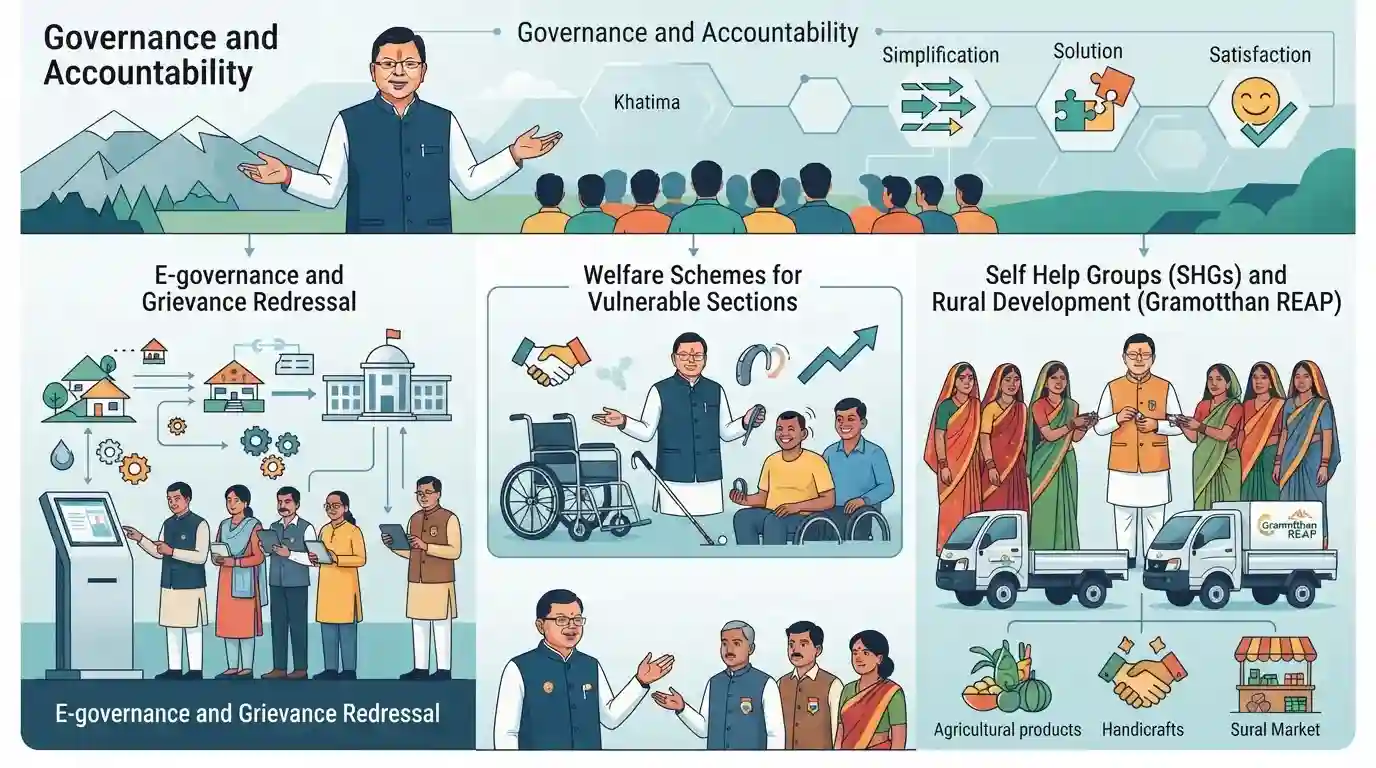
Uttarakhand Chief Minister Pushkar Singh Dhami held a public grievance redressal camp in Khatima, promoting the state's governance model based on 'Simplification, Solution, and Satisfaction'. During the event, he distributed assistive devices to persons with disabilities to enhance their mobility and self-reliance. Additionally, under the Gramotthan Rural Enterprise Acceleration Project (REAP), keys for utility vehicles were provided to cluster-level federations, aiming to strengthen Self-Help Groups (SHGs), boost rural livelihoods, and empower women. The Chief Minister also instructed local officials to ensure prompt and transparent resolution of citizen issues at the grassroots level.
Key Points
- Uttarakhand Chief Minister Pushkar Singh Dhami addressed public grievances in Khatima, emphasizing the governance mantra of 'Simplification, Solution, and Satisfaction' for effective administration.
- Assistive devices, including modern motorized tricycles, wheelchairs, hearing aids, and walking sticks, were distributed to empower Divyangjans (persons with disabilities).
- Under the Gramotthan REAP (Rural Enterprise Acceleration Project) scheme, utility vehicle keys were distributed to cluster-level federations to support local Self-Help Groups (SHGs).
- The REAP scheme aims to boost the rural economy, promote women's empowerment, and enhance the livelihood opportunities of rural entrepreneurs.
Important Terms
Gramotthan REAP (Rural Enterprise Acceleration Project)

An Uttarakhand government initiative, supported by IFAD, aimed at boosting rural livelihoods, stemming migration, and doubling the incomes of low-income families through financial assistance and training for micro-enterprises.
UPSC context
GS Paper 2 & 3 (Welfare Schemes/Rural Economy). Tests knowledge of state-level poverty alleviation and rural entrepreneurship programs.
Self-Help Groups (SHGs)
Small, informal associations of individuals, typically from marginalized backgrounds, who voluntarily come together to pool savings, access micro-credit, and collectively address economic and social challenges to achieve self-reliance.
UPSC context
GS Paper 2 (Role of SHGs). Essential for topics on grassroots mobilization, microfinance, women's empowerment, and poverty alleviation.
Cluster Level Federations (CLFs)
An apex organizational network comprising multiple Self-Help Groups (SHGs) within a geographic cluster. They pool resources, enhance negotiating power, and manage community investment funds to scale up local empowerment.
UPSC context
GS Paper 2 (Governance/Institutions). Tests understanding of multi-tiered decentralized structures under schemes like the National Rural Livelihoods Mission (NRLM).
Prelims Trap
Gramotthan REAP is a Central Sector Scheme fully funded by the Union Government under DAY-NRLM.
Gramotthan REAP is a state-led project funded in partnership with the International Fund for Agricultural Development (IFAD), a UN specialized agency.
Static Concepts Connected
What is the three-tier institutional structure of Self Help Groups (SHGs) under DAY-NRLM?
- SHG (Base Level): Typically 10-20 women from economically homogenous backgrounds formed at the village level to encourage thrift and credit.
- Village Organization (VO): A federation of primary SHGs at the village or gram panchayat level to coordinate activities and manage broader social issues.
- Cluster-Level Federation (CLF): A higher-level federation of VOs at the block or cluster level designed to handle larger economic scale, market linkages, and enterprise acceleration.
What is the International Fund for Agricultural Development (IFAD)?
- Origin: A Rome-based UN specialized agency and International Financial Institution established in 1977 following the 1974 World Food Conference.
- Core Mandate: To eradicate rural poverty, increase food security, and improve nutrition in developing nations through low-interest loans and grants.
- India's Role: India is a founding member and a major recipient of IFAD project funding, partnering frequently on state-level rural livelihood projects.
Cross-Topic Patterns
Distress Migration + SHG Livelihoods
State-led SHG interventions are increasingly framed not just as poverty alleviation, but as critical demographic tools to reverse hill-state distress out-migration by generating localized economic opportunities.
Lakhpati Didi + State Policy Convergence
National initiatives like 'Lakhpati Didi' rely directly on state-level infrastructural upgrades—like providing utility vehicles to Cluster-Level Federations—to operationalize market access and scale up rural enterprises.

The structural linkage between UN agencies (IFAD), local SHG networks (CLFs), and target-based schemes (Lakhpati Didi) is highly testable.
Linked PYQs · 3
Linked PYQs · 3
- 2025UKPSC_PRELIMSGS1
Consider the following statements about Uttarakhand Human Rights Commission and choose the correct option from the options given below: 1. Uttarakhand Human Rights Commission came into existence on May 13, 2013. 2. The objectives of UHRC was to bring about greater accountability and transparency in governance.
- 2025UKPSC_PRELIMSGS1
Arrange the following social welfare schemes in chronological order: i. Integrated Rural Development Programme (IRDP) ii. Rural Employment Generation Programme (REGP) iii. Prime Minister Rojgar Yojana (PMRY) iv. Rural Landless Employment Guarantee Programme (RLEGP)
- 2025UKPSC_PRELIMSGS1
Which programme was approved by the Union Cabinet in April, 2025 to develop border villages ?
