Uttarakhand Flags Off Special Pilgrimage Train for Somnath
Source:indiagazette ↗
Why It Matters
This article highlights major administrative, legislative, and cultural developments in Uttarakhand. For UKPSC Prelims, understanding state-specific initiatives like the UCC (Uttarakhand being the first post-independence state to pass it), the transition of the Madrasa Board to the State Minority Education Authority, and pilgrimage tourism circuits (Kedarkhand, Manaskhand, Haripur Kalsi) is highly relevant as state-centric governance, history, and culture feature heavily in the exam.
Summary
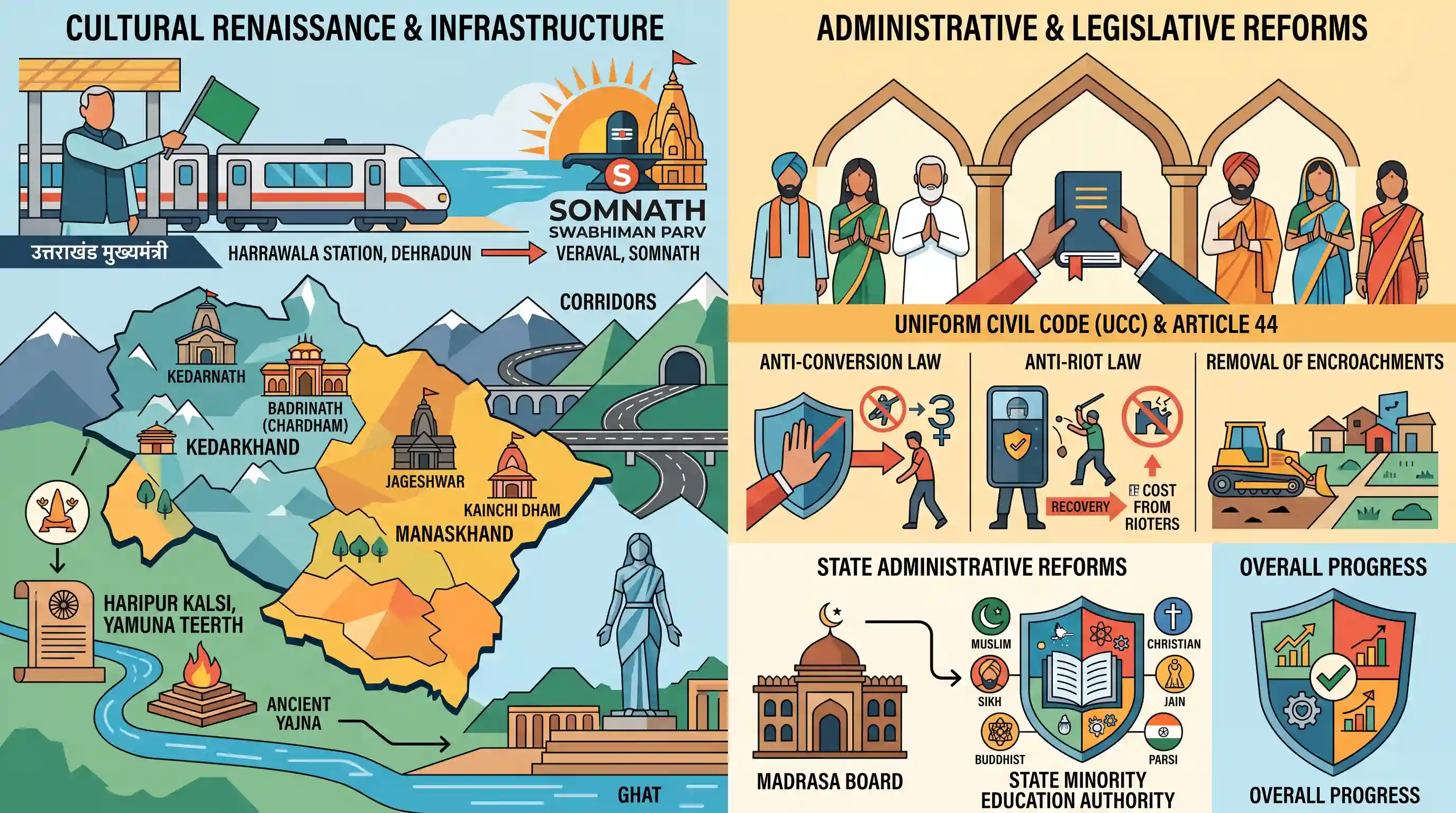
Uttarakhand Chief Minister Pushkar Singh Dhami flagged off a special train from Harrawala Railway Station in Dehradun to Veraval on the occasion of the 'Somnath Swabhiman Parv'. The initiative reflects a broader push by the state and central governments toward cultural renaissance, including the development of Kedarkhand and Manaskhand temple circuits, the restoration of Yamuna Teerth at Haripur Kalsi, and infrastructure corridors. The Chief Minister also highlighted major administrative and legislative milestones of his government, including the implementation of the Uniform Civil Code (UCC), stringent anti-conversion and anti-riot laws, the removal of encroachments, and the establishment of the Uttarakhand State Minority Education Authority to replace the Madrasa Board.
Key Points
- Uttarakhand Chief Minister Pushkar Singh Dhami flagged off a special pilgrimage train carrying nearly 700 devotees from Harrawala Railway Station in Dehradun to Veraval (Somnath), Gujarat, under the 'Somnath Swabhiman Parv' initiative.
- The pilgrimage group comprises women from Self-Help Groups (SHGs), government scheme beneficiaries, saints, and representatives of various social groups, serving as cultural ambassadors of Uttarakhand's spiritual heritage.
- The state government is actively developing the Kedarkhand (Garhwal region) and Manaskhand (Kumaon region) temple circuits, alongside restoring the historical Yamuna Teerth at Haripur Kalsi. Kalsi is highly significant as the site of Ashoka's major rock edicts.
- Major corridor projects such as the Haridwar-Rishikesh Corridor and the Sharda Corridor are underway to enhance religious tourism infrastructure in Uttarakhand. Additionally, a Centre for Hindu Studies has been established at Doon University, Dehradun.
- In terms of legislative and administrative reforms, Uttarakhand is the first state in independent India to implement the Uniform Civil Code (UCC) to ensure equal legal standards for all citizens.
- The state has also enacted stringent anti-conversion and anti-riot laws, reclaimed over 13,000 acres of government land from illegal encroachment, and established the Uttarakhand State Minority Education Authority in place of the Madrasa Board to reform religious-educational administration.
Important Terms
Uniform Civil Code (UCC)

A common set of civil laws governing personal matters like marriage, divorce, inheritance, and adoption for all citizens, replacing distinct religion-based personal laws.
UPSC context
GS Paper II (Polity & Governance) - Article 44 (DPSP), federalism, gender justice, and personal law codification.
Somnath Swabhiman Parv
A cultural commemoration marking 1,000 years since the first invasion of Somnath Temple (1026 CE) and 75 years since its post-Independence reconstruction and restoration (1951 CE).
UPSC context
GS Paper I (Art & Culture) - temple architecture (Somnath), medieval history, and cultural heritage revival.
Manaskhand Temple Circuit
A connectivity and infrastructure initiative to develop, beautify, and link ancient temples in Uttarakhand’s Kumaon region, promoting spiritual tourism and local livelihoods.
UPSC context
GS Paper I (Art & Culture) & GS Paper III (Tourism) - regional connectivity, heritage conservation, and economic growth.
Sharda Corridor
A multi-phase infrastructure and spiritual project rejuvenating the Sharda Riverfront in Tanakpur, combining eco-sensitivity, flood-protection, tourism, and border-region economic growth.
UPSC context
GS Paper III (Infrastructure & Disaster Management) - sustainable riverfront development, border connectivity, and disaster resilience.
Anti-riot Law
A stringent legislative framework allowing the government to recover the costs of public and private property damage directly from rioters and their accomplices.
UPSC context
GS Paper II (Polity & Governance) - law and order, legislative deterrence, and protection of public infrastructure.
Anti-conversion Law
Legislation that criminalizes religious conversions carried out through force, misrepresentation, fraud, coercion, allurement, or under false identity for marriage.
UPSC context
GS Paper II (Fundamental Rights) - Article 25 (Freedom of Religion), state legislative power, and individual liberties.
Prelims Trap
The Uttarakhand Uniform Civil Code (UCC) applies uniformly to all communities and tribes residing within the state without exception.
The Uttarakhand UCC Act, 2024, explicitly exempts Scheduled Tribes (notified under Article 342 of the Constitution) from its jurisdiction to protect their customary rights.
Static Concepts Connected
What is the historical and epigraphical significance of the Kalsi Rock Edict?
- Location and Completeness: Located in Dehradun (Uttarakhand) at the Yamuna-Tons confluence, it is the only site in North India holding a complete set of Ashoka's 14 Major Rock Edicts.
- Language and Script: The inscriptions are carved on quartz rock, written in the Prakrit language using the ancient Brahmi script.
- Edict XIII Content: It records Ashoka's remorse over the Kalinga War, his conversion to Buddhism, and names five contemporary Hellenistic (Greek) kings to whom he sent Dhamma envoys.
What is the constitutional and legislative framework of the Uniform Civil Code (UCC)?
- Constitutional Directive: Article 44 of the Constitution (Part IV, DPSP) directs the State to secure a Uniform Civil Code for all citizens throughout the territory of India.
- Legislative Jurisdiction: Personal laws (marriage, divorce, inheritance, succession) fall under Entry 5 of the Concurrent List (Seventh Schedule), enabling both Parliament and State Legislatures to enact laws.
- Judicial Stance: The Supreme Court in landmark rulings like Shah Bano (1985) and Sarla Mudgal (1995) has consistently urged the state to implement Article 44 to foster national integration.
Cross-Topic Patterns
Temple corridors + Federal infrastructure integration
Connecting regional religious circuits (like Manaskhand) with inter-state rail networks aligns cultural diplomacy with federal transport infrastructure, driving local economic growth.
Article 30 + Minority educational administration
Replacing sectarian boards with unified state minority authorities tests the constitutional balance between state regulatory oversight and Article 30 minority administrative rights.

Uttarakhand's UCC tribal exemptions and Kalsi's Ashokan rock edict features are likely to be tested via multi-statement prelims questions.
Linked PYQs · 3
Linked PYQs · 3
- 2024UKPSC_PRELIMSGS1
UTDB is established in Uttarakhand to promote:
- 2025UKPSC_PRELIMSGS1
The Silkyara Tunnel spanning ______ is expected to shorten the distance between Gangotri and Yamunotri above 20 km .
- 2025UKPSC_PRELIMSGS1
Consider the following statements with reference to Uttarakhand and choose the correct answer: 1. The executive of Uttarakhand includes Governor as the head of the state. 2. It also includes the Chief Minister and his/her council of ministers.
