Uttarakhand CM Distributes Appointment Letters to Candidates
Source:awazthevoice ↗
Why It Matters
Understanding governance reforms, anti-corruption policies like the Anti-Copying Law, and the constitutional architecture of State Public Service Commissions (Article 315-323) is crucial for both SPSC and civil services examinations covering state polity and administrative systems.
Summary
Uttarakhand Chief Minister Pushkar Singh Dhami handed over appointment letters to 182 successful UKPSC PCS 2024 candidates. He emphasized four administrative principles—Simplification, Resolution, Disposal, and Public Satisfaction—to ensure efficient service delivery. The Chief Minister highlighted the state's 2023 strict Anti-Copying Law as a benchmark for transparency in public recruitment, while reiterating the state’s focus on leveraging youth potential and water resources to check migration and achieve PM Modi's vision of 'Uttarakhand's decade'.
Key Points
- Uttarakhand Chief Minister Pushkar Singh Dhami distributed appointment letters to 182 candidates selected through the UKPSC PCS Main Examination-2024 and 5 selected as Personal Assistants in the Agriculture Department.
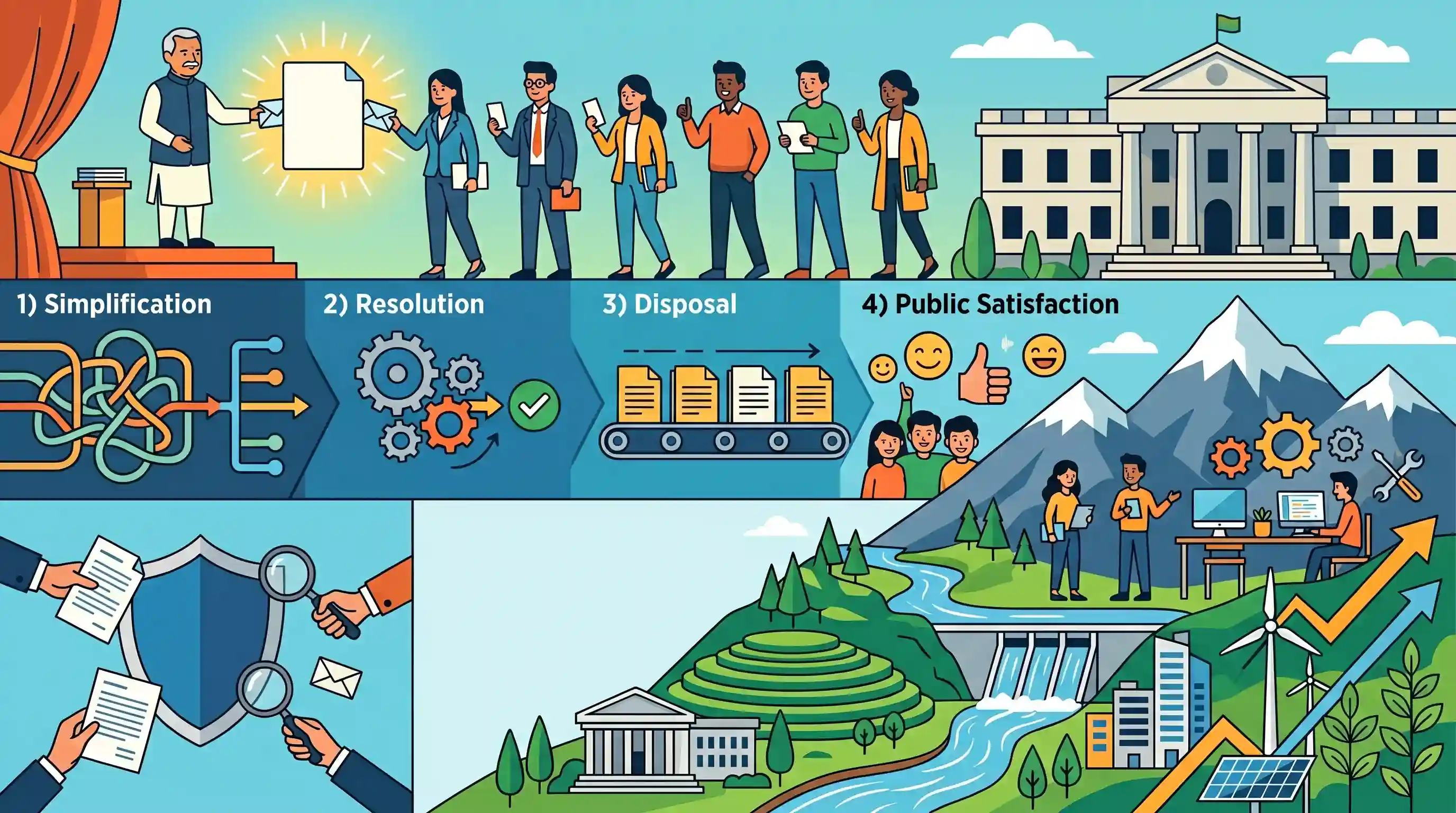
- The CM highlighted the four core pillars of the state's governance and administrative machinery: Simplification, Resolution, Disposal, and Public Satisfaction (सरलीकरण, समाधान, निस्तारण, जन-संतुष्टि).
- He emphasized the role of Uttarakhand's strict anti-copying law (enacted in 2023) in restoring the credibility and transparency of the recruitment process, which helped over 34,000 youths secure government jobs in the past four and a half years.
- Reflecting on Prime Minister Narendra Modi's declaration from Kedarnath, he urged newly appointed officers to translate the vision of making the third decade of the 21st century 'Uttarakhand's decade' into reality.
- The state's development model focuses on stopping youth migration by creating employment opportunities matching local talent and leveraging Uttarakhand's prime assets: water resources and youth potential.
Important Terms
Uttarakhand Competitive Examination (Measures for Prevention and Redressal of Unfair Means in Recruitment) Act, 2023

A stringent state legislation enacted in Uttarakhand that imposes severe penalties, including life imprisonment and fines up to ₹10 crores, to prevent cheating, paper leaks, and other malpractices in public examinations.
UPSC context
GS Paper II (Governance and Public Services); tests candidate awareness of administrative and legal reforms aimed at ensuring transparency in public recruitments.
Uttarakhand Public Service Commission
The state-level constitutional body established under Article 315 on May 15, 2001, to conduct examinations and recruit candidates for various civil services and departmental positions in Uttarakhand.
UPSC context
GS Paper II (Constitutional Bodies); tests understanding of state-level recruitment agencies, their structure, autonomy, and role in public administration.
State Public Service Commission
A constitutional body established in each Indian state under Article 315 of the Constitution to recruit officers for state-level civil services and advise the governor on civil service matters.
UPSC context
GS Paper II (Constitutional Bodies); tests detailed knowledge of SPSC composition, appointment, removal, and role in federal administrative structure.
Department of Agriculture and Farmers' Welfare
A state government department responsible for implementing agricultural schemes, enhancing crop productivity, supporting farmers, and driving rural economic growth across Uttarakhand's diverse terrain.
UPSC context
GS Paper III (Agriculture and Socio-Economic Development); tests familiarity with institutional mechanisms for rural development, agrarian reforms, and employment in hill states.
Prelims Trap
The Chairman and members of a State Public Service Commission can be suspended and removed from office by the state Governor.
While the state Governor appoints SPSC members under Article 316, only the President can remove them under Article 317, following a Supreme Court reference.
Static Concepts Connected
What constitutional safeguards ensure the structural independence of a State Public Service Commission (SPSC)?
- Removal power restricted: SPSC members are appointed by the Governor but can only be removed by the President of India under strict constitutional grounds.
- Charged expenditure: Entire SPSC expenditure, including salaries and pensions, is charged on the Consolidated Fund of the State and is non-votable.
- No re-appointment: SPSC chairpersons and members are ineligible for re-appointment to the same post after completing their six-year or 62-year tenure.
What is the 'Ghost Villages' phenomenon and how does a Migration Commission address it?
- Ghost villages defined: Refers to completely abandoned, uninhabited villages (bhootia gaon) in hill regions resulting from systemic socio-economic out-migration.
- Migration Commission role: A specialized state body that maps out-migration trends and advises on region-specific livelihood strategies to reverse demographic distress.
- Targeted convergence schemes: Combines micro-entrepreneurship, ecological tourism, and sustainable hill agriculture to incentivize local youth to remain in hill districts.
Cross-Topic Patterns
Exam Integrity + Article 16 Equal Opportunity
Severe anti-copying laws safeguard Article 16's promise of equal employment opportunity by dismantling illicit cartels that distort meritocratic public recruitment processes.
Migration + Himalayan Ecological Fragility
Mass out-migration from Himalayan border villages creates security vulnerabilities and economic voids, necessitating climate-resilient local employment and ecological services evaluation.

UPSC may test the structural independence of SPSCs, focusing on the Governor's appointment power vs the President's exclusive removal power.
Linked PYQs · 1
Linked PYQs · 1
- 2012UKPSC_PRELIMSGS1
Who among the following is not appointed by the State Governor?
