Kailash Mansarovar Yatra First Batch Flagged Off from Tanakpur
Source:newsonair ↗
Why It Matters
The Kailash Mansarovar Yatra via the Tanakpur route in Champawat showcases the convergence of spiritual tourism, regional economic development, and border-area security. It highlights the strategic role of Uttarakhand's border districts (such as Champawat) and the State's policy focus on promoting indigenous crafts through 'Vocal for Local' and enhancing tourism infrastructure via statutory bodies like the UTDB.
Summary
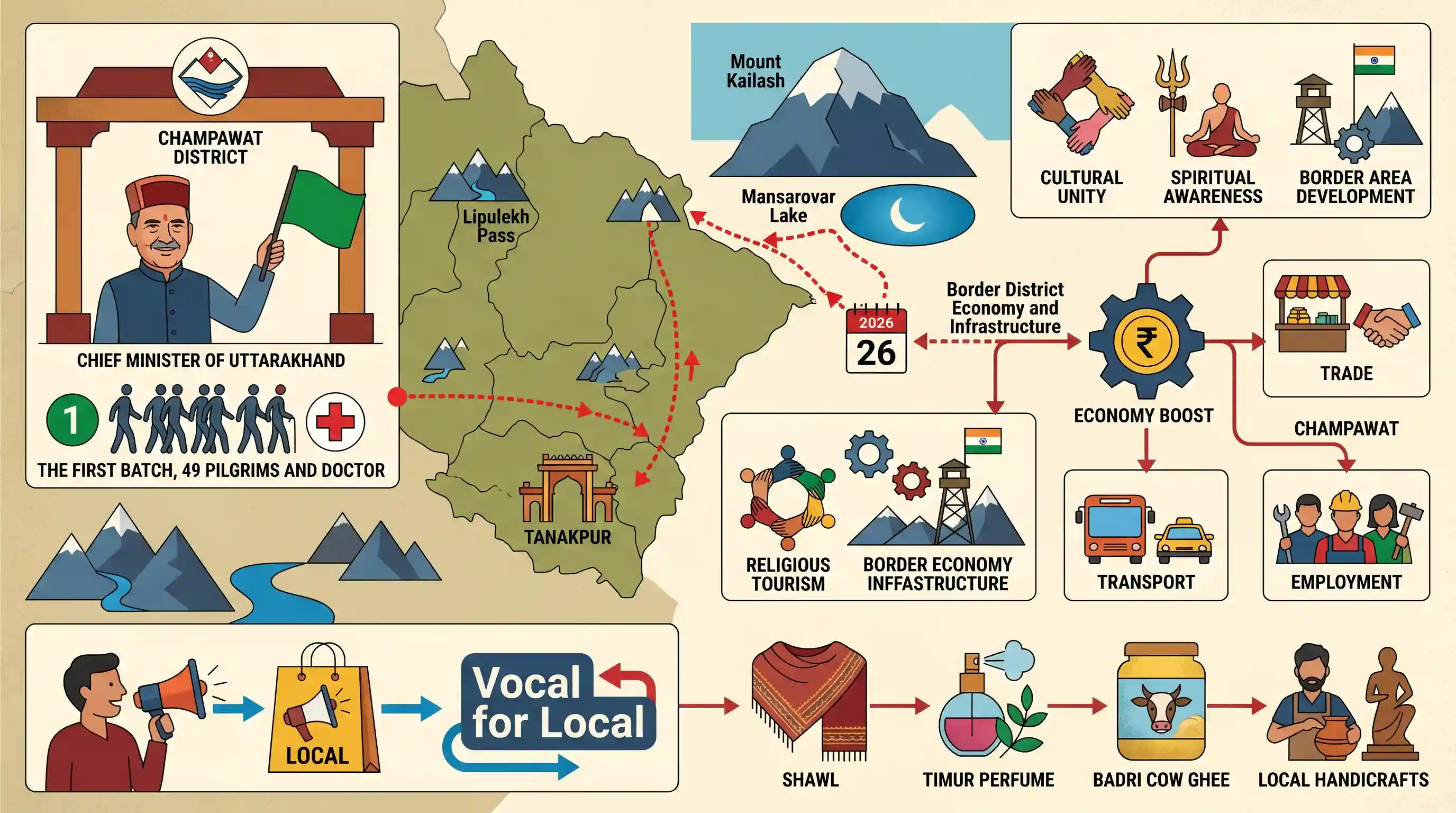
Uttarakhand Chief Minister Pushkar Singh Dhami flagged off the first batch of 49 pilgrims for the Kailash Mansarovar Yatra 2026 from Tanakpur in Champawat district. Operating via the Tanakpur route for the second consecutive year, the pilgrimage is expected to stimulate religious tourism, trade, transport, and employment in the border district. The Chief Minister appealed to pilgrims to support the 'Vocal for Local' initiative by purchasing local handicrafts and products, emphasizing that the yatra serves as a symbol of cultural unity, spiritual awareness, and border area development.
Key Points
- Uttarakhand Chief Minister Pushkar Singh Dhami flagged off the first batch of the Kailash Mansarovar Yatra 2026 from Tanakpur in Champawat district.
- The first batch consists of 49 pilgrims (34 men and 15 women) representing various Indian states, including a dedicated medical officer (Dr. Arun Kumar) from Tamil Nadu.
- This marks the second consecutive year that the pilgrimage is being operated via the Tanakpur route in Champawat, an initiative expected to significantly boost regional transport, trade, and the local hospitality sector in the border district.
- The Chief Minister emphasized the 'Vocal for Local' campaign, urging pilgrims to buy local handicrafts and products, aligning religious tourism with grassroots economic empowerment and border area development.
- From a geographic and administrative perspective, Champawat is one of the five border districts of Uttarakhand sharing international boundaries, and Tanakpur serves as a critical entry point close to historical pilgrimage sites like the Purnagiri temple.
Important Terms
Kailash Mansarovar Yatra

An annual high-altitude pilgrimage to Mount Kailash and Lake Mansarovar in Tibet, organized by the Ministry of External Affairs. It holds profound religious significance for Hindus, Buddhists, Jains, and Bon followers.
UPSC context
GS Paper I (Art & Culture / Geography) & GS Paper II (IR). Tests pilgrimage routes, trans-Himalayan geography, and India-China relations.
Lipulekh Pass
A strategic trans-Himalayan mountain pass located in Uttarakhand's Kumaon region near the India-Nepal-China tri-junction. It serves as an active trade route and a primary corridor for the Kailash Mansarovar Yatra.
UPSC context
GS Paper I (Physical Geography) & GS Paper II (IR). Tests trans-Himalayan geography, border disputes (Treaty of Sugauli), and regional trade.
Vocal for Local
A government campaign promoting indigenous manufacturing, domestic consumption of local goods, and self-reliance (Aatmanirbhar Bharat), integrated under NITI Aayog's Aspirational Blocks Programme to bolster rural micro-enterprises and local economies.
UPSC context
GS Paper III (Indian Economy). Tests knowledge of rural industrialization, MSME policies, and national self-reliance strategies.
Uttarakhand Tourism Development Board (UTDB)
A statutory apex body established under the UTDB Act, 2001, responsible for advising the Uttarakhand government, formulating tourism policies, and promoting sustainable, eco-friendly, and adventure-based tourism.
UPSC context
State PSC (UKPSC) & GS Paper III. Tests understanding of state-level statutory bodies, regional development, and sustainable tourism frameworks.
Kumaon Mandal Vikas Nigam (KMVN)
A state government undertaking of Uttarakhand established in 1971 to promote regional tourism, manage hospitality infrastructure, and coordinate logistics for the annual Kailash Mansarovar Yatra.
UPSC context
State PSC (UKPSC) & GS Paper I. Tests regional administrative bodies, hospitality management, and border economy development.
Prelims Trap
All five international border districts of Uttarakhand share borders with both China and Nepal.
Only Pithoragarh shares a dual border. Uttarkashi and Chamoli border only China, while Champawat and Udham Singh Nagar border only Nepal.
Static Concepts Connected
What is the geographical significance of the Lipulekh Pass and the Kali River?
- Lipulekh Pass: Located at the India-China-Nepal tri-junction, serving as the primary mountain pass for the Kailash Mansarovar pilgrimage.
- Kali River: Also known as the Sharda River, it forms the natural international boundary between India and Nepal under the 1816 Sugauli Treaty.
What is the Border Area Development Programme (BADP)?
- Nodal Agency: Implemented by the Ministry of Home Affairs to address the special development needs of people living near international borders.
- Primary Objective: Focuses on infrastructure, economic opportunities, and social integration to secure and stabilize strategically sensitive frontier regions.
Cross-Topic Patterns
Sacred Geography and Border Geopolitics
Developing pilgrimage infrastructure like the Kailash Mansarovar route acts as a soft-power tool, asserting sovereign presence and administrative control along disputed Himalayan borders.
Vibrant Villages and Local Livelihoods
Promoting local handicrafts in remote border districts aligns with schemes like Vibrant Villages to counter depopulation and secure vulnerable border frontiers through demographic stability.

UPSC may map Kumaon Himalayan passes (Lipulekh, Untadhura) and adjacent river systems to test border geography and bilateral treaties.
Linked PYQs · 3
Linked PYQs · 3
- 2024UKPSC_PRELIMSGS1
Hindu religious pilgrimage place named 'Purnagiri' is situated in which of the following districts of Uttarakhand ?
- 2021UKPSC_PRELIMSGS1
How many districts of Uttarakhand are linked with the international boundaries ?
- 2024UKPSC_PRELIMSGS1
UTDB is established in Uttarakhand to promote:
