Uttarakhand Administers Doorstep Governance Campaign in Chamoli
Source:aninews ↗
Why It Matters
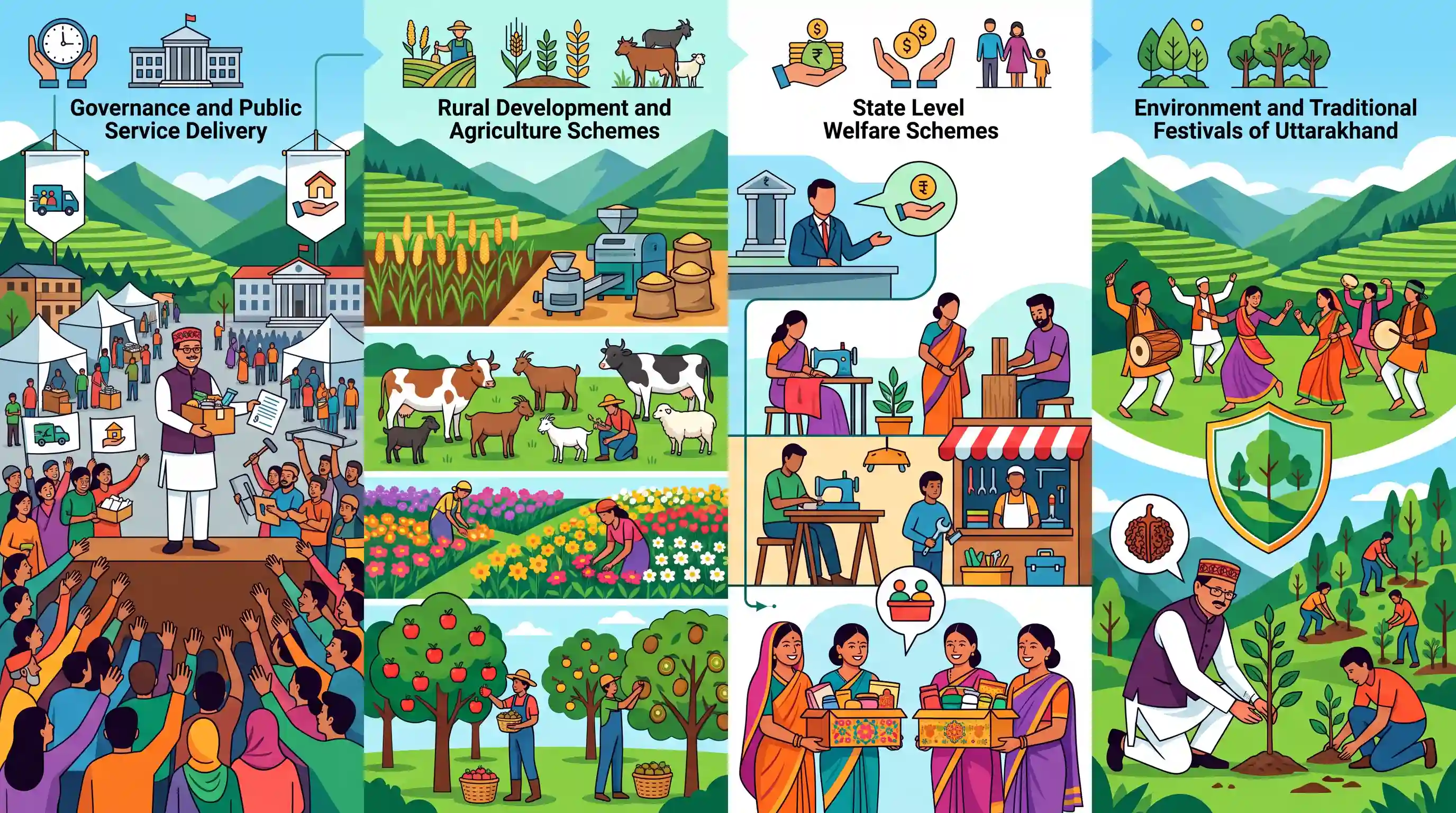
This event demonstrates how Uttarakhand's public service delivery is decentralized through localized camps, directly addressing mountain-specific livelihoods (such as barnyard millet processing and horticulture) and linking traditional conservation practices (Harela festival) with state environmental targets.
Summary
During the 'Seva, Good Governance and Dedication' Fortnight, Uttarakhand Chief Minister Pushkar Singh Dhami led the 'Jan-Jan Ki Sarkar, Jan-Jan Ke Dwar' administrative outreach camp in Gopeshwar, Chamoli. He distributed welfare materials, financial aid, and equipment to 4,632 beneficiaries. Key distributions and project approvals spanned across local millet (Jhangora) processing, livestock rearing, floriculture, high-value horticulture (Apple and Kiwi missions), interest-free cooperative loans, self-employment assistance, and Mahalakshmi Kits for women. The CM also celebrated the Harela festival by planting a Rudraksha sapling, emphasizing local afforestation and climate resilience.
Key Points
- Uttarakhand Chief Minister Pushkar Singh Dhami distributed welfare materials, approval letters, and financial aid at the 'Jan-Jan Ki Sarkar, Jan-Jan Ke Dwar' public service camp in Gopeshwar, Chamoli.
- The camp processed over 1,737 departmental applications and resolved 172 out of 203 public grievances on the spot to enhance transparent and direct governance.
- Agricultural value addition was promoted through the distribution of Barnyard Millet (Jhangora) threshing and processing machines to mountain farmers to guarantee fair market prices.
- Several key state and central schemes were leveraged: Deendayal Upadhyay Cooperative Farmer Welfare Scheme (0% interest loans), NABARD Polyhouse Scheme, Apple Mission (saplings and anti-hail nets), Kiwi Mission, and Chief Minister Self-Employment Scheme (entrepreneurship cheques).
- The CM planted a Rudraksha sapling under the 'Har Gaon Ka Yahi Paigam: Ek Ped Maa Ke Naam' campaign of the Harela festival, which highlights Uttarakhand's deep cultural link between nature conservation and afforestation.
Important Terms
Jan-Jan Ki Sarkar, Jan-Jan Ke Dwar programme

An administrative outreach campaign of the Uttarakhand government conducting localized public service camps to ensure on-the-spot grievance redressal and direct delivery of welfare schemes to citizens' doorsteps.
UPSC context
GS Paper II (Governance); tests understanding of citizen-centric administrative reforms, decentralized service delivery, and last-mile welfare execution.
Deendayal Upadhyay Cooperative Farmer Welfare Scheme
A key Uttarakhand government scheme providing interest-free loans of up to ₹3 lakh to farmers and up to ₹5 lakh to Self-Help Groups to support agricultural and non-agricultural rural activities.
UPSC context
GS Paper III (Agriculture & Rural Credit); tests knowledge of institutional cooperative systems and strategies to double farm incomes.
National Livestock Mission
A flagship central scheme launched in 2014-15 to enhance livestock productivity, promote entrepreneurship in poultry, piggery, and small ruminants, and secure feed and fodder availability.
UPSC context
GS Paper III (Animal Husbandry); tests understanding of allied agricultural sectors, sustainable breed development, and livestock-based livelihoods.
Kiwi Mission Scheme
A specialized horticultural initiative in Uttarakhand to scale up kiwi fruit cultivation in hilly districts through substantial capital subsidies, aimed at boosting high-value farming and preventing rural migration.
UPSC context
GS Paper III (Agriculture); tests knowledge of crop diversification, climate-resilient horticulture, and hill-area developmental strategies.
Prime Minister Formalisation of Micro Food Processing Enterprises (PMFME) Scheme
A centrally sponsored scheme under Aatmanirbhar Bharat Abhiyan providing financial subsidies, seed capital, and training to modernize, upgrade, and formalize unorganized micro-food processing enterprises.
UPSC context
GS Paper III (Food Processing); tests comprehension of value-addition in agriculture, micro-enterprise formalization, and rural industrialization.
Mukhyamantri Swarozgar Yojana
A flagship self-employment initiative of the Uttarakhand government offering financial subsidies and credit-linked bank loans to local youth and returning migrants to set up micro-enterprises.
UPSC context
GS Paper III (Employment & MSMEs); tests understanding of rural livelihood creation and checking migration through localized entrepreneurship.
Prelims Trap
Harela is celebrated in Chhattisgarh, while Hareli is the traditional monsoon green festival of Uttarakhand.
The names are frequently reversed to confuse candidates. Harela (from 'Har' meaning green/monsoon) belongs to Uttarakhand, while Hareli is celebrated in Chhattisgarh.
Static Concepts Connected
What is the significance of Millets in dryland agriculture and India's global initiative?
- Climate Resilience: Millets are climate-smart, photo-insensitive, require minimal water (dryland crops), and are highly resilient to temperature spikes.
- Global Promotion: India championed the International Year of Millets (IYM) 2023 to promote global food security, grain diversification, and micro-nutrient access.
- GI Tagging & Value: Indigenous mountain varieties like Jhangora (Barnyard Millet) receive GI tags to elevate export potential and safeguard indigenous hilly agriculture.
How is the SDG India Index structured and managed by NITI Aayog?
- Institutional Lead: Developed by NITI Aayog to measure progress of all States/UTs on 115 indicators across 16 SDGs, fostering competitive federalism.
- Performance Tiers: States are categorized as Aspirant (0-49), Performer (50-64), Front Runner (65-99), and Achiever (100) based on their aggregate performance.
- Top Performers: In the 2023-24 index, Uttarakhand and Kerala emerged as the joint top performers with a score of 79, driven by high localization of development goals.
Cross-Topic Patterns
Eco-Cultural Festivals & Conservation
Traditional festivals like Harela and sacred groves link GS-1 Culture with GS-3 Biodiversity, showing how community-led ecological conservation is structurally incentivized through local rituals.
Cooperative Credit & Rural Migration
Zero-interest cooperative credit lines in fragile hill states address economic distress, demonstrating the synergy between GS-3 agricultural credit mechanisms and preventing distress rural-to-urban migration.

Harela vs Hareli geographical distinction paired with India's mountain millet GI tags likely to appear in regional geography questions.
Linked PYQs · 2
Linked PYQs · 2
- 2016UKPSC_PRELIMSGS1
'HARELA' festival of Uttarakhand is related to:
- 2025UKPSC_PRELIMSGS1
Consider the following statements with reference to animal husbandry in Uttarakhand. Select the correct answer from the codes given below : 1. Animal husbandry is a supplementary occupation of agriculture. 2. Sheep rearing in the mountainous areas has been affected by environmental degradation.
