Uttarakhand Pension Transfer and State Economic Indicators
Source:aninews ↗
Why It Matters
This article provides essential factual details regarding Uttarakhand's latest economic statistics (GSDP, per capita income), national rankings (NITI Aayog SDG Index, PFM Performance Index), and local developmental schemes, which are high-probability areas for the UKPSC PCS Prelims exam.
Summary
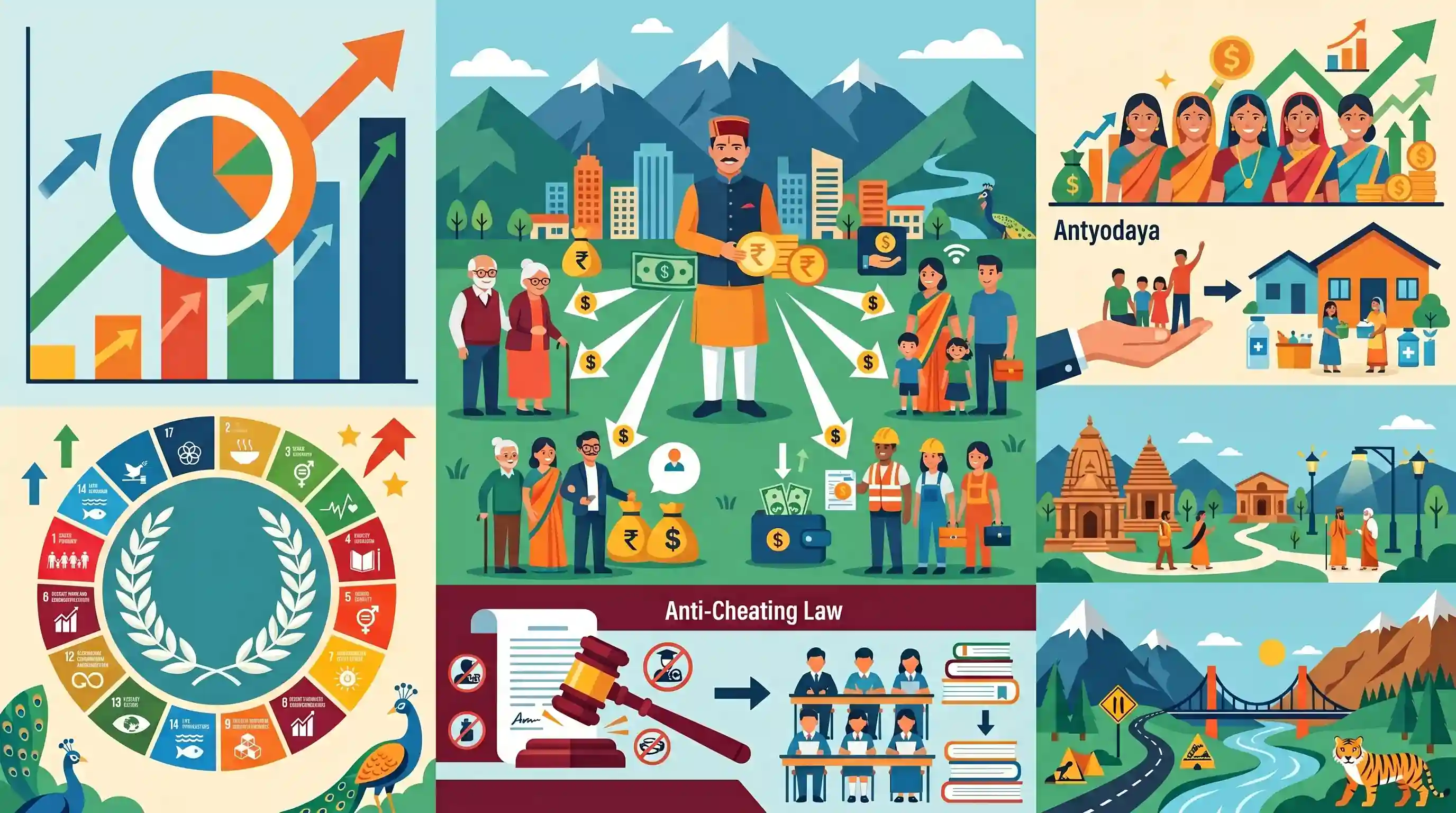
Uttarakhand Chief Minister Pushkar Singh Dhami transferred Rs 176.59 crore pension to over 9.7 lakh beneficiaries in Dehradun. The announcement highlighted key developmental indices of Uttarakhand, including its joint first rank in NITI Aayog's SDG Index, a 7.23% GSDP growth, major welfare schemes (Lakhpati Didi, Antyodaya), temple corridor infrastructure developments, and critical legal reforms like the anti-cheating law.
Key Points
- Chief Minister Pushkar Singh Dhami transferred Rs 176.59 crore pension to 9,74,338 beneficiaries in Uttarakhand during a state-level awareness programme in Dehradun.
- Economic achievements: Uttarakhand's Gross State Domestic Product (GSDP) grew by 7.23% in the last year, per capita income increased by 41% over four years, unemployment decreased by 4.4%, and the state budget crossed Rs 1 lakh crore.
- National Rankings: Uttarakhand secured the joint first position in NITI Aayog's SDG India Index (scoring 79 along with Kerala); ranked second among Special Category States in the Public Financial Management Performance Index; and was recognized as an 'Achiever' in Ease of Doing Business and 'Leader' in Startup rankings.
- Welfare initiatives: Under the Antyodaya initiative, eligible families are provided 3 free LPG cylinders annually. Lakhpati Didi Yojana is driving women's economic empowerment through Self-Help Groups (SHGs).
- Infrastructure & Corridors: Work is accelerating under the Kedarkhand and Manaskhand Temple Garland Missions alongside new corridors like Sharda, Rishikesh-Haridwar, Yamuna, Vivekananda, and Goljyu Corridors.
- Legal Reforms: Strong legislative measures have been implemented including a stringent anti-cheating law (facilitating transparent jobs for 33,000 youths), anti-conversion law, anti-riot legislation, and a land protection law.
Important Terms
Lakhpati Didi Yojana

A central initiative under DAY-NRLM targeting rural women in Self-Help Groups (SHGs) to help them achieve a sustainable annual household income of at least ₹1 lakh.
UPSC context
GS Paper II (Welfare Schemes for Vulnerable Sections) and GS Paper III (Inclusive Growth).
Vibrant Villages Programme
A central scheme designed to comprehensively develop infrastructure, livelihood opportunities, and connectivity in strategic border villages along India's international borders, thereby preventing out-migration.
UPSC context
GS Paper III (Internal Security & Border Area Management) and GS Paper II (Governance).
Manaskhand Mandir Mala Mission
A flagship state-level infrastructure and tourism development initiative aimed at widening roads and upgrading facilities around 16 identified mythological (Puranic) temples in the Kumaon region of Uttarakhand.
UPSC context
GS Paper I (Indian Heritage and Culture) and regional state-level geography and infrastructure.
Mukhyamantri Palayan Roktham Yojana
A state-level scheme in Uttarakhand focused on creating self-employment, building rural infrastructure, and promoting reverse migration in 474 identified migration-affected villages.
UPSC context
GS Paper I (Demography and Social Issues) and State-specific economic development.
Mukhyamantri Swarozgar Yojana
A flagship state scheme providing bank-linked loans and up to 25% capital subsidy to local youth and reverse migrants to establish small-scale enterprises in Uttarakhand.
UPSC context
GS Paper III (Employment & Resource Mobilization) and state economic policies.
Prelims Trap
Lakhpati Didi is a direct cash-transfer scheme that deposits ₹1 lakh annually into the bank accounts of all rural women.
It is a capacity-building initiative under DAY-NRLM. It empowers SHG women through skills and credit to earn a sustainable income, rather than gifting cash.
Static Concepts Connected
How is the NITI Aayog SDG India Index structured?
- Nodal agencies: Developed by NITI Aayog in collaboration with MoSPI, the United Nations, and state governments to track progress on 17 global goals.
- Performance tiers: Classifies states into four categories based on score: Aspirant (0-49), Performer (50-64), Front Runner (65-99), and Achiever (100).
What are the core objectives of the Vibrant Villages Programme (VVP)?
- Geographic coverage: Focuses on northern border blocks across Himachal Pradesh, Uttarakhand, Sikkim, Arunachal Pradesh, and Ladakh.
- Strategic goal: Enhances infrastructure, livelihoods, and connectivity in border villages to curb outward migration, strengthening national security.
Cross-Topic Patterns
Spiritual Tourism + Border Security
Linking temple corridor infrastructure with the Vibrant Villages Programme prevents border de-population. This merges cultural preservation with strategic internal security and territorial integrity.
SHG Microfinance + GSDP Growth
State-led adaptation of federal livelihood schemes like Lakhpati Didi demonstrates how local micro-finance and SHGs accelerate both GSDP and SDG achievements.

Vibrant Villages Programme's integration of border security with reverse migration and SDG metrics will likely feature in GS-III 2026.
Linked PYQs · 3
Linked PYQs · 3
- 2025UKPSC_PRELIMSGS1
What is the score of Uttarakhand in NITI Aayog's SDG India Index, 2023-24?
- 2025UKPSC_PRELIMSGS1
According to NITI Aayog's SDG India Index 2023-24, which state/states has the highest SDG index score? 1. Kerala 2. Uttarakhand 3. Goa 4. Tamil Nadu
- 2025UKPSC_PRELIMSGS1
Which programme was approved by the Union Cabinet in April, 2025 to develop border villages ?
