Har Ghar Jal scheme target and water source revival in Uttarakhand
Source:news-arena-india ↗
Why It Matters
The implementation of the Jal Jeevan Mission is a critical welfare and development indicator for Uttarakhand. Ensuring 100% tap water connectivity and addressing geographical challenges like groundwater recharge in hill districts are central to the state's sustainable development and governance goals, making it an important topic for state civil services exams.
Summary
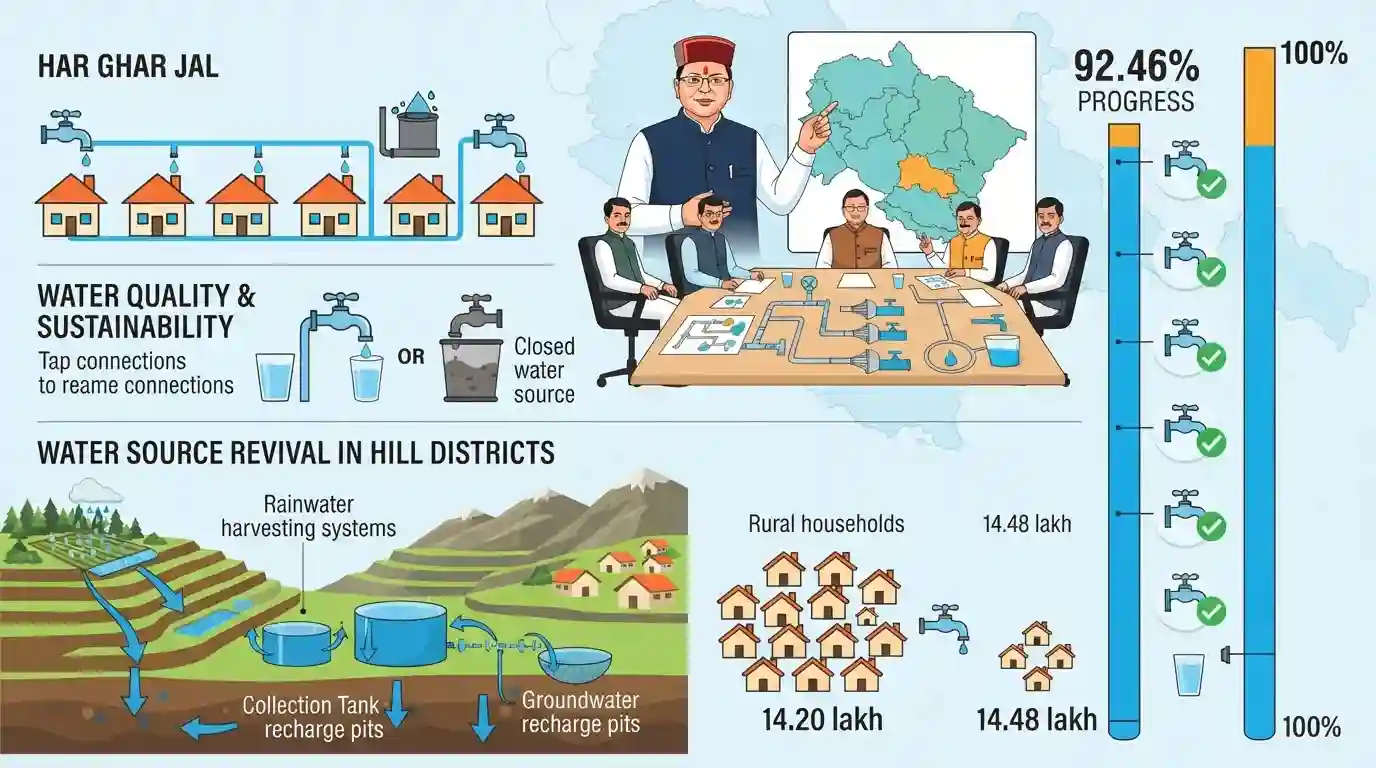
Uttarakhand Chief Minister Pushkar Singh Dhami held a review meeting for the Jal Jeevan Mission, pushing for 100% coverage under the 'Har Ghar Jal' programme. He directed officials to prioritize the regular supply of safe and clean drinking water rather than just increasing connection numbers. The CM underscored the necessity of rainwater harvesting and groundwater recharge to revive water sources in the hill districts. With 92.46% progress, 15,540 out of 16,555 schemes are completed, providing tap water to 14.20 lakh of the state's 14.48 lakh rural households.
Key Points
- Uttarakhand CM Pushkar Singh Dhami directed officials to ensure 100% coverage under the 'Har Ghar Jal' programme, part of the Jal Jeevan Mission.
- The Chief Minister emphasized the need for regular, sufficient, safe, and clean drinking water, not just the fulfillment of connection quotas.
- Focus was placed on protecting and reviving drinking water sources in hill districts through rainwater harvesting and groundwater recharge.
- Currently, 15,540 of 16,555 schemes have been completed, representing 92.46% overall progress in the state.
- Tap water connections have been provided to 14.20 lakh out of 14.48 lakh eligible rural households in Uttarakhand.
Important Terms
Jal Jeevan Mission

A flagship central government mission launched in 2019 under the Ministry of Jal Shakti, aiming to provide safe, adequate drinking water via individual functional household tap connections to every rural household.
UPSC context
GS Paper 2 (Government Policies) and GS Paper 3 (Water Resources). Tests knowledge of rural infrastructure, health impacts, and federal welfare targets.
Har Ghar Jal programme
A core goal of the Jal Jeevan Mission aimed at providing 100% functional tap water coverage (55 liters per capita per day) to every rural household on a regular, long-term basis.
UPSC context
GS Paper 2 (Social Justice). Highly relevant for assessing state-wise progress in water access, rural sanitation, and corresponding health outcomes.
Groundwater recharge
The hydrologic process where surface water infiltrates downward into groundwater aquifers. In hill regions, augmenting this artificially is critical to replenishing depleted water tables and reviving natural springs.
UPSC context
GS Paper 1 (Geography) and GS Paper 3 (Environment). Evaluated in topics concerning water stress, climate resilience, and watershed management.
Rainwater harvesting
The practice of collecting and storing rainwater runoff for productive onsite use or aquifer replenishment. It is a vital sustainable water management strategy, especially in topographically challenging areas like Uttarakhand.
UPSC context
GS Paper 3 (Conservation). Essential for answering questions on sustainable development, traditional water conservation, and regional water resource management.
Prelims Trap
Jal Jeevan Mission is a 100% centrally funded scheme focused exclusively on laying tap water connections to rural households.
JJM relies on a fund-sharing pattern (90:10 for Himalayan/NE States, 50:50 for others). Furthermore, it includes mandatory source sustainability measures (recharge, greywater management), not just laying pipes.
Static Concepts Connected
What is the community institutional framework under Jal Jeevan Mission?
- Paani Samitis: Village Water and Sanitation Committees (VWSCs) or Paani Samitis are mandatory, comprising at least 50% women and 25% marginalized sections.
- Village Action Plan: VWSCs prepare a Village Action Plan detailing water source development, supply infrastructure, and greywater management.
- O&M Responsibility: They are empowered to operate, maintain, and manage the in-village water supply systems, ensuring decentralized governance.
What is Springshed Management in the context of hill water security?
- Aquifer Focus: It focuses on managing and recharging the underground aquifers (springsheds) that feed mountain springs, rather than just surface-level watersheds.
- Policy Integration: Recognized under WDC-PMKSY 2.0 to revive drying springs in the Himalayas and Western Ghats, crucial for sustaining drinking water schemes.
Cross-Topic Patterns
JJM and Multidimensional Poverty
Access to safe drinking water under schemes like JJM directly impacts the 'Standard of Living' dimension of the National Multidimensional Poverty Index (MPI), aiding poverty alleviation targets.
Himalayan Topography vs. Infrastructure
The physical geography of the Himalayas (porous aquifers, steep gradients) necessitates localized springshed management and groundwater recharge over standard plains-based surface water extraction models.

Expect a multi-statement Prelims question testing the mandatory nature of Paani Samitis and greywater management components within JJM.
Linked PYQs · 2
Linked PYQs · 2
- 2025UKPSC_PRELIMSGS1
Which of the following is not an indicator for the dimension of Standard of Living in India's National Multidimensional Poverty Index?
- 2025UKPSC_PRELIMSGS1
What were the duties of 'KAMIN' in Uttarakhand during the Colonial period?
