Uttarakhand organic farming push and rural livelihood strategy
Source:chinimandi ↗
Why It Matters
This event highlights top-level policy push for organic farming in Uttarakhand. It directly connects with three crucial UKPSC GS Paper-1 syllabus areas: the agricultural dominance of Udham Singh Nagar district (the state's highest net-sown area), the integration of animal husbandry with farming (manure usage), and key state cultural shrines (the historical Purnagiri Temple).
Summary
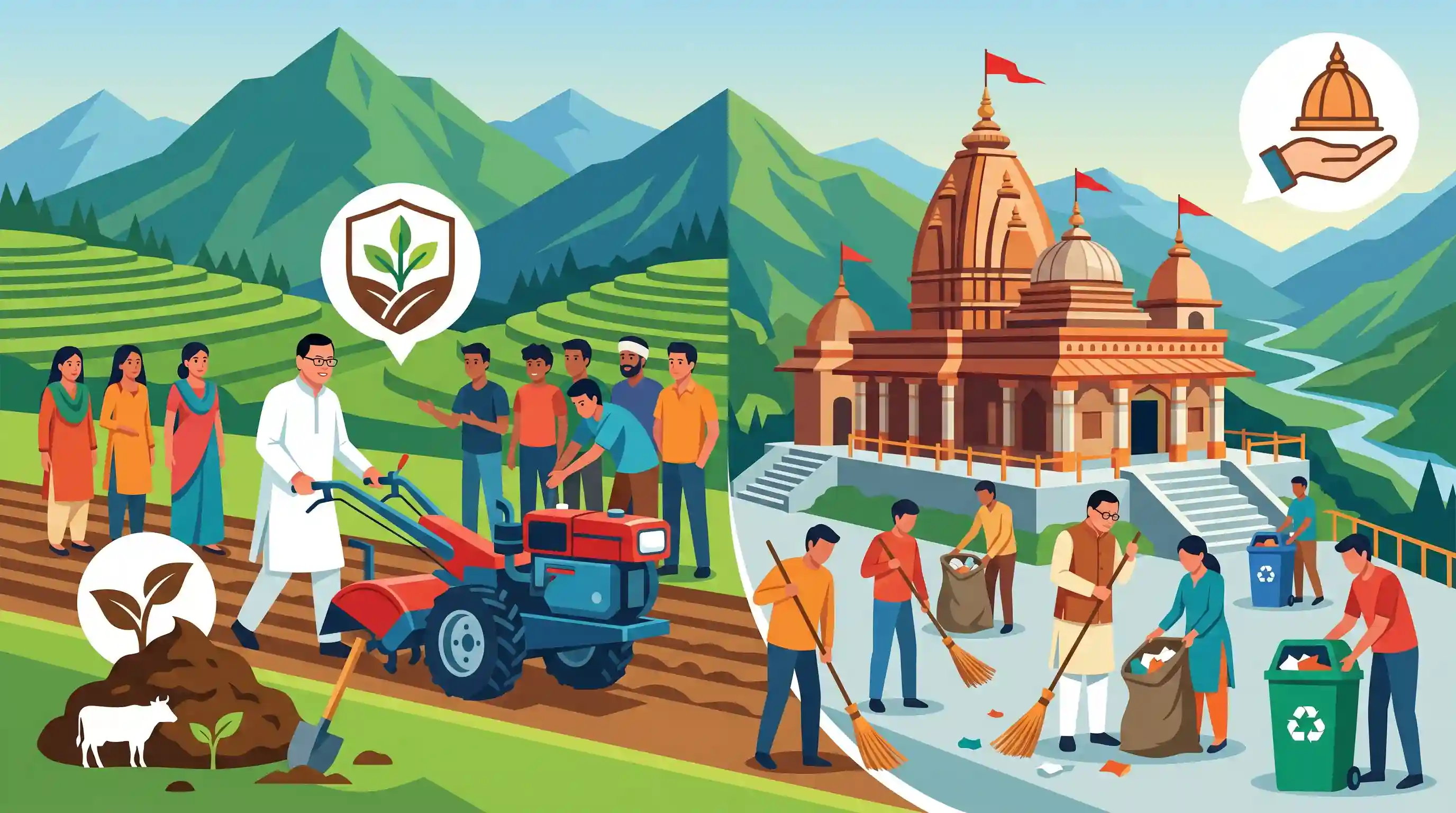
Uttarakhand CM Pushkar Singh Dhami actively promoted organic and traditional farming by ploughing his field with a power tiller and applying cow dung manure at his private residence in Khatima, Udham Singh Nagar. During his visit, he also participated in a cleanliness drive at the local Purnagiri Temple premises in Nagla Tarai, emphasizing the state's focus on organic agriculture, rural youth connection, and cultural heritage conservation.
Key Points
- Uttarakhand Chief Minister Pushkar Singh Dhami promoted organic and natural farming practices by personally operating a power tiller to plough a field and applying traditional cow dung manure at his private residence in Nagla Tarai, Khatima.
- The Chief Minister advocated for the integration of modern agricultural technology with traditional organic methods to improve soil health, protect the environment, and reduce dependence on chemical fertilizers.
- CM Dhami also participated in a cleanliness and tree-planting drive on the premises of the local Purnagiri Temple in the Nagla Tarai area of Khatima, urging community action towards heritage preservation and environmental conservation.
- He highlighted that the Uttarakhand state government is actively supporting farmers through targeted schemes focused on traditional agriculture, horticulture, and high-value organic local products to boost rural incomes.
Important Terms
Paramparagat Krishi Vikas Yojana (PKVY)

A centrally sponsored scheme launched in 2015 to promote organic and sustainable chemical-free agriculture through a cluster-based approach and peer-certified organic certification.
UPSC context
GS Paper III: Sustainable Agriculture. Tests understanding of governmental schemes targeting soil health and organic farming promotion.
Bhartiya Prakritik Krishi Paddhati (BPKP)
A sub-scheme of Paramparagat Krishi Vikas Yojana (PKVY) introduced in 2020-21 to promote traditional indigenous natural farming practices free from synthetic chemicals.
UPSC context
GS Paper III: Agriculture. Tests concepts of natural farming, biomass recycling, and cost-effective organic inputs.
Uttarakhand Organic Commodity Board (UOCB)
A state-level agency established in 2003 to promote, organize, and institutionalize organic agricultural activities, certification, and export-driven market linkages within Uttarakhand.
UPSC context
GS Paper III: Land Reforms & Agriculture. Tests state-level institutional mechanisms and policy frameworks for sustainable farming models.
Participatory Guarantee System (PGS)
A locally focused, decentralized organic quality assurance system that certifies producers based on active participation, peer-review, and mutual trust rather than third-party audit.
UPSC context
GS Paper III: Agricultural Marketing & Certification. Tests cost-effective, farmer-led certification options for smallholder domestic growers.
Maa Purnagiri Temple
A major Hindu temple and Shakti Peeth in Uttarakhand's Champawat district, situated on the Annapurna peak and celebrated for its annual Navratri pilgrimage.
UPSC context
GS Paper I: Art and Culture. Tests regional religious heritage, major pilgrimage routes, and cultural tourism in India.
Udham Singh Nagar District
An administrative district in Uttarakhand's fertile Terai region, named after revolutionary Shaheed Udham Singh and known as the "food bowl of Uttarakhand" for its rich agriculture.
UPSC context
GS Paper I & III: Indian Geography & History. Tests regional geography, agricultural hubs, and historical links to freedom fighters.
Prelims Trap
Sikkim was the first Indian state to enact dedicated statutory legislation regulating and penalizing organic farming violations.
Sikkim was the first fully organic state (2016), but Uttarakhand was the first state to pass dedicated statutory organic legislation (Organic Agriculture Act, 2019).
Static Concepts Connected
How do PGS-India and NPOP organic certification systems differ?
- PGS-India focus: A peer-review certification mechanism tailored for domestic markets, administered by the Ministry of Agriculture.
- NPOP focus: A third-party certification program primarily aimed at export markets, regulated by APEDA under the Ministry of Commerce.
- Operator scale: PGS-India certifies farmer groups (minimum 5 members) and doesn't support individual certification, unlike NPOP.
What are the geographical features of the Kali (Sharda) River?
- Origin: Rises at Kalapani in the Great Himalayas, Pithoragarh district of Uttarakhand, bordering Nepal.
- Boundary function: Serves as the continuous international boundary between India and Nepal along its upper reach.
- Downstream course: Enters the plains as the Sharda River and merges with the Ghaghara River in Uttar Pradesh.
Cross-Topic Patterns
Organic farming vs WTO Green Box
Domestic support for organic transitions (like PKVY) falls under WTO Green Box subsidies, allowing India to promote ecological farming without inviting trade disputes.
Himalayan ecology and Sharda Treaty
Ecological conservation near the Kali River basin directly intersects with transboundary hydro-diplomacy under the historic 1996 Mahakali Treaty between India and Nepal.

State-level organic laws versus Sikkim's status, alongside PGS-India vs NPOP certification differences, will likely be tested in 2026.
Linked PYQs · 3
Linked PYQs · 3
- 2025UKPSC_PRELIMSGS1
Which of the following districts of Uttarakhand has the highest agricultural land ?
- 2025UKPSC_PRELIMSGS1
Consider the following statements with reference to animal husbandry in Uttarakhand. Select the correct answer from the codes given below : 1. Animal husbandry is a supplementary occupation of agriculture. 2. Sheep rearing in the mountainous areas has been affected by environmental degradation.
- 2024UKPSC_PRELIMSGS1
Hindu religious pilgrimage place named 'Purnagiri' is situated in which of the following districts of Uttarakhand ?
