Uttarakhand grassroots governance and women welfare schemes
Source:lokmattimes ↗
Why It Matters
This article highlights critical state-level governance models, social-security schemes (Mahalakshmi Yojana), economic initiatives for rural women (Didi Cafe), and major legislative changes (UCC and the Anti-Cheating law) in Uttarakhand. These topics, along with the demographic aspects of the Tharu tribe, are frequently featured in the UKPSC PCS Prelims Exam.
Summary
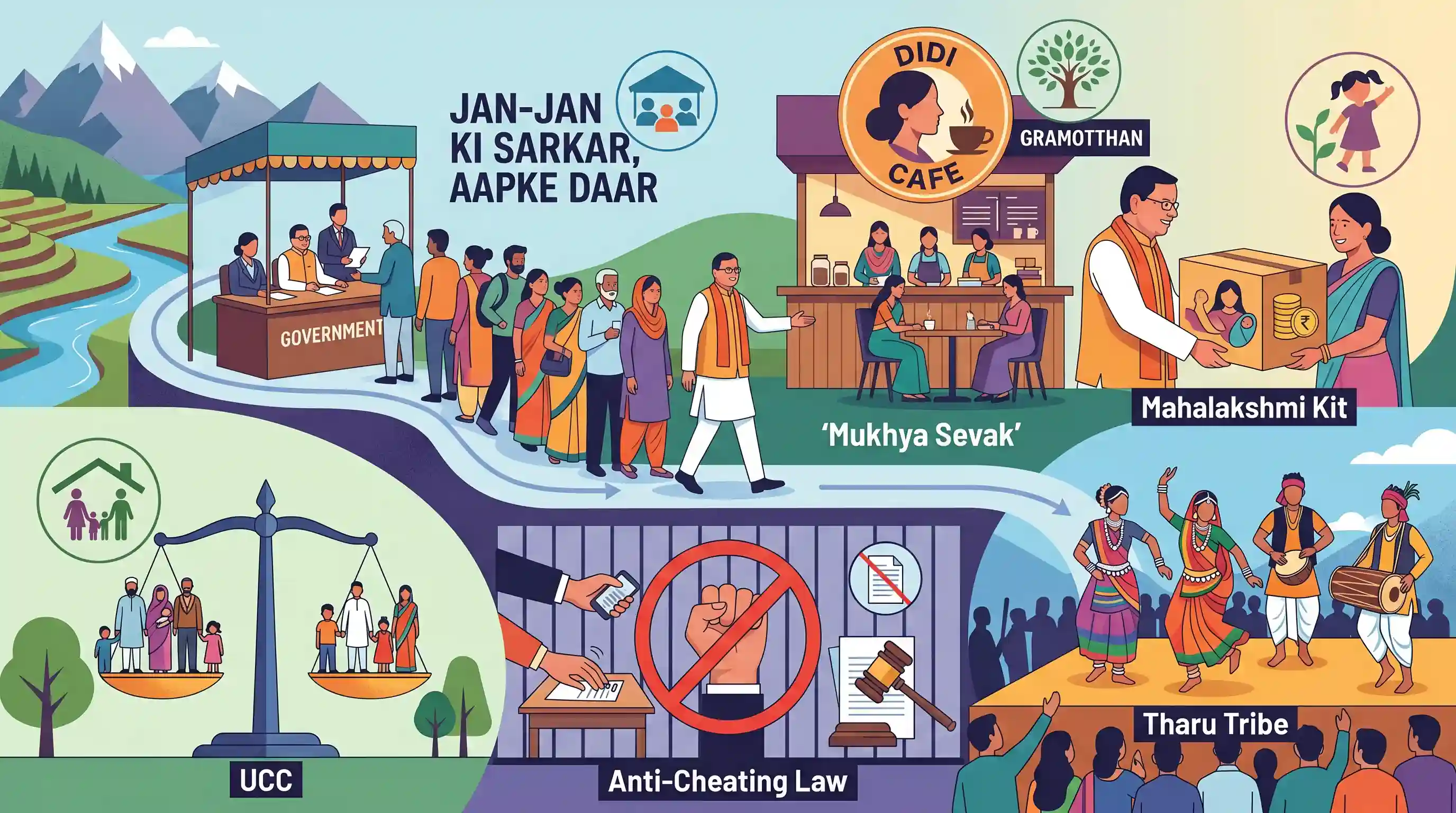
During his visit to his home constituency of Khatima, Uttarakhand Chief Minister Pushkar Singh Dhami led the 'Pragati Path Yatra' and the 'Jan-Jan Ki Sarkar, Mukhya Sevak Aapke Dwar' outreach program. The visit emphasized grassroots development, women's empowerment, and key administrative reforms. Notable highlights included the inauguration of the 'Didi Cafe' under the Gramotthan Project, the distribution of Mahalakshmi Kits, and reference to major legislative achievements like the Uniform Civil Code (UCC) and the state's strict Anti-Cheating Law. The event also featured traditional cultural performances by the local Tharu Tribe, showcasing the region's unique tribal heritage.
Key Points
- Chief Minister Pushkar Singh Dhami led the 'Pragati Path Yatra' and attended the public outreach program 'Jan-Jan Ki Sarkar, Mukhya Sevak Aapke Dwar' in Khatima, Udham Singh Nagar district.
- The CM inaugurated the 'Didi Cafe,' a grassroots livelihood initiative run by local women self-help groups under the Gramotthan Project to promote economic independence.
- Under the 'Mukhyamantri Mahalakshmi Yojana,' Mahalakshmi Kits containing nutritional and hygiene essentials were distributed to pregnant women and newborn girls.
- Major state reforms were highlighted, including the implementation of the landmark Uniform Civil Code (UCC) and the state's stringent Anti-Cheating Law to ensure transparency in competitive exams.
- The event featured cultural performances by the Tharu Tribe, which is historically the most populous Scheduled Tribe in Uttarakhand and primarily resides in the Terai region.
Important Terms
Uniform Civil Code (UCC) of Uttarakhand Act, 2024

A state-level law that replaces religion-based personal civil laws with a unified set of rules governing marriage, divorce, inheritance, and live-in relationships for all citizens, excluding Scheduled Tribes.
UPSC context
GS Paper II: Constitution and Polity. Tests understanding of uniform civil laws, Article 44 (DPSP), and the integration of diverse personal laws.
Uttarakhand Competitive Examination (Measures for Prevention and Redressal of Unfair Means in Recruitment) Act, 2023
A stringent anti-cheating law passed by Uttarakhand to curb exam malpractices, imposing life imprisonment and up to ₹10 crore fine on individuals or organizations involved in paper leaks.
UPSC context
GS Paper II: Governance and Administration. Tests knowledge of public recruitment integrity, anti-corruption, transparency, and accountability in state competitive exams.
Mukhyamantri Mahalakshmi Yojana
A maternal and newborn welfare scheme in Uttarakhand providing essential hygiene and nutrition kits to post-delivery mothers of newborn children to improve maternal and child health.
UPSC context
GS Paper II: Welfare schemes for vulnerable sections. Tests understanding of maternal and child healthcare, gender equality, and social security programs.
Gramotthan Project
A rural livelihood initiative (Rural Enterprise Acceleration Project) in Uttarakhand aimed at promoting micro-enterprises and sustainable income opportunities for low-income rural households through Self-Help Groups.
UPSC context
GS Paper II: Rural development, poverty alleviation, and women empowerment. Tests knowledge of SHG-led models in promoting rural livelihood security.
Didi Cafe Initiative
A livelihood and women-empowerment program in Uttarakhand where local women's Self-Help Groups (SHGs) operate cafes under the Gramotthan Project, serving clean, traditional food at reasonable prices.
UPSC context
GS Paper II: Development processes and the development industry. Tests knowledge of SHGs, micro-entrepreneurship, and economic empowerment of rural women.
Jan-Jan Ki Sarkar, Mukhya Sevak Aapke Dwar
A citizen-centric governance and public outreach campaign led by the Uttarakhand Chief Minister to address public grievances directly and ensure welfare scheme delivery at the grassroots.
UPSC context
GS Paper II: Governance. Tests understanding of transparency, grievance redressal mechanisms, and decentralized, direct citizen-state communication models.
Prelims Trap
The Uniform Civil Code enacted by Uttarakhand applies uniformly to all residents, overriding all tribal customary laws within the state.
While the UCC aims for uniformity, the Uttarakhand UCC Act explicitly exempts Scheduled Tribes, protecting their customary laws under constitutional provisions.
Static Concepts Connected
What is the constitutional basis of the Uniform Civil Code (UCC) and its federal dynamics?
- Constitutional Provision: Article 44 in Part IV of the Constitution directs the State to secure a Uniform Civil Code for all citizens throughout India.
- Legal Nature: As a Directive Principle of State Policy (DPSP), Article 44 is non-justiciable and cannot be directly enforced by courts.
- Federal Aspect: Marriage, divorce, and inheritance fall under the Concurrent List, allowing both Parliament and state legislatures to enact laws.
What are the key tribal profiles and classifications of Uttarakhand?
- Five Major Tribes: Jaunsari, Tharu, Bhotia, Buksa, and Raji were declared Scheduled Tribes in 1967.
- PVTG Representation: The Raji (Van Rawat) tribe is the only designated Particularly Vulnerable Tribal Group (PVTG) in Uttarakhand.
- Tharu Demographics: Concentrated in the Terai region, the Tharu tribe is historically the most populous Scheduled Tribe in the state.
Cross-Topic Patterns
DPSP Implementation vs. Tribal Autonomy
Balances Article 44 (UCC) with Article 371 and Fifth/Sixth Schedule protections, demonstrating how modern uniform legislation must respect customary tribal rights.
Border Security and Transhumance Geopolitics
Explores how the disruption of the Bhotia tribe’s trans-Himalayan trade after 1962 reshaped border security and necessitated programs like the Vibrant Villages Scheme.

Statements on UCC exceptions for STs combined with Article 44 and DPSP enforceability are highly probable in Prelims 2026.
Linked PYQs · 2
Linked PYQs · 2
- 2025UKPSC_PRELIMSGS1
In which of the following year were the Jaunsari, Tharu, Bhotia, Buksa and Raji tribes declared Scheduled Tribes in Uttarakhand?
- 2005UKPSC_PRELIMSGS1
Which of the following Tribal population is highest among all the tribes of Uttaranchal?
