Uttarakhand CM Dhami announces development push in Jaunsar Bawar
Source:indianmasterminds ↗
Why It Matters
The culture, geography, and welfare of the Jaunsari tribe are central topics in the UKPSC syllabus. Historical milestones (such as the 1967 declaration of ST status) and distinct regional features (like the Mahasu Devta temple and the Mauna-fair) are frequently asked in the state civil services exam.
Summary
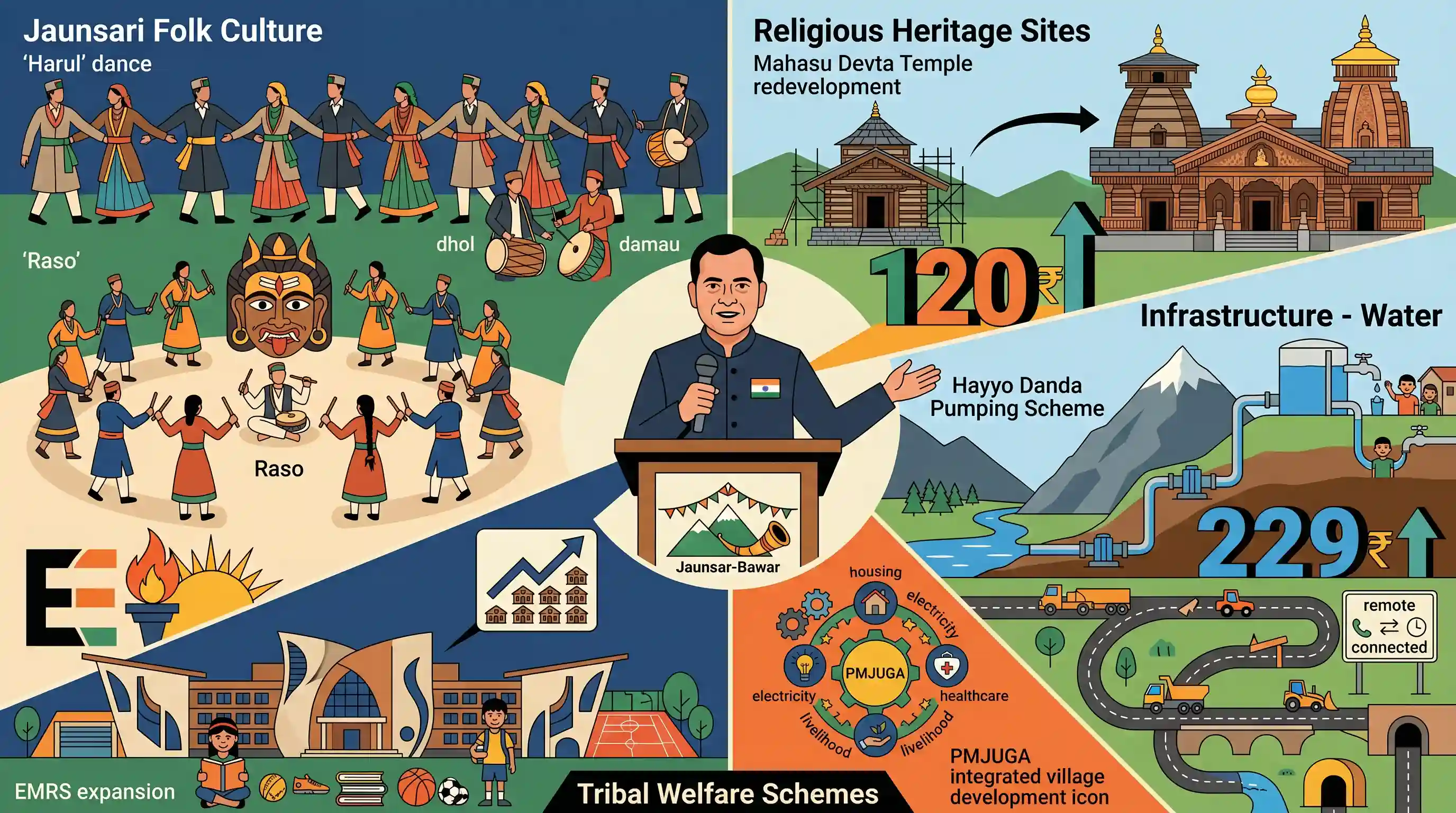
During the Jaunsar-Bawar Folk Cultural Festival 2026, Uttarakhand Chief Minister Pushkar Singh Dhami announced comprehensive infrastructure and welfare initiatives worth thousands of crores for the Jaunsar-Bawar tribal region. Highlighting cultural elements like Raso and Harul folk dances, the CM outlined major projects including the ₹120 crore Mahasu Devta Temple redevelopment, the ₹229 crore Hayyo Danda Pumping Scheme, and several road connectivity projects. Additionally, he highlighted tribal welfare progress under schemes like PMJUGA and the expansion of Eklavya Model Residential Schools (EMRS) across the state.
Key Points
- Uttarakhand CM Pushkar Singh Dhami announced major development projects during the Jaunsar-Bawar Folk Cultural Festival and Sports Meet 2026, held at Naghat, Dehradun.
- Folk traditions of the region, such as Raso, Harul, and Baund, were celebrated as cultural pride markers of the Jaunsari tribal community.
- A master plan worth ₹120 crore was announced for the redevelopment of the historic Mahasu Devta Temple complex, a central pilgrimage site for the Jaunsar-Bawar region.
- Under the Pradhan Mantri Janjatiya Unnat Gram Abhiyan (PMJUGA), 128 tribal villages in Uttarakhand have been identified for comprehensive development, including basic facilities like internet, electricity, and roads.
- Educational initiatives include the expansion of Eklavya Model Residential Schools (functioning in Kalsi, Mehrawana, Bajpur, and Khatima, with upcoming sites in Bajpur and Chakrata) and 16 operational Ashram-style schools.
- Welfare measures for local tribes include financial assistance of ₹50,000 for the marriage of tribal daughters and a ₹1 crore corpus fund established for the Tribal Research Institute.
Important Terms
Pradhan Mantri Janjatiya Unnat Gram Abhiyan (PMJUGA)

A flagship Central scheme launched in 2024 to ensure saturation coverage of essential infrastructure, healthcare, education, and livelihood interventions across approximately 63,000 tribal-majority villages in India over five years.
UPSC context
GS Paper II (Welfare Schemes) and GS Paper III (Inclusive Growth), testing policies for marginalized socio-economic empowerment.
Eklavya Model Residential Schools (EMRS)
A Ministry of Tribal Affairs scheme initiated in 1997-98 under Article 275(1) of the Constitution to provide free, high-quality middle and high-school residential education to Scheduled Tribe children in geographically remote areas.
UPSC context
GS Paper II (Social Justice/Education), testing interventions that address educational disparities and promote capacity building among marginalized groups.
Constitution (Scheduled Tribes) (Uttar Pradesh) Order, 1967
A presidential order issued under Article 342 of the Constitution of India that officially declared five indigenous communities—Jaunsari, Tharu, Bhotia, Buksa, and Raji—as Scheduled Tribes in undivided Uttar Pradesh.
UPSC context
GS Paper II (Polity/Constitution), testing tribal categorization criteria, constitutional protections, and the federal dynamics of state reorganisation.
Tribal Research Institute
State-level bodies funded by the Ministry of Tribal Affairs that act as think tanks for tribal development, policy planning, and the preservation of tribal cultural heritage, such as Uttarakhand's TRI in Dehradun.
UPSC context
GS Paper II (Social Justice) and GS Paper I (Society), testing governance infrastructure and research-based policy design for tribal communities.
Jaunsar-Bawar Sanskritik Punrutthan Samiti
A cultural organization in Uttarakhand dedicated to preserving, promoting, and documenting the unique cultural heritage, folk dances (such as Raso and Harul), and identity of the Jaunsar-Bawar tribal region.
UPSC context
GS Paper I (Indian Culture), testing local community efforts, regional folk traditions, and intangible heritage preservation in Himalayan tribal areas.
Prelims Trap
The five major tribal groups of Uttarakhand were first officially notified as Scheduled Tribes only after the state's creation in 2000.
These five tribes (Jaunsari, Tharu, Bhotia, Buksa, Raji) were actually notified in 1967 under the Constitution (Scheduled Tribes) (Uttar Pradesh) Order, 1967, long before Uttarakhand's creation in 2000.
Static Concepts Connected
What is the Kath Kuni architectural style?
- Regional distribution: Prevalent in the Western Himalayan region, especially Himachal Pradesh and Uttarakhand's Jaunsar-Bawar and Garhwal belts.
- Key materials: Seismic-resistant building technique using alternating horizontal layers of dry stone masonry and deodar wood.
- Structural design: Built entirely without cement or mortar, allowing flexibility and energy dissipation during earthquakes.
What is the Pradhan Mantri Janjatiya Unnat Gram Abhiyan (PMJUGA)?
- Target population: Aims at socio-economic saturation in over 63,000 tribal-majority villages, benefiting around 5 crore tribal people across 30 States/UTs.
- Convergence model: Executed over a 5-year period through the convergence of 17 central ministries implementing crucial infrastructure and welfare schemes.
- Evolutionary link: It builds on the targeted saturation strategy successfully deployed in the PM-JANMAN scheme for PVTGs.
Cross-Topic Patterns
Tribal transhumance and border geopolitics
The high-altitude Bhotia tribe’s historical trans-Himalayan trade routes to Tibet highlight how geographical isolation and international borders shape tribal livelihoods and national security.
Himalayan folk rituals and UNESCO protection
The ritual theater 'Ramman' reflects the symbiotic relationship between biodiversity conservation and religious lore in the Garhwal Himalayas, intersecting culture with environmental protection.

PMJUGA convergence framework and Himalayan Kath-Kuni temple architecture likely to be combined in a culture-cum-governance question in 2026.
Linked PYQs · 2
Linked PYQs · 2
- 2025UKPSC_PRELIMSGS1
In which of the following year were the Jaunsari, Tharu, Bhotia, Buksa and Raji tribes declared Scheduled Tribes in Uttarakhand?
- 2016UKPSC_PRELIMSGS1
Where is 'Mauna-fair' held?
