Nainital Girder Bridge and Flood Protection Projects Inaugurated
Source:indiagazette ↗
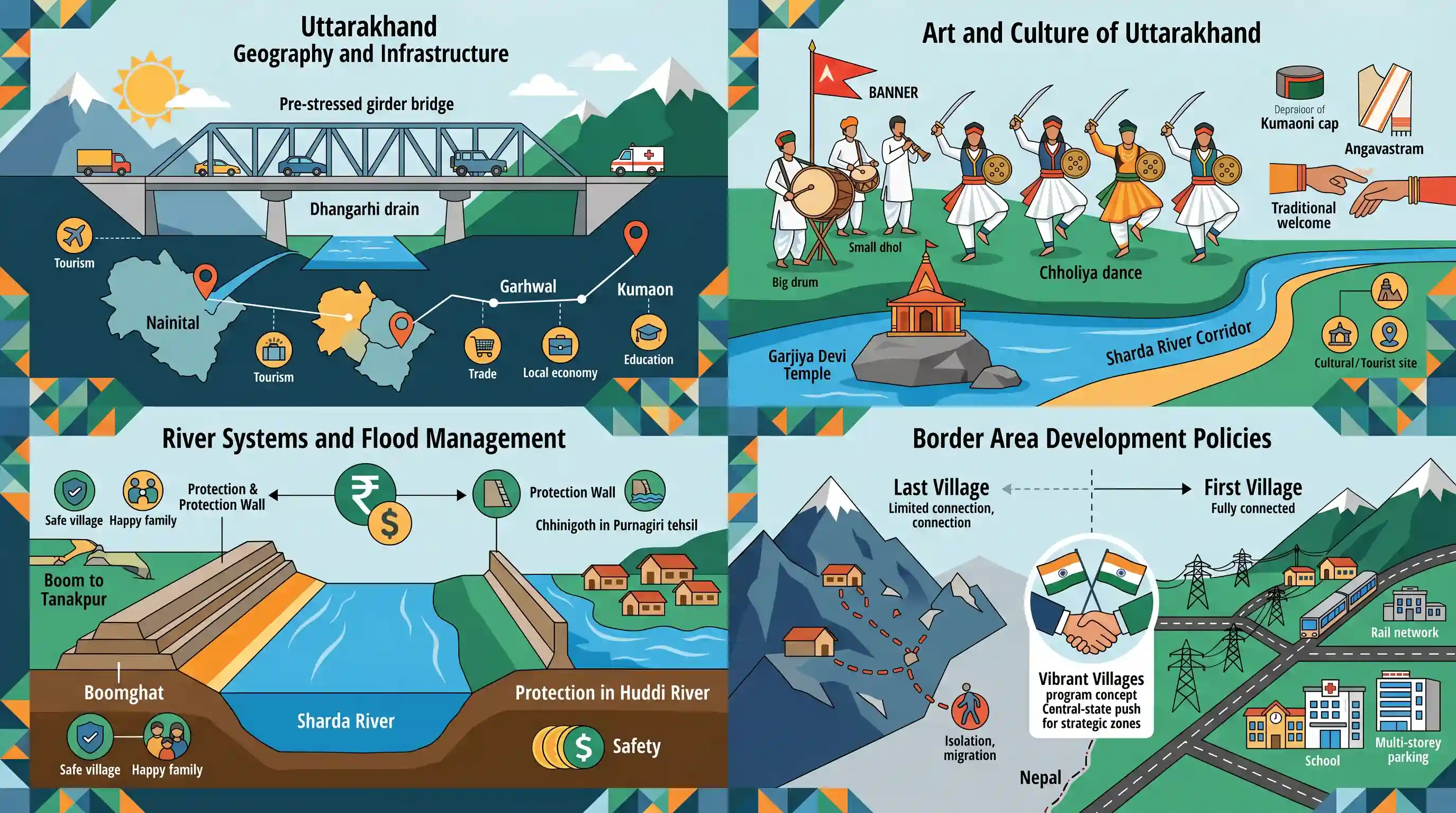
Why It Matters
The developments touch upon major UKPSC GS-1 themes, including Kumaon geography (Sharda/Huddi rivers, Tanakpur, Nainital, Champawat), religious and cultural heritage (Purnagiri tehsil, Garjiya Devi Temple, Chholiya folk dance), and border governance initiatives (Vibrant Villages Programme).
Summary
Uttarakhand Chief Minister Pushkar Singh Dhami inaugurated a newly constructed girder bridge over the Dhangarhi drain on NH-309 in Ramnagar, Nainital, enhancing regional road connectivity. He also inspected the Garjiya Devi Temple premises to review developmental projects. Additionally, the CM laid the foundation stone for two crucial flood protection works worth over Rs 65 crore at Boomghat in Champawat district, including a Rs 60.21 crore Sharda River embankment and a Rs 5.74 crore protection wall on the Huddi River in Purnagiri tehsil. The event underscored the central/state push to develop border zones as the country's 'first villages' and featured a traditional Kumaoni Chholiya dance welcome.
Key Points
- Uttarakhand CM Pushkar Singh Dhami inaugurated a new girder bridge over the Dhangarhi drain on National Highway 309 (NH-309) in Ramnagar, Nainital district, solving long-standing monsoon transit problems.
- The CM, accompanied by MoS Ajay Tamta, visited and reviewed developmental works at the historical Garjiya Devi Temple premises in Ramnagar.
- Foundation stones were laid for two key flood protection projects worth over Rs 65 crore at Boomghat in Champawat district.
- The first major project is a Rs 60.21 crore river embankment on the Sharda River from Boom to Tanakpur.
- The second is a Rs 5.74 crore flood protection wall on the Huddi River to protect Chhinigoth village under Purnagiri tehsil.
- The initiatives align with the Prime Minister's vision of rebranding and developing border settlements as 'first villages' (under the Vibrant Villages philosophy) to check out-migration.
- The cultural welcome included a performance of the traditional Kumaoni folk dance, Chholiya.
Important Terms
Vibrant Villages Programme

A central initiative focused on the comprehensive development of strategic villages along India's international land borders to improve living standards, provide livelihood opportunities, and stem out-migration.
UPSC context
GS Paper II (Government Schemes) and GS Paper III (Border Security); tests border area development and strategic infrastructure.
Chholiya Dance
A thousand-year-old traditional folk dance from Uttarakhand's Kumaon region, featuring martial-style swordplay, traditional attire, and performed during weddings and festivals to ward off evil.
UPSC context
GS Paper I (Indian Heritage & Culture); tests awareness of regional folk dances, martial arts heritage, and local traditions.
Sharda River
A major Himalayan river, also known as the Kali or Mahakali, originating in Uttarakhand's Pithoragarh, serving as the India-Nepal boundary, and eventually merging with the Ghaghara.
UPSC context
GS Paper I (Geography of India); tests river drainage systems, transboundary river agreements, and bilateral boundary dynamics.
Garjiya Devi Temple
A famous Hindu Shakti shrine dedicated to Goddess Parvati, situated atop a massive rock in the middle of the Kosi River near Ramnagar in Nainital, Uttarakhand.
UPSC context
GS Paper I (Indian Heritage & Culture); tests knowledge of sacred geography, temple sites, and regional cultural architecture.
Prelims Trap
Chholiya is a traditional martial art dance native to the Garhwal region, tracing its history back to the Parmar dynasty.
Chholiya is specifically native to the Kumaon region (not Garhwal) and is historically associated with the Chand kings (not the Parmars or Katyuris of Garhwal).
Static Concepts Connected
What are the cultural features of the Kumaoni Chholiya dance?
- Martial Heritage: It is a martial dance dating back to the 10th-century Chand kings of Kumaon, symbolizing royal marriage processions marching under threat.
- Performance Style: Typically performed during weddings and religious festivals using mock sword-and-shield combat movements to ward off negative spirits.
- Musical Instruments: Accompanied by traditional Kumaoni wind and percussion instruments including the dhol, damau, ransingha, and bhankora.
What is the geography and significance of the Sharda (Kali) River?
- Origin and Course: Originates as the Kali River in the High Himalayas of Pithoragarh district, forming the natural border between India and Nepal.
- Bilateral Treaty: Its transboundary water-sharing and joint hydro-power development (Pancheshwar Project) are governed by the 1996 Indo-Nepal Mahakali Treaty.
- Confluence: It enters the plains at Tanakpur as the Sharda River before merging with the Ghaghara River, a major tributary of the Ganga.
Cross-Topic Patterns
Transboundary rivers + Bilateral diplomacy
Sharda (Kali) River infrastructure works interface with the 1996 Mahakali Treaty, demonstrating how local state flood protection projects intersect with Indo-Nepal transboundary water diplomacy.
Border infrastructure + National security
Developing 'first villages' under the Vibrant Villages Programme mitigates border de-population (ghost villages), transforming civilian infrastructure into active national security deterrents.

Himalayan border management (Vibrant Villages) combined with Indo-Nepal transboundary river diplomacy likely to form a GS paper-3 question.
Linked PYQs · 3
Linked PYQs · 3
- 2024UKPSC_PRELIMSGS1
Which of the following folk dances/celebrations of Uttarakhand is included in the intangible heritage list of UNESCO ?
- 2024UKPSC_PRELIMSGS1
Hindu religious pilgrimage place named 'Purnagiri' is situated in which of the following districts of Uttarakhand ?
- 2025UKPSC_PRELIMSGS1
Which programme was approved by the Union Cabinet in April, 2025 to develop border villages ?
