Uttarakhand Tribal Conclave in Chamoli Focuses on Welfare Schemes
Source:aninews ↗
Why It Matters
Directly relevant to Uttarakhand state-specific current events concerning governance, welfare schemes, and development policies for Scheduled Tribes (such as Bhotia, Jaunsari, Tharu, Buksa, and Raji).
Summary
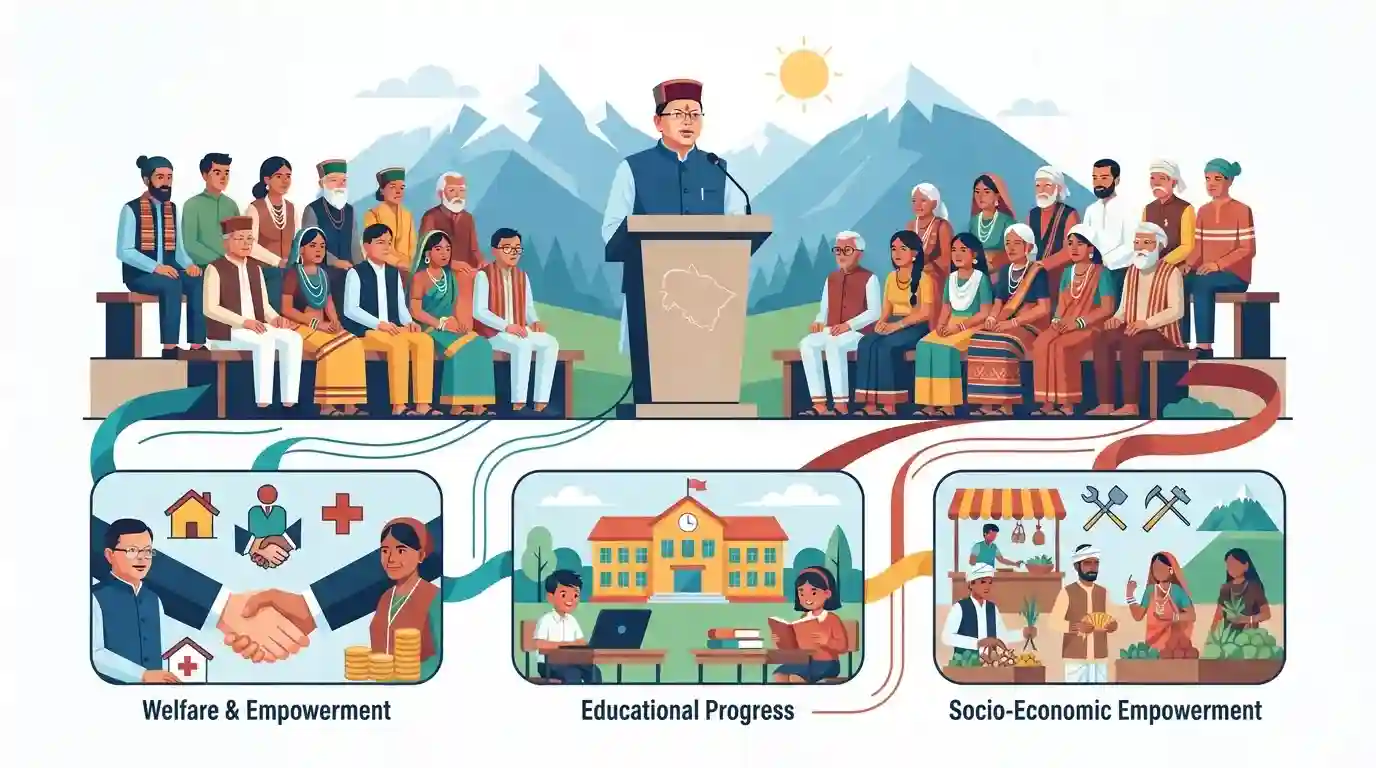
Uttarakhand Chief Minister Pushkar Singh Dhami addressed a tribal conclave in Chamoli, emphasizing ongoing government initiatives for the welfare, educational progress, and socio-economic empowerment of tribal communities in the state.
Key Points
- Uttarakhand Chief Minister Pushkar Singh Dhami highlighted various tribal welfare initiatives during a tribal conclave held in Chamoli district.
- Emphasis was placed on the socio-economic development, educational advancement, and preservation of the cultural heritage of Scheduled Tribes in the hill state.
- The state government aims to bridge development gaps in remote and tribal-dominated pockets of Uttarakhand.
Important Terms
Scheduled Tribes of Uttarakhand

Five communities officially recognized as Scheduled Tribes in Uttarakhand—Bhotia, Buksa, Jaunsari, Raji, and Tharu—each possessing distinct linguistic, cultural, and socio-economic characteristics.
UPSC context
UKPSC Mains Paper V (General Studies - II / Uttarakhand Specific) — Tests knowledge of the state's vulnerable sections, tribal demography, and welfare.
Chamoli District
A high-altitude Himalayan district in Uttarakhand that is home to remote border valleys like Niti and Mana, inhabited predominantly by the Bhotia tribal community.
UPSC context
UKPSC Prelims & Mains (Uttarakhand Geography & Polity) — Tests regional awareness, administrative divisions, and tribal settlement patterns in border areas.
Bhotia Tribe
A prominent Scheduled Tribe of Uttarakhand inhabiting high-altitude Himalayan border regions such as the Niti and Mana valleys, traditionally engaged in transhumance and trans-Himalayan trade.
UPSC context
UKPSC Mains Paper V (Society & Culture of Uttarakhand) — Tests understanding of indigenous hill tribes, their cultural heritage, and seasonal migration.
Prelims Trap
Sixth Schedule administration in Chamoli or tribal-dominated districts of Uttarakhand
Aspirants often assume Uttarakhand has Sixth Schedule areas, but no district in Uttarakhand falls under the Sixth Schedule; administration relies on Fifth Schedule-like provisions and state specific tribal policies.
Static Concepts Connected
What are the major Scheduled Tribes recognized in the State of Uttarakhand?
- Notified Tribes: Five main tribes: Jaunsari, Bhotia, Tharu, Buksa, and Raji are notified as Scheduled Tribes in Uttarakhand.
- PVTG Status: Raji tribe: Classified as a Particularly Vulnerable Tribal Group (PVTG), primarily residing in Pithoragarh and Champawat districts.
- Distribution: Geographical spread: Jaunsaris are largely in Dehradun (Jaunsar-Bawar), while Tharus and Buksas inhabit the Udham Singh Nagar Terai belt.
Cross-Topic Patterns
Tribal Welfare & Forest Rights Act
Tribal welfare schemes in hill states directly intersect with Fifth/Sixth Schedule debates and Van Panchayat rights under the Forest Rights Act.
Border Security & Vibrant Villages Programme
Chamoli's strategic border location connects tribal development initiatives with the Vibrant Villages Programme for frontier security and demographics.

Uttarakhand tribal schemes + specific Particularly Vulnerable Tribal Groups (PVTGs) demography is a recurrent UKPSC matching question.
Linked PYQs · 1
Linked PYQs · 1
- 2025UKPSC_PRELIMSGS1
In which of the following year were the Jaunsari, Tharu, Bhotia, Buksa and Raji tribes declared Scheduled Tribes in Uttarakhand?
