Saat Mod Highway Project Tree Felling Halted by Uttarakhand CM
Source:thehansindia ↗
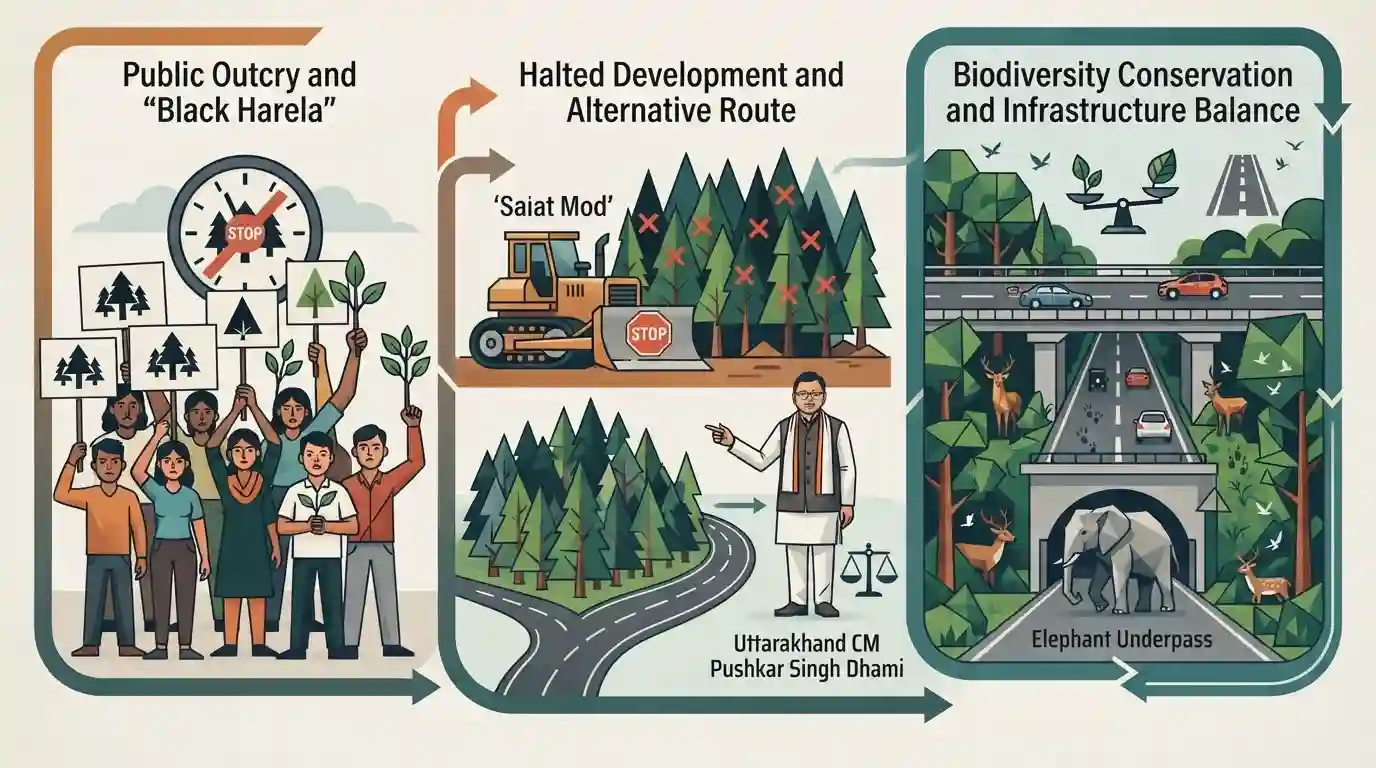
Why It Matters
Highlights the conflict between infrastructure development (highway widening) and environmental conservation (deforestation, habitat fragmentation) in ecologically sensitive regions like Uttarakhand. It also brings the state's traditional 'Harela' festival into focus as a symbol of environmental activism.
Summary
Following intense public outcry and protests by environmentalists observing a 'Black Harela', Uttarakhand CM Pushkar Singh Dhami halted tree-felling on the 'Saat Mod' stretch between Dehradun and Rishikesh. The proposed felling of over 3,000 trees was part of the NHAI's four-laning project for the Bhaniyawala-Rishikesh highway. The Chief Minister has directed officials to look for an alternative route to balance developmental needs with environmental preservation. The project had incorporated wildlife safety measures, including an elephant underpass, highlighting the delicate balance required between infrastructure development and habitat conservation in the state.
Key Points
- Uttarakhand Chief Minister Pushkar Singh Dhami ordered a halt to the felling of trees on the 'Saat Mod' stretch of the Dehradun-Rishikesh route amid widespread public protests.
- The tree-felling was slated for a four-laning highway project (Bhaniyawala-Rishikesh) implemented by the NHAI on Hybrid Annuity Mode (HAM).
- Around 3,115 sal, teak, and mango trees were marked to be felled, leading locals and environmentalists to observe 'Black Harela', protesting the traditional 'Harela' festival that celebrates nature and plantation.
- The project design includes provisions for wildlife conservation, such as a 1.25 km underpass to facilitate the movement of elephants and other wild animals.
- CM Dhami directed the PWD officials to seek an alternative route that minimizes environmental impact while proceeding with development.
Important Terms
Harela Festival

A traditional folk festival of Uttarakhand celebrating the onset of monsoon and the sowing cycle. It symbolises nature worship, greenery, and environmental conservation, where families plant seeds and worship Lord Shiva and Goddess Parvati.
UPSC context
GS Paper I (Art & Culture: Indian Festivals) and GS Paper III (Environment: Community-led ecological conservation).
National Highways Authority of India (NHAI)
A statutory autonomous body under the Ministry of Road Transport and Highways, established under the NHAI Act, 1988, responsible for developing, maintaining, and managing India's national highways network.
UPSC context
GS Paper III (Infrastructure: Roads; Statutory Bodies), testing public-private partnerships, infrastructure financing, and environmental impact of development.
Public Works Department (PWD)
A government agency at state and central levels in India tasked with the planning, construction, and maintenance of public infrastructure, including roads, bridges, government buildings, and other public utility systems.
UPSC context
GS Paper II (Governance) and GS Paper III (Infrastructure), testing the execution of state-led infrastructure projects and public asset management.
Prelims Trap
The Harela festival, which celebrates nature and plantation during the monsoon, is native to the state of Chhattisgarh.
Aspirants frequently confuse Uttarakhand's 'Harela' festival with Chhattisgarh's 'Hareli' festival, as both are monsoon-centric agricultural celebrations with highly similar names.
Static Concepts Connected
What is the Hybrid Annuity Mode (HAM) in infrastructure?
- Financing Mix: A combination of EPC (40%) and BOT-Annuity (60%) models to optimize risk.
- Revenue Collection: NHAI collects the toll risk-free for the developer, paying them in fixed biannual annuities.
- Risk Allocation: The government bears the revenue/traffic risk, while the private partner handles construction and operational risks.
Constitutional Mandates for Environmental Protection
- Article 48A: A DPSP added by the 42nd Amendment directing the State to safeguard forests and wildlife.
- Article 51A(g): A Fundamental Duty obligating citizens to protect and improve the natural environment, including forests.
- Concurrent List: Forests and wildlife protection were shifted from State to Concurrent List via the 42nd Amendment.
Cross-Topic Patterns
Traditional Festivals as Protest Tools
The evolution of Kumaon's agricultural Harela festival into 'Black Harela' illustrates how traditional cultural institutions are mobilized for contemporary environmental activism.
Linear Infrastructure vs Corridor Connectivity
Integrating elephant underpasses in highway expansions highlights the regulatory push to mandate structural eco-ducts within fragmented wildlife habitats.

Expect a 2026 question mapping infrastructure models (like HAM) alongside conservation mitigation tools like eco-ducts and underpasses.
Linked PYQs · 3
Linked PYQs · 3
- 2025UKPSC_PRELIMSGS1
Which of the following statements about causes of biodiversity loss is/are correct ? 1. Habitat loss and fragmentation are the most important cause driving animals and plants to extinction. 2. Human activities lead to over-exploitation of natural resources. 3. When a species becomes extinct, the plant and animal species associated with it do not become extinct. Choose the correct answer using following options :
- 2024UKPSC_PRELIMSGS1
Which Constitutional Amendment Act relates to the protection and improvement of environment and safeguarding of forests and wildlife ?
- 2016UKPSC_PRELIMSGS1
'HARELA' festival of Uttarakhand is related to:
