Uttarakhand Public Grievance Redressal Directives Issued for Officials
Source:aninews ↗
Why It Matters
The resolution of public grievances is a core aspect of Good Governance (GS2). For state PCS exams, the functioning of the Chief Minister's office and state administration directives form practical examples of administrative accountability and citizen-centric governance models.
Summary
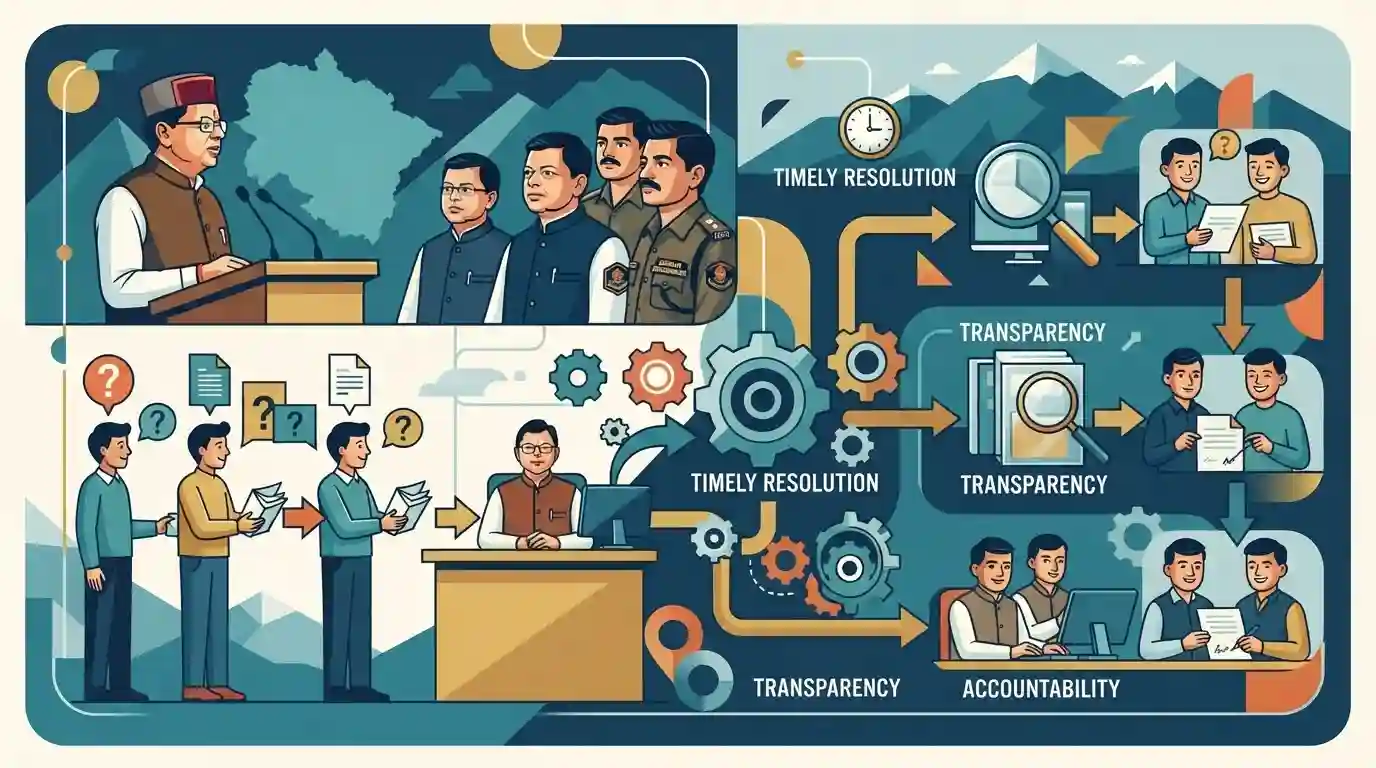
Uttarakhand Chief Minister Pushkar Singh Dhami has directed state officials to prioritize the timely resolution of public grievances. Speaking at a grievance redressal event at his camp office in Dehradun, he instructed senior officials, including the Garhwal Commissioner, to ensure prompt action on citizen complaints, underscoring the state administration's focus on good governance, transparency, and accountability.
Key Points
- Uttarakhand CM Pushkar Singh Dhami held a public grievance redressal session at Mukhya Sevak Sadan in Dehradun.
- He directed the Garhwal Commissioner and Inspector General to ensure priority-based and time-bound disposal of complaints.
- The Chief Minister emphasized the state government's commitment to delivering good governance, transparency, and accountability to citizens.
Important Terms
Public Grievance Redressal Mechanism

The formal institutional framework used to receive, process, and resolve citizens' complaints regarding public service delivery and government functioning.
UPSC context
Core to GS Paper 2 (Governance). Tests understanding of tools like CPGRAMS, Sevottam model, and administrative responsiveness.
Good Governance
A model of public administration focused on managing state affairs in an effective, equitable, transparent, and accountable manner to ensure the welfare of citizens.
UPSC context
Crucial for GS Papers 2 & 4. Tests its eight foundational principles and application in ethical public service.
Accountability
The obligation of public officials to explain their actions, justify their decisions, and accept formal responsibility for governance outcomes before citizens and institutional checks.
UPSC context
Central to GS Papers 2 & 4. Evaluates checks on power, institutional integrity, and anti-corruption mechanisms.
Transparency
The practice of keeping government decision-making processes and information openly accessible, enabling public scrutiny and preventing administrative secrecy.
UPSC context
Key for GS Papers 2 & 4. Tests the importance of the RTI Act, e-governance, and building public trust.
Citizen-Centric Administration
A governance approach that places citizens at the center of administrative priorities, ensuring seamless public service delivery while minimizing bureaucratic delays and red tape.
UPSC context
GS Paper 2 (Governance). Evaluates the shift toward responsive administration, citizen charters, and participative governance models.
State Administration
The executive machinery operating at the provincial level, responsible for implementing policies, maintaining law and order, and delivering essential public services to citizens.
UPSC context
GS Paper 2 (Polity & Governance). Tests the roles of the Chief Minister, state bureaucracy, and decentralized governance frameworks.
Prelims Trap
"CPGRAMS mandates the resolution of all citizen grievances, including pending RTI queries and sub-judice court cases."
CPGRAMS explicitly excludes certain types of grievances, including sub-judice cases, RTI matters, religious matters, and personal or family disputes. It is not an absolute, all-encompassing portal.
Static Concepts Connected
What are the three pillars of the Sevottam assessment model?
- Citizen's Charter: Publicly specifying the service delivery standards, timelines, and commitments of a government department.
- Grievance Redressal: Establishing a robust, accessible mechanism to handle and resolve complaints when service delivery standards are not met.
- Service Delivery Capability: Building the infrastructural and human resource capacity of the organization to successfully deliver on its charter commitments.
How do state-level Right to Public Services (RTPS) Acts function?
- Statutory Guarantee: They provide citizens with a statutory, legal right to receive notified public services within a strictly stipulated timeframe.
- Appellate and Penalty: They establish a tier of designated officers, appellate authorities, and mechanisms to impose financial penalties on officers for unjustified delays.
Cross-Topic Patterns
State E-portals and CPGRAMS integration
State-level grievance portals (like CM Helplines) are increasingly being integrated with the national CPGRAMS portal, reflecting cooperative federalism in standardizing citizen-centric e-governance across India.
Grievance Redressal & 2nd ARC Reforms
The 2nd ARC emphasized that robust public grievance redressal is the cornerstone of citizen-centric administration, directly tying into state rankings on the Good Governance Index (GGI).

Expect Mains questions linking state-level e-governance initiatives (like Apuni Sarkar) to the broader Sevottam model and accountability.
Linked PYQs · 1
Linked PYQs · 1
- 2025UKPSC_PRELIMSGS1
Consider the following statements with reference to Uttarakhand and choose the correct answer: 1. The executive of Uttarakhand includes Governor as the head of the state. 2. It also includes the Chief Minister and his/her council of ministers.
