Uttarakhand Single Use Plastic Ban and Tiger Day Campaign
Source:hindustantimes ↗
Why It Matters
Highlights the intersection of tourism, waste management, and wildlife conservation in ecologically fragile Himalayan states, an important case study for environmental policy and sustainable development in GS3.
Summary
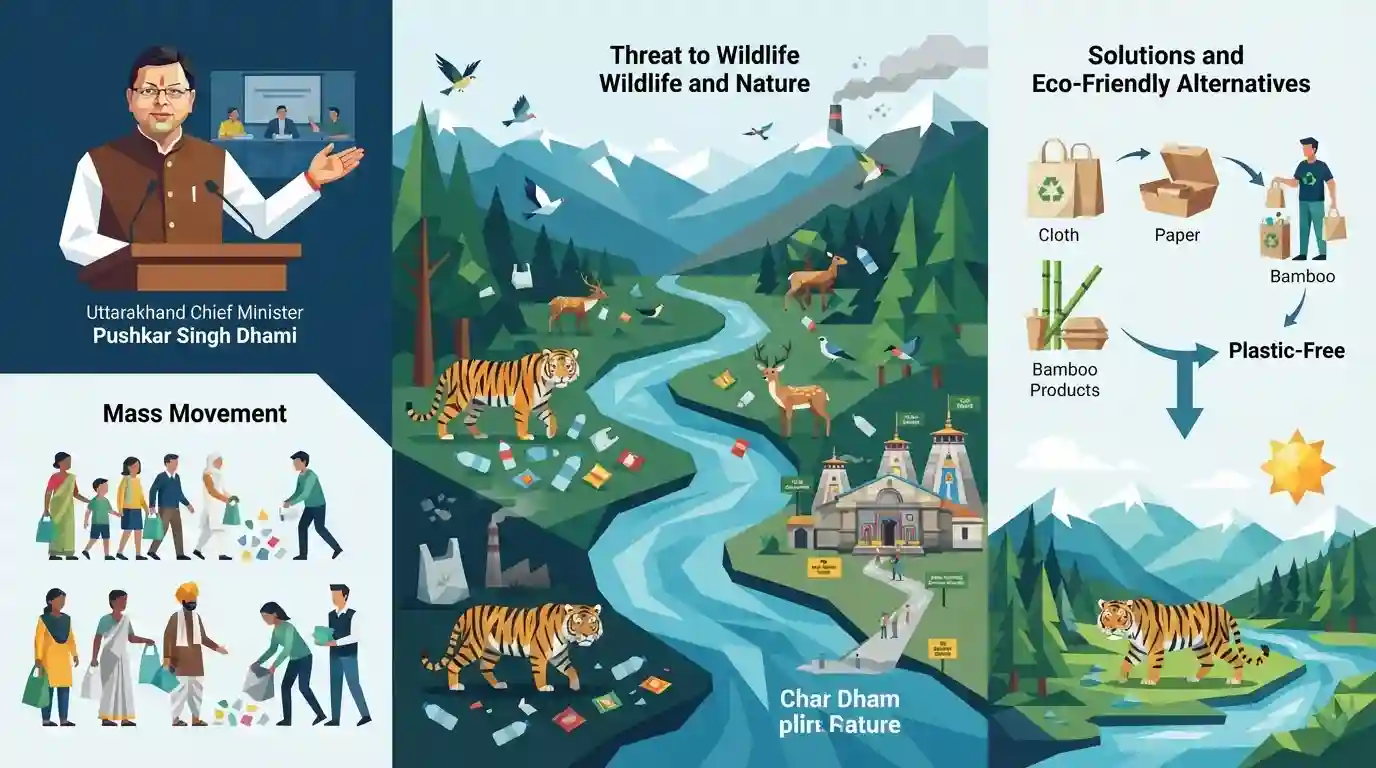
Uttarakhand Chief Minister Pushkar Singh Dhami has called for a mass movement to make the state free of single-use plastic. Speaking at a workshop on World Tiger Day, he highlighted the severe threat that plastic waste poses to the state's rivers, forests, and wildlife. The government is focusing on making the Char Dham routes and other tourist spots plastic-free while urging citizens, pilgrims, and industries to adopt eco-friendly packaging and alternative materials.
Key Points
- Uttarakhand CM Pushkar Singh Dhami emphasized the need for active public participation to effectively implement the ban on single-use plastic in the state.
- He addressed a consultation workshop organized on World Tiger Day, highlighting the threat of plastic waste to wildlife, forests, and rivers.
- Special campaigns are underway to make the Char Dham pilgrimage routes and major tourist destinations plastic-free.
- The Chief Minister appealed to citizens and industries to adopt eco-friendly alternatives and modern recycling technologies.
Important Terms
Single-Use Plastic

Disposable plastic items designed to be used only once for the same purpose before being discarded, characterized by low utility and high potential to litter.
UPSC context
GS Paper III (Environment): Important for waste management policies, Plastic Waste Management Rules, and environmental pollution.
Char Dham Yatra
A sacred Hindu pilgrimage circuit in the Indian Himalayas, encompassing four holy shrines in Uttarakhand: Yamunotri, Gangotri, Kedarnath, and Badrinath.
UPSC context
GS Paper I (Culture) and Paper III (Environment): Relevant to Himalayan ecology, sustainable infrastructure development, and disaster management.
Eco-Tourism
Sustainable, nature-based travel that minimizes negative environmental impacts, supports biodiversity conservation, and provides socio-economic benefits to local communities.
UPSC context
GS Paper III (Biodiversity & Environment): Tests sustainable development models, tourism economy, and balancing conservation with livelihood options.
International Tiger Day
Observed annually on July 29, this global awareness day was established in 2010 to promote tiger habitat protection and raise awareness about tiger conservation.
UPSC context
GS Paper III (Biodiversity & Conservation): Tests knowledge on Project Tiger, IUCN status of tigers, and national wildlife conservation strategies.
Solid Waste Management
The systematic control of the generation, storage, collection, transport, processing, and disposal of solid waste to prevent environmental pollution and protect health.
UPSC context
GS Paper III (Environment): Crucial for answers on urban infrastructure, environmental pollution, and municipal waste management rules.
Prelims Trap
"India completely banned the production and use of all single-use plastics starting July 1, 2022."
The ban is not absolute. It applies only to identified SUP items with low utility and high littering potential (e.g., plastic cutlery, ear buds).
Static Concepts Connected
What are the key provisions of Plastic Waste Management (Amendment) Rules, 2021?
- Phase-out: Prohibits specific low-utility, high-littering SUP items like plastic balloon sticks, cutlery, and thermocol.
- Thickness mandate: Increased the minimum thickness of plastic carry bags to 120 microns to facilitate collection, recycling, and reuse.
- EPR framework: Gave legal force to Extended Producer Responsibility (EPR) guidelines for plastic packaging waste management.
What is the St. Petersburg Declaration on Tiger Conservation?
- Tx2 Goal: A global commitment (Tx2 goal) made by 13 tiger range countries in 2010 to double the number of wild tigers by 2022.
- India's milestone: India successfully achieved the Tx2 target in 2018, four years ahead of the global deadline.
Cross-Topic Patterns
Himalayan ecology & carrying capacity
The push for plastic-free Char Dham routes links directly to recent Supreme Court interventions on assessing the carrying capacity of fragile Himalayan eco-sensitive zones.
Wildlife corridors & waste pollution
Linking World Tiger Day to plastic waste highlights how unregulated tourism and solid waste fragment Shivalik-Gangetic tiger habitats, worsening human-wildlife conflict.

Expect a 2026 prelims question combining Extended Producer Responsibility (EPR) under Plastic Rules with Himalayan carrying capacity.
Linked PYQs · 5
Linked PYQs · 5
- 2025UKPSC_PRELIMSGS1
Match the items given in Column-I and II : | Column-I | Column-II | |---|---| | A. Biomagnification | 1. Synthesis of ozone | | B. Electrostatic precipitation | 2. Solid waste | | C. Landfills | 3. Concentration build up at successive trophic levels | | D. Stratosphere | 4. Particulate matter | Codes : A B C D
- 2025UKPSC_PRELIMSGS1
Which of the following statements about causes of biodiversity loss is/are correct ? 1. Habitat loss and fragmentation are the most important cause driving animals and plants to extinction. 2. Human activities lead to over-exploitation of natural resources. 3. When a species becomes extinct, the plant and animal species associated with it do not become extinct. Choose the correct answer using following options :
- 2025UKPSC_PRELIMSGS1
Consider the following statements and select the correct answer from the options given below : Statement 1 : Uttarakhand is highly vulnerable to climate change. Statement 2 : Climate change is causing water stress and depleting biodiversity in Uttarakhand.
- 2016UKPSC_PRELIMSGS1
Maintenance of genetic diversity in National Parks is done by
- 2024UKPSC_PRELIMSGS1
Which of the following National Park of Uttarakhand has been included in Project Tiger Scheme in 2015 ?
