Uttarakhand Government Observes Emergency Commemoration and Welfare
Source:hindustantimes ↗
Why It Matters
This article bridges state-level governance (welfare policies for Loktantra Senanis) with central constitutional concepts such as the 1975 National Emergency, Article 352, and the post-Emergency amendments that shaped India's modern democratic structure.
Summary
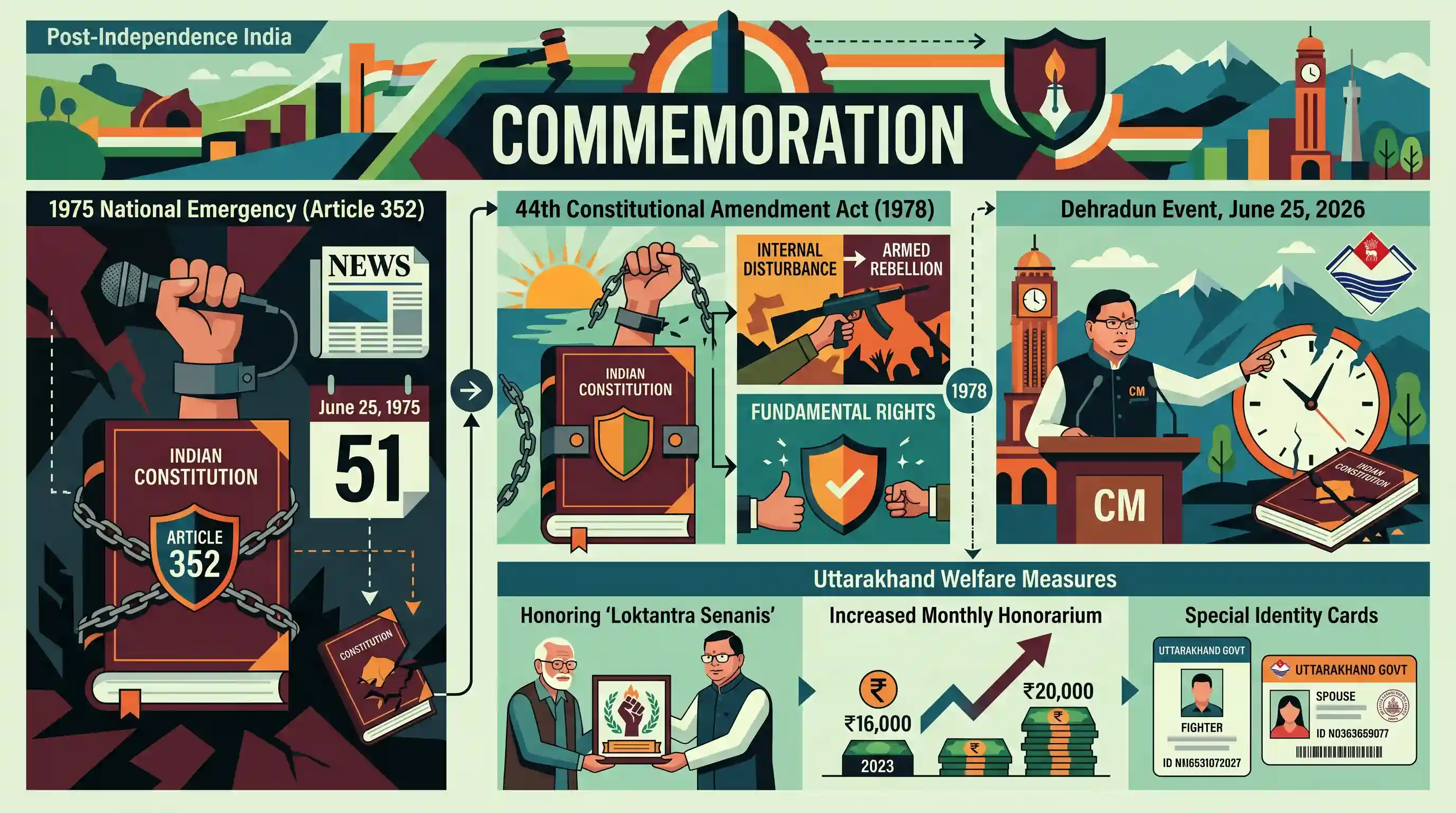
Uttarakhand Chief Minister Pushkar Singh Dhami observed 'Samvidhan Hatya Diwas' in Dehradun on June 25, 2026, commemorating the 51st anniversary of the 1975 Emergency. During the event, he honored 'Loktantra Senanis' (democracy fighters) and detailed welfare measures taken by the state government, including increasing their monthly honorarium from ₹16,000 to ₹20,000 in 2023 and issuing special identity cards to the fighters and their dependent spouses.
Key Points
- Uttarakhand CM Pushkar Singh Dhami marked the 51st anniversary of the 1975 Emergency as 'Samvidhan Hatya Diwas' (Constitution Murder Day) on June 25, 2026, in Dehradun.
- He honored 'Loktantra Senanis' (democracy fighters) and their family members for their sacrifices and efforts to restore democratic values and civil liberties during the Emergency.
- The Uttarakhand state government increased the monthly pension/honorarium for Loktantra Senanis from ₹16,000 to ₹20,000 in 2023.
- The state government has issued special identity cards to Loktantra Senanis imprisoned during the Emergency and their dependent spouses to facilitate state benefits.
- The political background ties into Article 352 of the Indian Constitution, the suspension of fundamental rights under Articles 358 and 359, and subsequent reforms under the 44th Constitutional Amendment Act of 1978.
Important Terms
Samvidhan Hatya Diwas

Observed annually on June 25, this day commemorates the imposition of the 1975 Emergency, honoring those who fought against the suspension of democratic rights and celebrating the resilience of India's Constitution.
UPSC context
GS Paper II (Polity): Constitutional history, Emergency provisions (Article 352), and safeguards for democratic institutions.
Loktantra Senani Honorarium Scheme
A welfare initiative by state governments, like Uttarakhand, providing monthly pensions and benefits to individuals (or their surviving spouses) imprisoned under MISA or DIR during the 1975–1977 National Emergency.
UPSC context
GS Paper II (Governance): Welfare schemes for vulnerable sections; GS Paper I: Post-independence political history.
Uttarakhand Government
The state-level governing authority of Uttarakhand, established under the Constitution of India, executing state laws and policies through an elected legislature and cabinet headed by the Chief Minister.
UPSC context
GS Paper II (State Executive & Federalism): Structure and functioning of state governments, center-state relations, and regional welfare policies.
Bharatiya Janata Party (BJP)
A major national political party in India, founded in 1980, known for its nationalist ideology and currently heading the ruling National Democratic Alliance coalition at the Centre.
UPSC context
GS Paper II (Polity): Political party systems, electoral politics, and representation of people's issues in a parliamentary democracy.
Prelims Trap
The President can declare a National Emergency under Article 352 based solely on the written advice of the Prime Minister.
The 44th Amendment explicitly changed this to the written advice of the entire Union Cabinet (ministers of cabinet rank), not just the Prime Minister, to prevent unilateral declarations.
Static Concepts Connected
What are the key differences between Articles 358 and 359 regarding the suspension of Fundamental Rights?
- Automatic vs Presidential Order: Article 358 automatically suspends the rights under Article 19, whereas Article 359 only suspends the right to move courts for enforcement of specified rights.
- External vs Internal Emergency: Article 358 applies only during external emergencies (war/aggression), whereas Article 359 can operate during both external and internal emergencies.
- Inviolable Articles: Under Article 359, the President cannot suspend the enforcement of Articles 20 (protection against conviction) and 21 (right to life and liberty).
How did the 44th Amendment Act of 1978 reform the Emergency provisions under Article 352?
- Grounds Modified: Substituted the term 'internal disturbance' with 'armed rebellion' to limit the scope of declaring an internal emergency.
- Cabinet Consent: Mandated that the President can only declare emergency on the written recommendation of the entire Union Cabinet.
- Stricter Approval: Requires parliamentary approval within one month (instead of two) by a special majority in both Houses.
Cross-Topic Patterns
Executive overreach vs judicial review
The historical shift from the 38th Amendment to the Minerva Mills case (1980) established that National Emergency proclamations remain subject to judicial review for mala fide intent.
State welfare and federal narratives
State-level 'Loktantra Senani' pension schemes showcase how state welfare policies align with national political narratives, reflecting elements of cooperative and competitive federalism.

Expect a multi-statement Prelims question testing the subtle operational differences between Article 358 and Article 359 post-44th Amendment.
Linked PYQs · 3
Linked PYQs · 3
- 2021UKPSC_PRELIMSGS1
Right to Property belongs to which category amongst the following?
- 2025UKPSC_PRELIMSGS1
Which of the following rights is/are not included in the 'Right to Freedom' under Article 19(1) ? 1. Right of equal opportunities 2. Right to assemble peaceably 3. Right to practise any profession 4. Freedom of speech and expression
- 2025UKPSC_PRELIMSGS1
Which among the following pairs is correctly matched? 1. Chairman of First Finance Commission - Nityanand Swami 2. First Advocate General of Uttarakhand - Nanda Ballabh Tiwari 3. First Chief Minister of Uttarakhand - Indu Kumar Pandey 4. First Woman Governor of Uttarakhand - Margaret Alva
