Uttarakhand Minority Education Authority Replaces State Madrasa Board
Source:indianmasterminds ↗
Why It Matters
The replacement of the Madrasa Board with a secular, modern education authority and the implementation of the UCC are critical legislative and governance developments in Uttarakhand, highly relevant for GS2 questions on vulnerable sections, state policies, and the Constitution.
Summary
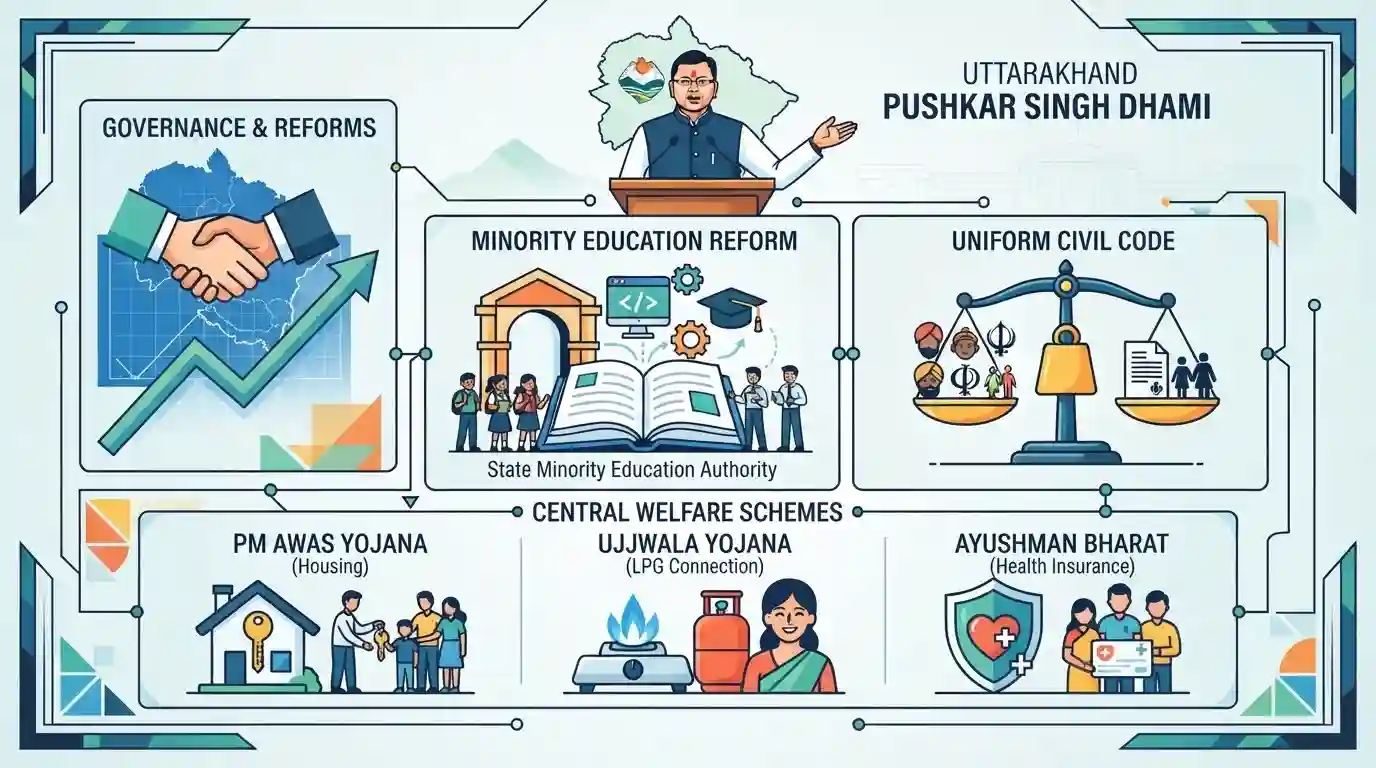
Uttarakhand Chief Minister Pushkar Singh Dhami addressed a Beneficiary Conference in Dehradun, highlighting key governance and welfare reforms. He emphasized the state's focus on minority education through the creation of the State Minority Education Authority, which replaces the traditional Madrasa Board to offer modern, skill-based education. Additionally, Dhami lauded Uttarakhand's pioneering implementation of the Uniform Civil Code (UCC) and celebrated the positive societal impacts of central schemes like the PM Awas Yojana, Ujjwala Yojana, and Ayushman Bharat.
Key Points
- Chief Minister Pushkar Singh Dhami attended a Beneficiary Conference in Dehradun, emphasizing the state's commitment to equitable development.
- The Uttarakhand government has replaced the Madrasa Board with the State Minority Education Authority to provide modern and employment-oriented education to minority communities.
- Uttarakhand's historic implementation of the Uniform Civil Code (UCC) was underscored as a crucial measure for ensuring equal rights, dignity, and justice, especially for women.
- The conference celebrated the success of major central welfare initiatives, including PM Awas Yojana, Ujjwala Yojana, and Ayushman Bharat, in improving citizens' lives.
Important Terms
Uniform Civil Code (UCC)

A proposed or unified personal law framework replacing diverse religion-specific personal laws governing marriage, divorce, inheritance, and adoption for all citizens, as outlined under Article 44 of the Indian Constitution.
UPSC context
GS Paper II: Indian Constitution, Directive Principles of State Policy (Article 44), personal law reforms, and gender justice.
State Minority Education Authority
The Uttarakhand State Minority Education Authority (USMEA) is a unified regulatory body established in 2026 to oversee and modernize educational institutions of all six notified minority communities under a common framework.
UPSC context
GS Paper II: Governance, minority welfare, educational reforms, and fundamental rights (Articles 29 and 30).
Uttarakhand Madrasa Board
The state regulatory body responsible for overseeing traditional Islamic schools (madrasas) in Uttarakhand, which was officially dissolved in July 2026 to integrate madrasa students into the mainstream, modern, and skill-based educational framework.
UPSC context
GS Paper II: Social justice, educational policy, and administrative reforms affecting minority communities.
Pradhan Mantri Awas Yojana
A flagship centrally sponsored housing scheme launched in 2015-16 divided into Urban (PMAY-U) and Gramin (PMAY-G) components, aiming to provide affordable, all-weather pucca houses with basic amenities to eligible socio-economically weaker sections.
UPSC context
GS Paper II: Social justice, welfare schemes, and urban/rural development initiatives.
Ujjwala Yojana
A flagship central sector social welfare scheme launched in 2016 to provide clean cooking fuel (LPG connections) to adult women from below poverty line (BPL) households, reducing indoor air pollution and health hazards.
UPSC context
GS Paper II & III: Women empowerment, health indicators, clean energy transition, and pollution reduction.
Ayushman Bharat
The world's largest government-funded health assurance scheme, launched in 2018, providing cashless health coverage of up to ₹5 lakh per family per year for secondary and tertiary care hospitalization to vulnerable families.
UPSC context
GS Paper II: Social sector, public health governance, financial protection against medical poverty, and universal health coverage.
Prelims Trap
The State Minority Education Authority was created to exclusively regulate Islamic educational institutions.
Although the Authority replaces the Madrasa Board, it regulates educational institutions for all six centrally notified minority communities (Muslims, Christians, Sikhs, Parsis, Jains, Buddhists).
Static Concepts Connected
Can the State regulate minority educational institutions under Article 30?
- Not absolute: The right to administer under Article 30(1) is not absolute. The state can introduce reasonable regulations to maintain academic excellence and educational standards.
- Permissible checks: The state can legally intervene to prevent maladministration, ensure health and hygiene standards, and prescribe minimum educational qualifications for teachers.
- Core autonomy: However, state regulations cannot destroy the minority character of the institution or completely strip the management's administrative autonomy.
How can individual states implement a Uniform Civil Code (UCC)?
- Concurrent List: Personal laws like marriage, divorce, and succession fall under Entry 5 of the Concurrent List, allowing both the Centre and State legislatures to pass laws.
- Presidential Assent: Under Article 254(2), a state law on a Concurrent List subject that contradicts Central law can prevail within that state if it receives Presidential assent.
- DPSP Mandate: Article 44 directs the State to endeavor to secure a UCC, providing constitutional and philosophical backing for state-level legislative efforts like Uttarakhand's.
Cross-Topic Patterns
Concurrent List and State UCCs
Because personal laws are in the Concurrent List, individual states can enact a UCC, overriding existing central personal laws, provided they obtain Presidential assent under Article 254(2).
RTE Exemptions vs Minority Status
Minority institutions enjoy exemption from the RTE Act. When states try to enforce modern education standards through statutory authorities, it often sparks legal battles over Article 30 autonomy.

State regulation of Article 30 minority institutions and the Concurrent List mechanics of state-level UCCs are high-probability 2026 topics.
Linked PYQs · 2
Linked PYQs · 2
- 2025UKPSC_PRELIMSGS1
A key focus of Viksit Bharat Yatra is to disseminate information and facilitate access to which of the following areas ?
- 2025UKPSC_PRELIMSGS1
What was the key focus of the Waqf Amendment Bill introduced in April, 2025 ?
