Uttarakhand CM Dhami attends Judicium conference at UPES Dehradun
Source:ani ↗
Why It Matters
This article highlights the convergence of state governance and judiciary, focusing on judicial accessibility in hilly terrains, technological modernization (e-Courts), and milestone state policies (UCC, anti-copying laws) which are recurring themes in UKPSC PCS Prelims.
Summary
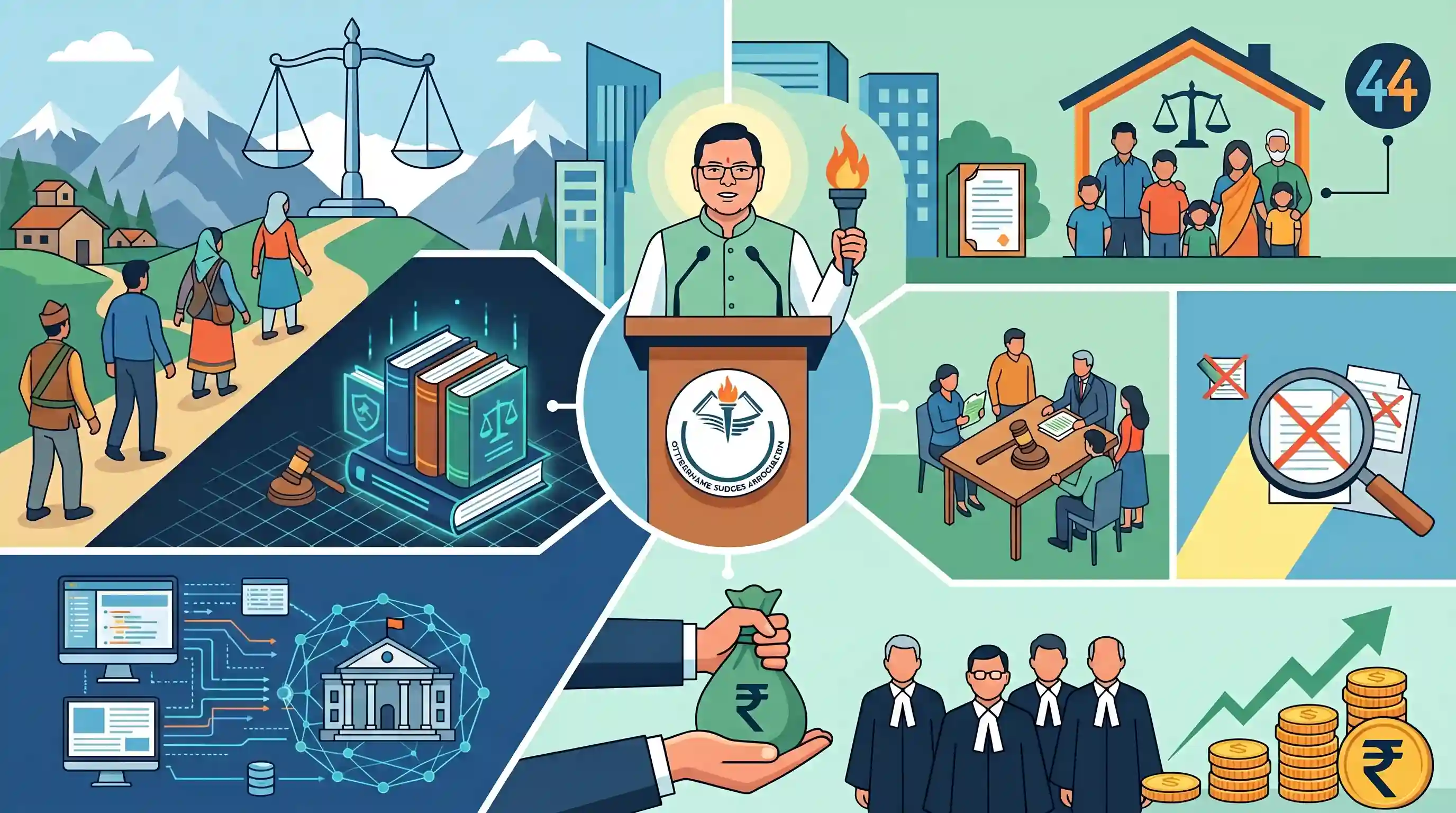
Uttarakhand CM Pushkar Singh Dhami attended 'Judicium 2.0', the annual conference of the Uttarakhand Judges Association at UPES Bidholi in Dehradun. He emphasized making justice delivery inclusive, transparent, and accessible, particularly for remote mountainous regions. He highlighted several national and state-level judicial and administrative reforms, including the new criminal laws (BNS, BNSS, BSA), the e-Courts project, Uttarakhand's Uniform Civil Code (UCC), Revenue Lok Adalats, and strict anti-copying laws. Additionally, he announced a Rs 5 crore welfare fund allocation for the association.
Key Points
- Chief Minister Pushkar Singh Dhami attended 'Judicium 2.0: Inclusion, Access and Strengthening,' the annual conference of the Uttarakhand Judges Association, held at UPES Bidholi in Dehradun.
- The CM emphasized that timely, impartial, and inclusive justice delivery is crucial for remote, mountainous regions of Uttarakhand, ensuring geography or economic challenges do not hinder legal access.
- Modernisation of the judicial system was highlighted, referencing the implementation of the new criminal laws (BNS, BNSS, BSA) alongside digital reforms like e-Courts, National Judicial Data Grid (NJDG), e-filing, and virtual hearings.
- Key state-specific initiatives were underscored, including the historic implementation of the Uniform Civil Code (UCC) in Uttarakhand, Revenue Lok Adalats for land dispute resolution, and strict anti-copying and anti-conversion laws.
- The Chief Minister announced an allocation of Rs 5 crore for the welfare fund of the Uttarakhand Judges Association and released their commemorative publication.
Important Terms
Uniform Civil Code (UCC)

A common set of civil laws governing personal matters like marriage, divorce, and inheritance for all citizens, irrespective of religion, aimed at standardizing civil laws across communities.
UPSC context
GS Paper II (Polity). Tests knowledge of Article 44 (DPSP), personal law reforms, gender justice, and federalism.
Bharatiya Nyaya Sanhita (BNS)
India's codified substantive penal law, effective July 1, 2024, replacing the colonial-era Indian Penal Code of 1860, modernizing offenses and introducing reformative justice.
UPSC context
GS Paper II (Criminal Justice). Tests awareness of new penal provisions, decolonizing laws, and structural legal changes.
Bharatiya Nagarik Suraksha Sanhita (BNSS)
The procedural framework governing arrests, investigations, and trials in India, replacing the Code of Criminal Procedure, 1973 to incorporate technology-driven and time-bound justice.
UPSC context
GS Paper II (Judicial Reforms). Tests procedural reform awareness, police accountability, and digital integration in justice systems.
Bharatiya Sakshya Adhiniyam (BSA)
The legislative framework governing admissibility of evidence for fair trials, replacing the Indian Evidence Act, 1872 to modernize regulations on digital and electronic evidence.
UPSC context
GS Paper II (Governance/Tech). Tests digital evidentiary standards, judicial modernization, and legal admissibility protocols.
e-Courts Project
A collaborative national project initiated in 2007 for the ICT enablement of the Indian judiciary to enhance court efficiency, accessibility, and transparency.
UPSC context
GS Paper II (E-Governance/Judiciary). Tests digital public infrastructure, reducing court pendency, and tech-driven inclusive justice.
Legal Services Authorities Act, 1987
A statutory act establishing organizations like NALSA to deliver free, competent legal services to weaker sections and conduct Lok Adalats for dispute resolution.
UPSC context
GS Paper II (Statutory Bodies). Tests implementation of Article 39A, alternative dispute resolution, and marginalized access to justice.
Uttarakhand Anti-Copying Law
Strictest state-level legislation (enacted as an ordinance in 2023) addressing exam paper leaks, penalizing culprits with life imprisonment and massive fines.
UPSC context
GS Paper II (State Policies). Tests state governance, public exam reforms, integrity systems, and administrative deterrence.
Prelims Trap
The Governor has sole authority over the postings, promotions, and disciplinary matters of officers in the state's subordinate judiciary.
While the Governor makes formal appointments under Article 233, Article 235 vests exclusive administrative and disciplinary control in the High Court to safeguard judicial independence.
Static Concepts Connected
What are the constitutional provisions governing the Subordinate Judiciary?
- Article 233 Appointments: District Judges are appointed, posted, and promoted by the Governor of the State in consultation with the High Court.
- Eligibility Criteria: Direct recruitment requires a minimum of seven years of practice as an advocate and a recommendation for appointment by the High Court.
- Article 235 Control: Administrative and disciplinary control over district and subordinate courts is vested exclusively in the High Court to ensure separation of powers.
How does the Uniform Civil Code (UCC) align with state legislative powers?
- Article 44 Mandate: Article 44 of the Directive Principles of State Policy directs the State to secure a Uniform Civil Code for all citizens.
- Concurrent List Entry: Personal laws like marriage, divorce, and inheritance fall under Entry 5 of the Concurrent List, enabling state-level legislations.
- Tribal Protections: State UCCs must navigate tribal exemptions (Article 342) to protect indigenous customary laws from being overridden.
Cross-Topic Patterns
Subordinate judiciary + Separation of powers
Separation of powers under Article 50 is protected by vesting administrative control of lower courts in the High Court (Article 235), preventing state executive interference.
Digital justice + Right to access remedy
Phase III e-Courts project operationalizes Article 39A (equal justice) by using virtual hearings to bypass physical and geographical hurdles in mountainous terrains.

Constitutional division of power between the Governor and High Court over subordinate courts under Articles 233-235 is highly testable.
Linked PYQs · 3
Linked PYQs · 3
- 2024UKPSC_PRELIMSGS1
Who has been appointed as first woman Chief Justice of Uttarakhand High court ?
- 2024UKPSC_PRELIMSGS1
Regarding the Directive Principles of State Policy, which one of the following statements is not correct ?
- 2016UKPSC_PRELIMSGS1
In which year was the Collegium System for the appointment of Judges adopted by the Supreme Court of India?
