Uttarakhand Approves Ten Crore Rupees for Temples and Infrastructure
Source:indianmasterminds ↗
Why It Matters
UKPSC routinely tests candidates on micro-geographical and cultural details, such as the exact districts of minor temples, state budgetary allocations for infrastructure, and local tourism initiatives like Beatles Street near Chauraasi Kutiya.
Summary
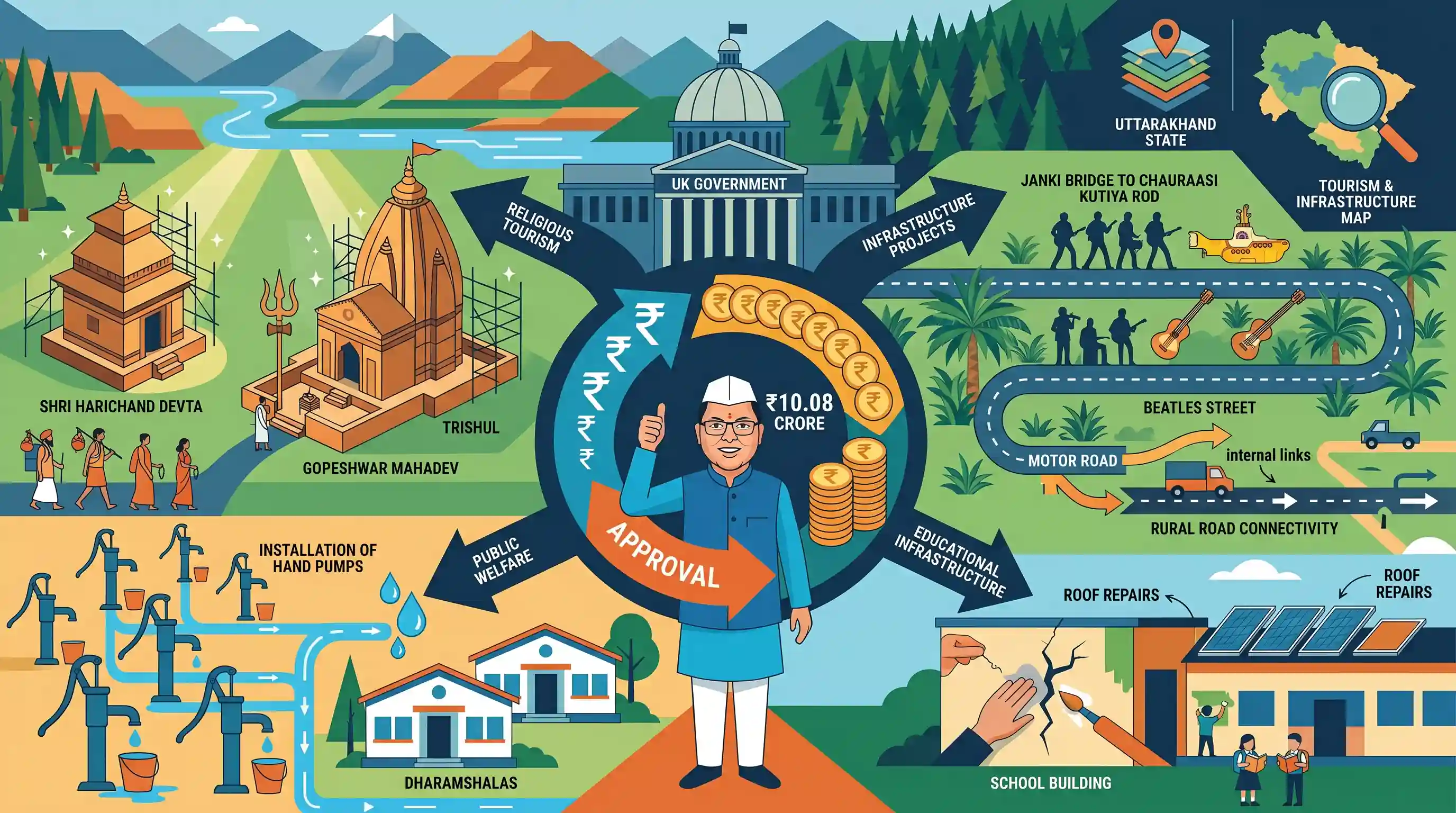
The Government of Uttarakhand, led by Chief Minister Pushkar Singh Dhami, approved ₹10.08 crore to promote religious tourism, improve rural road connectivity, and expand basic public amenities across the state. Notable initiatives include developing the Janki Bridge to Chauraasi Kutiya road in Yamkeshwar as 'Beatles Street', upgrading local temples (such as Shri Harichand Devta and Gopeshwar Mahadev), and funding public welfare projects like hand pumps and educational infrastructure repairs.
Key Points
- Uttarakhand CM Pushkar Singh Dhami has approved administrative and financial sanctions worth ₹10.08 crore for integrated development projects across several districts.
- The funding is divided into temple beautification/master planning, road connectivity and upgrades, and public welfare/rural infrastructure.
- Significant temple projects include the Shri Harichand Devta Temple in Didihat (Pithoragarh), Gopeshwar Mahadev Temple in Someshwar (Almora), and Shiva Temple in Bhikiyasain (Almora).
- Under connectivity, the road from Janki Bridge to Chauraasi Kutiya in Yamkeshwar will be developed as 'Beatles Street' with an allocation of ₹85.74 lakh.
- Public infrastructure upgrades include setting up community dharamshalas in Nainital district, installing 50 hand pumps in Someshwar, and repairing Shri Guru Nanak Public Girls Inter College in Dehradun.
Important Terms
Chaurasi Kutiya

A historic ashram in Rishikesh, Uttarakhand, established in 1961 by Maharishi Mahesh Yogi. Popularly called the "Beatles Ashram," it is situated in the Rajaji Tiger Reserve and is being developed as a heritage tourism destination.
UPSC context
GS Paper I (Art and Culture) and State PCS. Tests knowledge of historical spiritual sites, cultural heritage, and modern tourism development.
Rajaji Tiger Reserve
A national park and tiger reserve spanning Dehradun, Haridwar, and Pauri Garhwal districts in Uttarakhand. Located in the Shivalik range, it is rich in biodiversity and majorly known for Asiatic elephants.
UPSC context
GS Paper III (Environment and Biodiversity). Tests knowledge of protected areas, wildlife conservation, and regional ecological significance.
Transcendental Meditation
A silent, mantra-based meditation technique introduced by Maharishi Mahesh Yogi in the mid-1950s. It aims to reduce stress and promote deep relaxation, gaining global prominence in the 1960s.
UPSC context
GS Paper I (Art and Culture / Indian Philosophy). Tests understanding of modern yoga movements and global cultural export.
Rishikesh
A sacred city in Uttarakhand situated on the banks of the Ganges. Revered as the "Yoga Capital of the World," it is a major international spiritual and adventure tourism center.
UPSC context
GS Paper I (Salient features of Indian Society / Pilgrimage Sites) and GS Paper III (Tourism Economy). Tests knowledge of cultural landscapes.
Religious Tourism
A form of tourism where travel is primarily motivated by religious or spiritual purposes, such as pilgrimages, visiting sacred sites, or participating in religious festivals and rituals.
UPSC context
GS Paper III (Infrastructure and Economic Development). Tests government policies like PRASHAD, Swadesh Darshan, and state-level spiritual tourism initiatives.
Prelims Trap
The Chand Dynasty of Kumaon established its rule in the 10th century by succeeding the Gurkha invaders.
The Chand Dynasty succeeded the ancient Katyuri Dynasty. Gurkha rule actually ended the Chand dynasty's reign in Kumaon in 1790, not the other way around.
Static Concepts Connected
Who were the Chands of Kumaon and what was their historical significance?
- Succession and Origin: Founded by Som Chand in the 10th century, they succeeded the Katyuris and ruled Kumaon until the Gurkha invasion of 1790.
- Architectural Legacy: They shifted their capital to Almora and patronized unique hill-temple architecture, blending indigenous styles with mainstream Nagara elements.
What are the key ecological features of the Rajaji Tiger Reserve?
- Location & Geography: Spans the Shivalik range in Uttarakhand, forming an important corridor for northwestern elephant and tiger populations.
- River Systems: It is bisected by the Ganga River, and its major tributaries like the Song and Suswa flow through the reserve.
Cross-Topic Patterns
Ecotourism vs. Forest Conservation
Developing tourist pathways like 'Beatles Street' inside tiger reserve buffer zones tests the regulatory balance under the Wildlife Protection Act and Forest Conservation rules.
Tourism-led rural migration mitigation
Upgrading rural infrastructure and temple circuits serves as an economic policy to stem out-migration and revive 'ghost villages' in Uttarakhand's hill districts.

Central Himalayan dynasties like the Chands and Katyuris, and their temple locations, remain highly probable targets for UPSC history MCQs.
Linked PYQs · 3
Linked PYQs · 3
- 2024UKPSC_PRELIMSGS1
UTDB is established in Uttarakhand to promote:
- 2024UKPSC_PRELIMSGS1
Hindu religious pilgrimage place named 'Purnagiri' is situated in which of the following districts of Uttarakhand ?
- 2025UKPSC_PRELIMSGS1
As per Uttarakhand Budget 2025-26, the amount allocated for Char Dham Road network improvement is
