Uttarakhand Approves Funds for AMRUT Water and University Projects
Source:indianmasterminds ↗
Why It Matters
UKPSC Prelims routinely tests knowledge of state-specific schemes, institutional locations (like the University in Bharsar or Dundeshwar Temple), and budget allocations to major infrastructure or tourism initiatives. Knowledge of AMRUT 2.0 implementation in the state is also relevant for urban infrastructure topics.
Summary
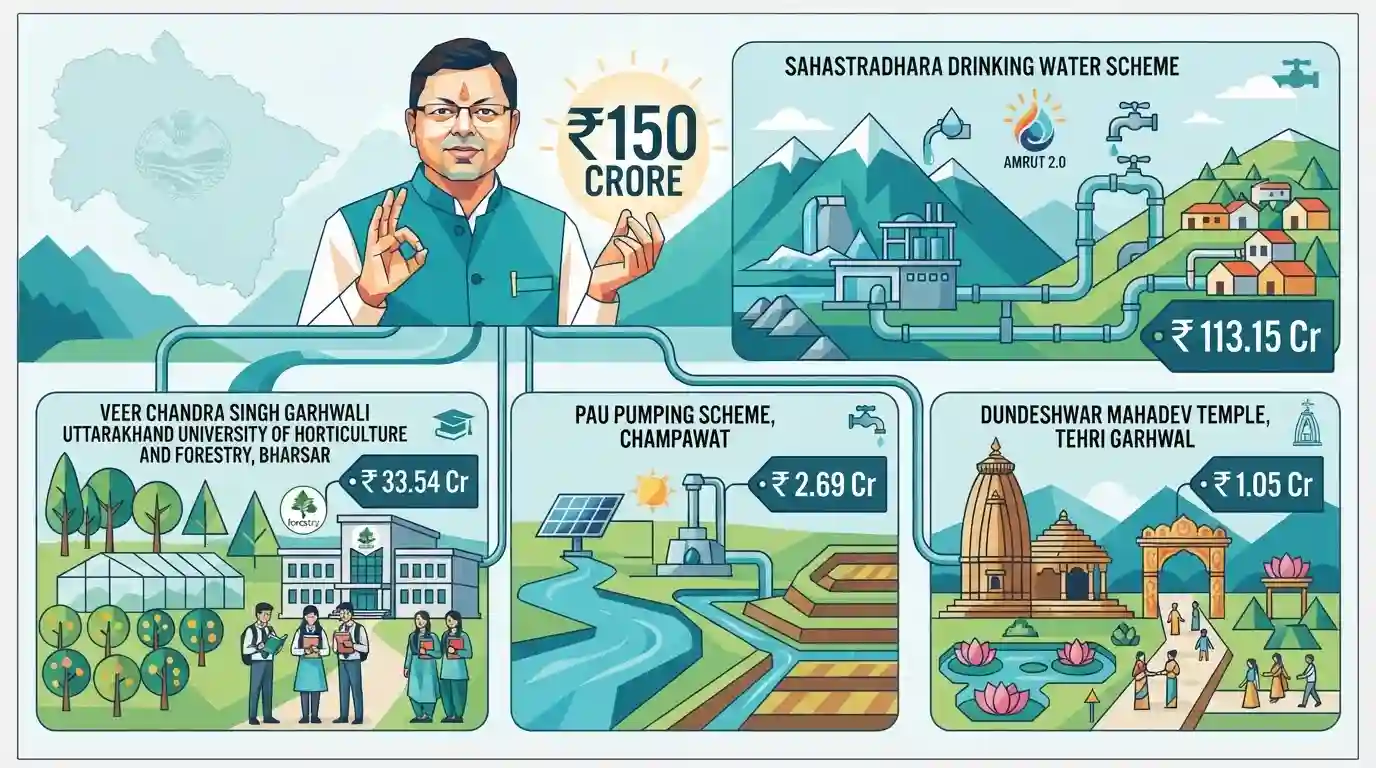
Uttarakhand Chief Minister Pushkar Singh Dhami has greenlit financial sanctions totaling approximately Rs 150 crore to advance regional development in education, drinking water, and religious tourism. Key allocations include Rs 113.15 crore for the Sahastradhara Drinking Water Scheme (under AMRUT 2.0), Rs 33.54 crore from the State Contingency Fund for the Veer Chandra Singh Garhwali Uttarakhand University of Horticulture and Forestry in Bharsar, and Rs 1.05 crore to beautify the Dundeshwar Mahadev Temple in Tehri Garhwal. An additional Rs 2.69 crore will fund the Pau Pumping Scheme in Champawat.
Key Points
- Uttarakhand CM Pushkar Singh Dhami has approved financial sanctions of nearly Rs 150 crore across education, drinking water, and tourism sectors.
- Rs 113.15 crore was allocated for the Sahastradhara Drinking Water Scheme under the AMRUT 2.0 programme.
- Rs 33.54 crore was approved from the State Contingency Fund for the Veer Chandra Singh Garhwali Uttarakhand University of Horticulture and Forestry situated in Bharsar.
- Rs 1.05 crore was earmarked for the beautification of the Dundeshwar Mahadev Temple in Tehri Garhwal district to boost religious tourism.
- Rs 2.69 crore was granted for the Pau Pumping Scheme in Lohaghat block, Champawat district.
Important Terms
AMRUT 2.0

The Atal Mission for Rejuvenation and Urban Transformation 2.0 is a central scheme launched in 2021 to ensure universal water supply and sewerage coverage across all statutory towns and promote a circular economy of water.
UPSC context
GS Paper 2 (Governance) and GS Paper 3 (Infrastructure). Tests knowledge of urban water management and centrally sponsored schemes.
Sahastradhara Drinking Water Scheme
A major ₹113.15 crore drinking water infrastructure project in Dehradun, Uttarakhand. Approved under AMRUT 2.0, it is implemented by the Uttarakhand Jal Sansthan to ensure regular urban water supply.
UPSC context
Important for State PSC and GS Paper 3 (Infrastructure). Tests awareness of regional urban development projects and AMRUT implementation.
Pau Pumping Scheme
A drinking water project in the Lohaghat block of Champawat district, Uttarakhand. It recently received ₹2.69 crore to strengthen pumping capacity and improve the area's local water supply facilities.
UPSC context
Relevant for Uttarakhand State PCS and GS Paper 3 (Infrastructure). Highlights state-level efforts in decentralized water infrastructure management.
State Contingency Fund
Established under Article 267(2) of the Indian Constitution, this fund is placed at the Governor's disposal to meet urgent, unforeseen expenditures pending formal authorization by the State Legislature.
UPSC context
GS Paper 2 (Polity). Tests constitutional knowledge regarding state financial administration, legislative financial control, and the powers of the Governor.
Prelims Trap
"The State Contingency Fund is placed at the disposal of the Chief Minister for immediate development projects."
Under Article 267(2) of the Constitution, the State Contingency Fund is placed at the disposal of the Governor, not the Chief Minister.
Static Concepts Connected
How does the State Contingency Fund operate under Article 267(2)?
- Constitutional Basis: Established by the State Legislature in the nature of an imprest to meet emergency or unforeseen expenditures.
- Executive Authority: It is placed at the disposal of the Governor, allowing advances pending formal authorization by the state legislature.
- Legislative Approval: Advances made from the fund must subsequently be authorized by the State Legislature, after which the fund is replenished.
What was the Peshawar Incident of 1930?
- Historical Context: Occurred in April 1930 during the Civil Disobedience Movement, led by Khan Abdul Ghaffar Khan's Khudai Khidmatgars (Red Shirts).
- The Incident: Veer Chandra Singh Garhwali and soldiers of the Royal Garhwal Rifles refused British orders to fire upon unarmed Pathan protestors.
- Significance: It demonstrated early signs of nationalist sympathy and insubordination within the British Indian Army ranks.
Cross-Topic Patterns
Urban vs. Rural Water Security Schemes
While AMRUT 2.0 (MoHUA) aims for universal water supply across statutory towns, the Jal Jeevan Mission (Ministry of Jal Shakti) focuses on functional household tap connections in rural areas.
Himalayan Hydrology & Micro-Tributaries
Sahastradhara's Baldi river feeds the Song river, which joins the Ganga. UPSC increasingly probes these micro-tributary and natural spring systems rather than just major peninsular or Himalayan rivers.

Expect 2026 prelims to test micro-tributaries (like the Song River) or Governor powers over the Article 267(2) State Contingency Fund.
Linked PYQs · 2
Linked PYQs · 2
- 2024UKPSC_PRELIMSGS1
UTDB is established in Uttarakhand to promote:
- 2025UKPSC_PRELIMSGS1
Where is the Herbal Research and Development Institute of Uttarakhand situated?
