Development Projects Worth Crores Approved for Infrastructure
Source:indian-masterminds ↗
Why It Matters
Information on district-specific state infrastructure like the Tankul Hydropower Project and tourist locations like Chaukori is critical for UKPSC Prelims. Such facts directly map to state-geography and economy MCQs frequently asked in the examination.
Summary
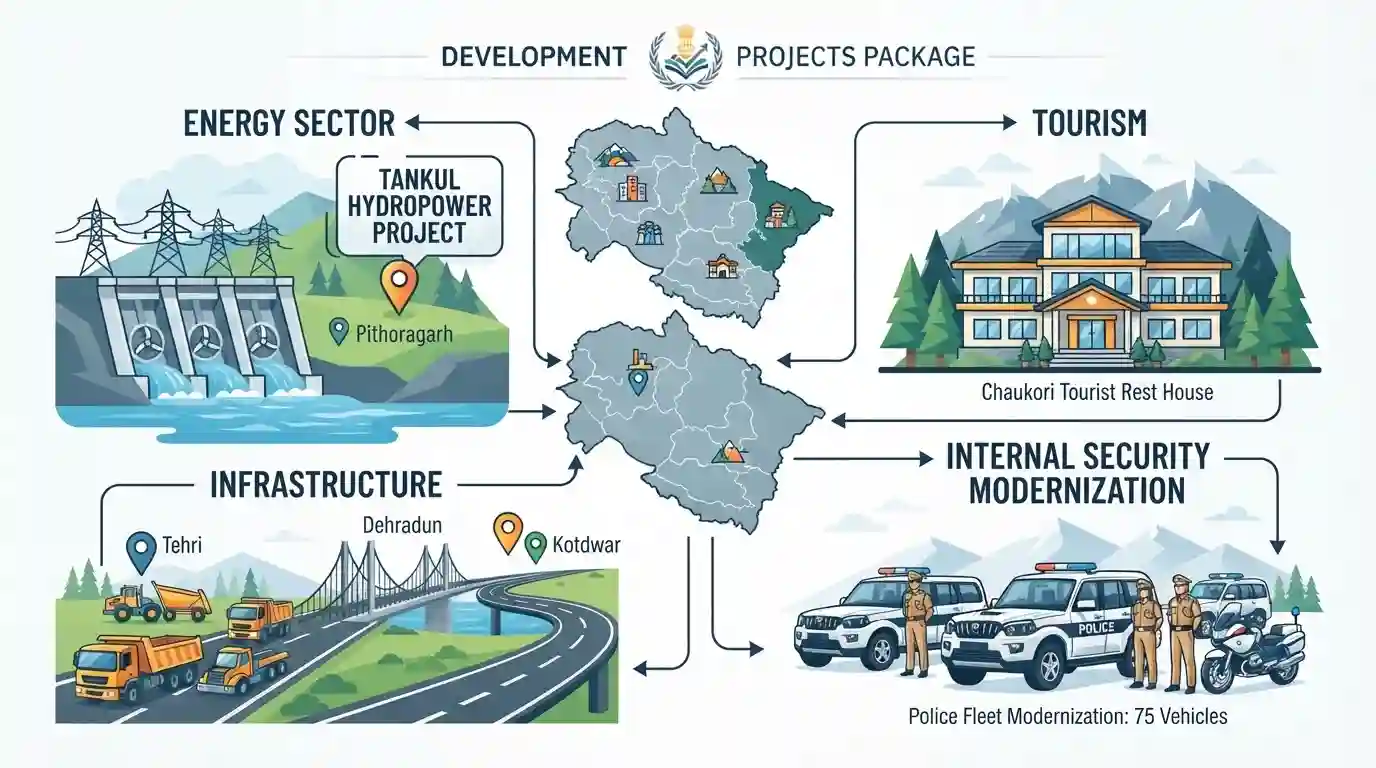
Uttarakhand Chief Minister Pushkar Singh Dhami has approved an extensive package of development projects worth Rs 190 crore. The highlight of the funding is the Rs 159.60 crore 12 MW Tankul Hydropower Project in Pithoragarh, continuing the state's focus on harnessing riverine energy resources. The package also addresses tourism through the upgradation of the Chaukori Tourist Rest House, alongside broad infrastructural enhancements such as new motor roads and bridges across Tehri, Dehradun, and Kotdwar. Additionally, the state police will be modernized with the addition of 75 new vehicles.
Key Points
- Uttarakhand Chief Minister Pushkar Singh Dhami sanctioned Rs 190 crore for various state development and construction works.
- A major allocation of Rs 159.60 crore was made for the 12 MW Tankul Hydropower Project located in Pithoragarh.
- Rs 4.75 crore was approved for the upgradation of the Tourist Rest House in Chaukori, Pithoragarh.
- Road and bridge infrastructure improvements include the Dhanaulti-Saudi Lagga Kyari motor road in Tehri, the Sahaspur area road in Dehradun, and a double-lane bridge at Gabbar Singh Camp in Kotdwar.
- Rs 5.56 crore was sanctioned to procure 75 new vehicles for the Uttarakhand Police to strengthen operational mobility.
Important Terms
Tankul Hydropower Project

A 12 MW run-of-the-river hydroelectric facility in Pithoragarh, Uttarakhand. It generates electricity using natural water flow without a large dam, minimizing environmental impact in the ecologically fragile Himalayan border region.
UPSC context
Covers GS-1 (Geography) and GS-3 (Renewable Energy). Demonstrates sustainable energy generation in ecologically sensitive border zones.
Chaukori
A high-altitude hill station in the Kumaon region of Pithoragarh, Uttarakhand. It is recognized for its historic tea estates, rich biodiversity, and panoramic views of prominent Himalayan peaks like Nanda Devi and Panchachuli.
UPSC context
Important for GS-1 (Geography) and GS-3 (Tourism). Showcases regional geographical landmarks and the development of eco-tourism infrastructure.
Police Modernization
The systematic upgrading of law enforcement infrastructure, mobility, weaponry, and technological capabilities. In Uttarakhand, this involves procuring new transport and riot-control vehicles to enhance the operational efficiency of the state police.
UPSC context
Relates to GS-2 (Governance) and GS-3 (Internal Security), focusing on capacity building and systemic reforms of law enforcement agencies.
Prelims Trap
"Run-of-the-river (RoR) projects require zero water storage and have no ecological impact."
RoR projects often use small "pondage" for daily flow regulation. They still require river diversion (tunnels) and disrupt aquatic ecosystems and sediment transport.
Static Concepts Connected
What distinguishes Run-of-the-River (RoR) hydroelectricity from traditional dam projects?
- Storage profile: RoR projects utilize the natural flow and elevation drop of a river, requiring little to no water storage (only minor pondage), unlike large reservoir dams.
- Ecological footprint: They involve significantly less submergence of land and displacement of local populations, making them the preferred model in steep, narrow Himalayan valleys.
- Generation flexibility: RoR output fluctuates with seasonal river flows (base load), whereas reservoir dams can store water to generate power on demand (peaking power).
Why do Himalayan states hold India's highest unexploited hydropower potential?
- Topographic gradient: The steep gradients and deep gorges of the Himalayas provide a high natural "head" (vertical drop), which generates massive kinetic energy for turbines.
- Perennial flow: Glacier-fed river systems (like the Ganga and Brahmaputra basins) ensure continuous, year-round water flow compared to the seasonal peninsular rivers.
Cross-Topic Patterns
Himalayan Hydropower + Disaster Management
The push for RoR hydropower in Uttarakhand links directly to GS3 Disaster Management, recalling the Chamoli flash floods and carrying-capacity debates in ecologically fragile Himalayan zones.
Border Infrastructure + Internal Security
Developing districts like Pithoragarh (bordering Tibet and Nepal) and modernizing local police forces aligns with the Vibrant Villages Programme and India's broader strategy for securing porous Himalayan frontiers.

Expect a GS3 question linking Himalayan hydropower expansion (RoR projects) with glacial lake outburst floods (GLOF) and carrying capacity.
Linked PYQs · 4
Linked PYQs · 4
- 2024UKPSC_PRELIMSGS1
Match the hydroelectric projects with the river on which they are constructed : | Name of Project | River | |---|---| | A. Koteshwar | 1. Asan | | B. Kulhal | 2. Alaknanda | | C. Tapoban Vishnugad | 3. Bhagirathi | | D. Vishnuprayag | 4. Dhalui | A B C D
- 2016UKPSC_PRELIMSGS1
The biggest Hydro-Electric Project of Uttarakhand State is:
- 2024UKPSC_PRELIMSGS1
Hindu religious pilgrimage place named 'Purnagiri' is situated in which of the following districts of Uttarakhand ?
- 2025UKPSC_PRELIMSGS1
Which of the following pairs is not correctly matched ? Name of Airport District
