Mahasu Devta Temple redevelopment announced at Jaunsar Bawar festival
Source:aninews ↗
Why It Matters
The Jaunsari tribe is the second-largest Scheduled Tribe in Uttarakhand. Questions about their socio-cultural identity (Raso, Harul, Mahasu Devta), geography of their region (Chakrata, Yamuna River), state infrastructure projects, and national schemes like Eklavya Model Residential Schools or Pradhan Mantri Janjatiya Unnat Gram Abhiyan are extremely common in the UKPSC PCS Prelims examination.
Summary
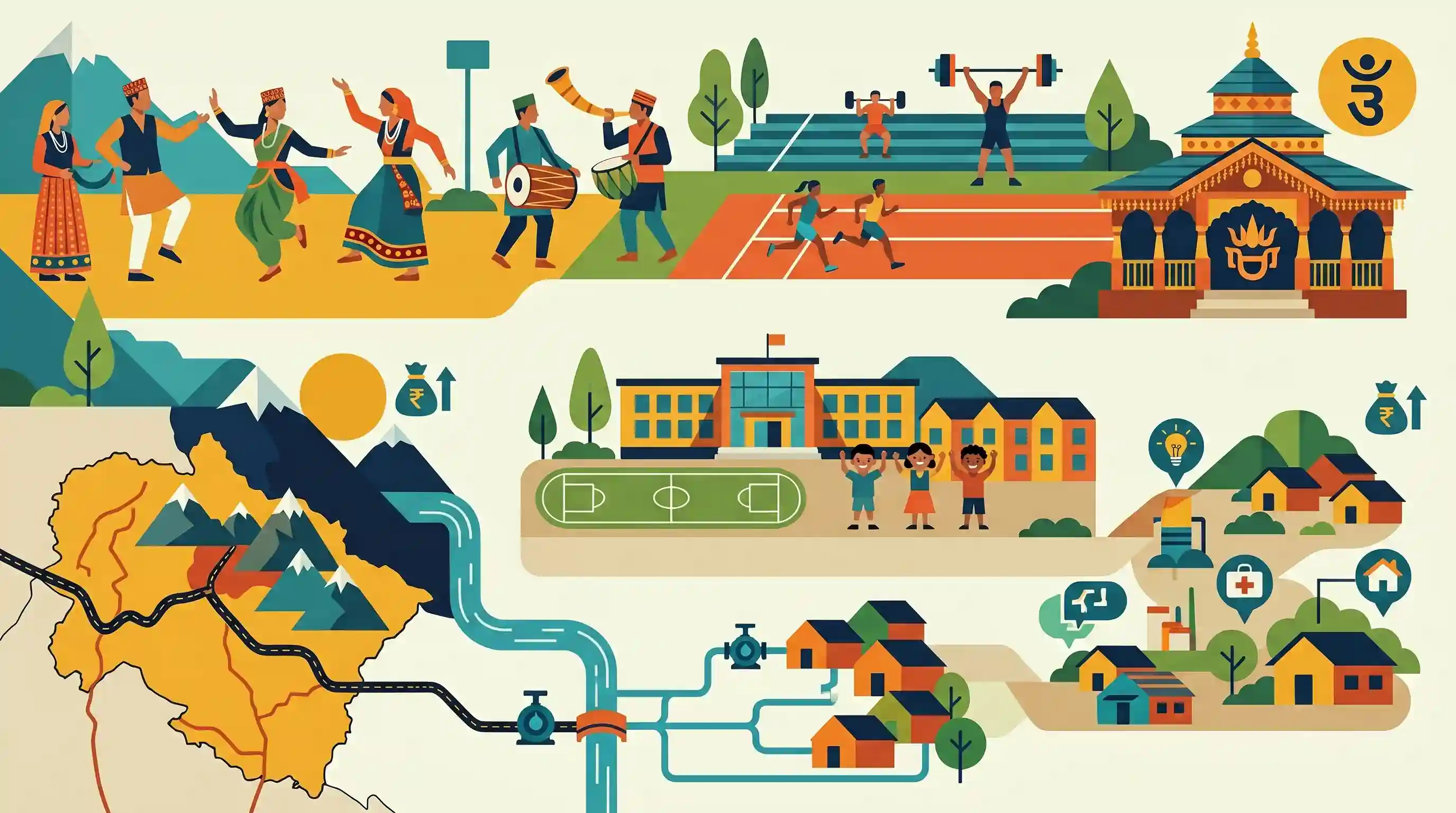
Uttarakhand Chief Minister Pushkar Singh Dhami announced a series of developmental, infrastructural, and welfare projects for the Jaunsar-Bawar region during the Jaunsar-Bawar Folk Cultural Festival and Sports Meet 2026 in Dehradun. Highlighting the rich cultural legacy of the Jaunsari tribe, including traditions like Raso, Harul, and Baund, the CM outlined a Rs 120-crore master plan for the Mahasu Devta Temple redevelopment, Rs 229-crore water pumping schemes, the expansion of Eklavya Model Residential Schools, and several road projects (including NH 707/707A). Additionally, 128 villages are being developed under the Pradhan Mantri Janjatiya Unnat Gram Abhiyan.
Key Points
- Uttarakhand Chief Minister Pushkar Singh Dhami announced multiple infrastructure and cultural preservation projects at the Jaunsar-Bawar Folk Cultural Festival and Sports Meet 2026, held at the Freedom Fighter Kedar Singh Stadium in Nagthat, Dehradun.
- Cultural Heritage: The Chief Minister highlighted the core cultural expressions of the Jaunsari tribe, including the folk dances Raso, Harul, and the Baund tradition. He noted that the Jaunsar-Bawar Sanskritik Punrutthan Samiti has been organizing this festival for 33 years to preserve regional heritage.
- Temple Redevelopment: Work is underway on a historic Rs 120 crore master plan for the grand redevelopment of the Mahasu Devta Temple complex (located in Hanol). Additionally, connectivity is being enhanced to the second Siddh Peeth Mahasu Maharaj Thaina in Kalsi block.
- Tribal Welfare Schemes: Under the Pradhan Mantri Janjatiya Unnat Gram Abhiyan, 128 tribal villages in the state are being comprehensively developed. Eklavya Model Residential Schools (EMRS) are actively operating in Kalsi, Mehrawana, Bajpur, and Khatima, with new facilities planned for Bajpur and Chakrata.
- A corpus fund of Rs 1 crore has been established for the state's Tribal Research Institute, and tribal families receive Rs 50,000 for their daughters' marriages.
- Infrastructure and Connectivity: Crucial infrastructure initiatives include the widening of National Highways NH 707 and NH 707A, resolving the chronic landslide issue near Jajred on the Kalsi-Chakrata road, and the construction of a 60-meter bridge over the Yamuna River.
- Drinking Water Projects: The Rs 229 crore New Chakrata Township Hayyo Danda Pumping Scheme and other pumping projects from the Yamuna River are underway to secure long-term water availability in the area.
Important Terms
Pradhan Mantri Janjatiya Unnat Gram Abhiyan

A centrally sponsored scheme aimed at improving the socio-economic status of tribal communities by ensuring saturation coverage of basic infrastructure, healthcare, education, and livelihood opportunities in tribal-majority villages.
UPSC context
GS Paper II (Social Justice/Welfare Schemes); tests knowledge of government initiatives targeting marginal tribal populations and rural saturation development.
Eklavya Model Residential Schools (EMRS) Scheme
A flagship Central Sector Scheme established to provide high-quality, free residential education (Classes VI to XII) to Scheduled Tribe students in remote blocks, narrowing educational disparities.
UPSC context
GS Paper II (Social Justice/Education); tests policies addressing tribal literacy, structural inclusion, and remote-area school infrastructure.
Pradhan Mantri Van Dhan Yojana
A livelihood initiative by the Ministry of Tribal Affairs and TRIFED aimed at economic empowerment of tribal forest gatherers by promoting value addition of Minor Forest Produce.
UPSC context
GS Paper III (Economic Development/Forestry); tests strategies for tribal entrepreneurship, sustainable livelihoods, and NTFP value-chain integration.
Pradhan Mantri Gram Sadak Yojana (PMGSY)
A centrally sponsored scheme launched in 2000 to provide all-weather road connectivity to unconnected rural habitations, reducing rural isolation and integrating local economies.
UPSC context
GS Paper III (Infrastructure/Rural Development); tests knowledge of physical connectivity schemes, regional inequality alleviation, and rural asset creation.
Jaunsari Tribe
A prominent agriculturalist-pastoralist Scheduled Tribe inhabiting Uttarakhand’s Jaunsar-Bawar region, recognized for distinct cultural practices, specific traditional social systems, and worship of Mahasu Devta.
UPSC context
GS Paper I (Indian Society/Social Structure); tests understanding of diverse indigenous cultures, regional demography, and constitutional scheduling of tribes.
Tribal Research Institute
State-level institutions guided by the Ministry of Tribal Affairs that conduct research, evaluation studies, and training programs to support evidence-based tribal policy formulation.
UPSC context
GS Paper II (Governance/Social Justice); tests understanding of institutional research-led mechanisms for tribal welfare and heritage preservation.
Prelims Trap
The Jaunsari tribe is the largest Scheduled Tribe in Uttarakhand, and their sacred Mahasu Devta temple lies directly along the Ganga river.
The Tharu tribe is actually the largest ST in Uttarakhand (31.29%), with Jaunsaris a close second. Also, the Mahasu Devta temple is on the Tons River, not the Ganga.
Static Concepts Connected
What are the key features of Himalayan Kath-Kuni architecture?
- Material mix: Alternating layers of dry stone masonry and interlocking deodar wood beams without any mortar or cement.
- Seismic resilience: Highly flexible timber joints allow structures to absorb and dissipate seismic energy during Himalayan earthquakes.
- Geographical range: Prevalent across Himachal Pradesh and the Jaunsar-Bawar region of Uttarakhand, showcasing indigenous high-altitude engineering.
What is the Pradhan Mantri Janjatiya Unnat Gram Abhiyan (PMJUGA)?
- Core objective: Launched to achieve saturation coverage of basic amenities across 63,000 tribal-majority villages in India over five years.
- Intersectoral convergence: A targets-driven convergence of 25 critical interventions across 17 distinct Union ministries.
- Key focus areas: Focuses on upgrading tribal houses, improving mobile connectivity, setting up EMRS, and boosting sustainable livelihood opportunities.
Cross-Topic Patterns
Vernacular architecture + Seismic resilience
Traditional wood-and-stone Kath-Kuni architecture offers valuable lessons for modern disaster management and constructing earthquake-resilient structures in seismic Zone V of the Himalayas.
Ethnobotany + Forest Rights Act
The Jaunsari use of 'Timru' (Zanthoxylum armatum) in community fishing bridges traditional tribal forest rights under FRA 2006 with biological conservation and sustainable local resources.

UPSC 2026 may test Kath-Kuni architecture, Tons River geography, and Jaunsari cultural traditions in a combined Art & Culture question.
Linked PYQs · 3
Linked PYQs · 3
- 2025UKPSC_PRELIMSGS1
In which of the following year were the Jaunsari, Tharu, Bhotia, Buksa and Raji tribes declared Scheduled Tribes in Uttarakhand?
- 2005UKPSC_PRELIMSGS1
Which of the following Tribal population is highest among all the tribes of Uttaranchal?
- 2024UKPSC_PRELIMSGS1
Which of the following folk dances/celebrations of Uttarakhand is included in the intangible heritage list of UNESCO ?
